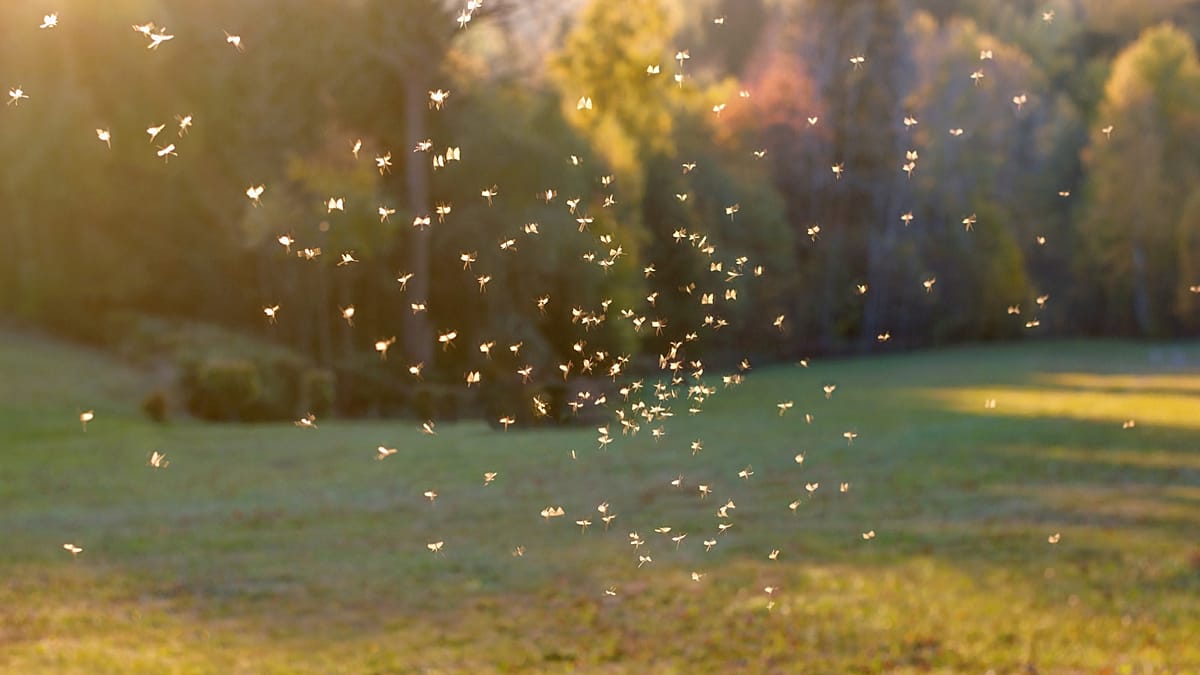
Mosquitoes are often called the world's deadliest animals, transmitting diseases that claim hundreds of thousands of lives each year. Now, scientists are turning the tables by using the insects' own waste to monitor the pathogens they carry, potentially giving humanity a head start in preventing outbreaks.
Dana Price, an entomologist at Rutgers University in the United States, has developed a device he calls a "mosquito toilet" that collects the liquid excrement of mosquitoes. This waste can then be analyzed for genetic traces of viruses and other pathogens, offering a non-invasive way to survey what's circulating in the environment.
"Our question is, is this virus in the environment?" Price told Euronews. "You just have to look for it. If you don't look for it, you won't find it." He added that the findings suggest the range of viruses that mosquitoes may naturally carry is much broader than previously thought.
The tool could be a game-changer for disease surveillance. Price noted that detecting traces of COVID-19 before it jumped to humans could have given researchers "a large head start" in understanding the virus and developing vaccines. This early-warning capability is especially relevant for Europe, where climate change is expanding the habitat of disease-carrying mosquitoes, bringing threats like West Nile virus and dengue fever to new regions.
How the mosquito toilet works
The device is a 3D-printed funnel coated with a water-repelling material that causes liquid to bead up and slide into a collection tube. In a recent experiment, researchers placed 50 Culex mosquitoes collected from a garden in New Jersey into the container, where they fed on a cotton pad soaked with sugar water and red food coloring. Over 18 hours, the mosquitoes' excrement, containing genetic traces of viruses and other organisms, was collected and later analyzed in a lab.
Unlike traditional methods that involve trapping and grinding up mosquitoes, analyzing their waste reduces the amount of mosquito DNA in samples, making viral genetic material easier to detect. This approach not only simplifies the process but also yields higher-quality genetic data.
Using this seemingly simple device, the team identified the first known evidence of a Hedwig-like virus in the Americas and detected several viruses that may be new to science. They also recovered a complete West Nile virus genome, demonstrating that mosquito waste contains enough high-quality genetic material to reconstruct an entire virus's genetic code, allowing researchers to identify specific variants or mutations.
Price emphasized that there is no reason for alarm. Identifying previously unknown viruses, or detecting them in places where they haven't been found before, does not necessarily mean they pose a threat. Instead, it may simply indicate that they have been circulating undetected.
Next steps for field deployment
While the tool has shown promise in a limited area, the team's next step is to expand the geographical scope of its research and improve the device to keep samples stable for longer, enabling extended collection periods. "The idea is that you could go, place these traps kind of in the middle of nowhere or some place that's really hard to reach and then go back in a few days or maybe even a week," Price said.
Being able to leave traps in remote locations for longer could make it easier to monitor pathogens in areas that are difficult to access regularly. The researchers are also working to develop devices that combine mosquito trapping with excreta collection in a single step, making field deployment more practical.
This innovation comes at a time when Europe is grappling with the spread of vector-borne diseases. The European Centre for Disease Prevention and Control has reported an increase in West Nile virus cases in southern and central Europe, and the tiger mosquito is establishing itself in new areas. Tools like the mosquito toilet could become part of a broader surveillance strategy, complementing existing efforts to protect public health.
As the research progresses, the hope is that this low-tech but clever approach will provide a cost-effective and scalable way to monitor emerging health threats, not just in Europe but globally. For now, the mosquito toilet remains a promising proof of concept, but its potential to save lives is undeniable.