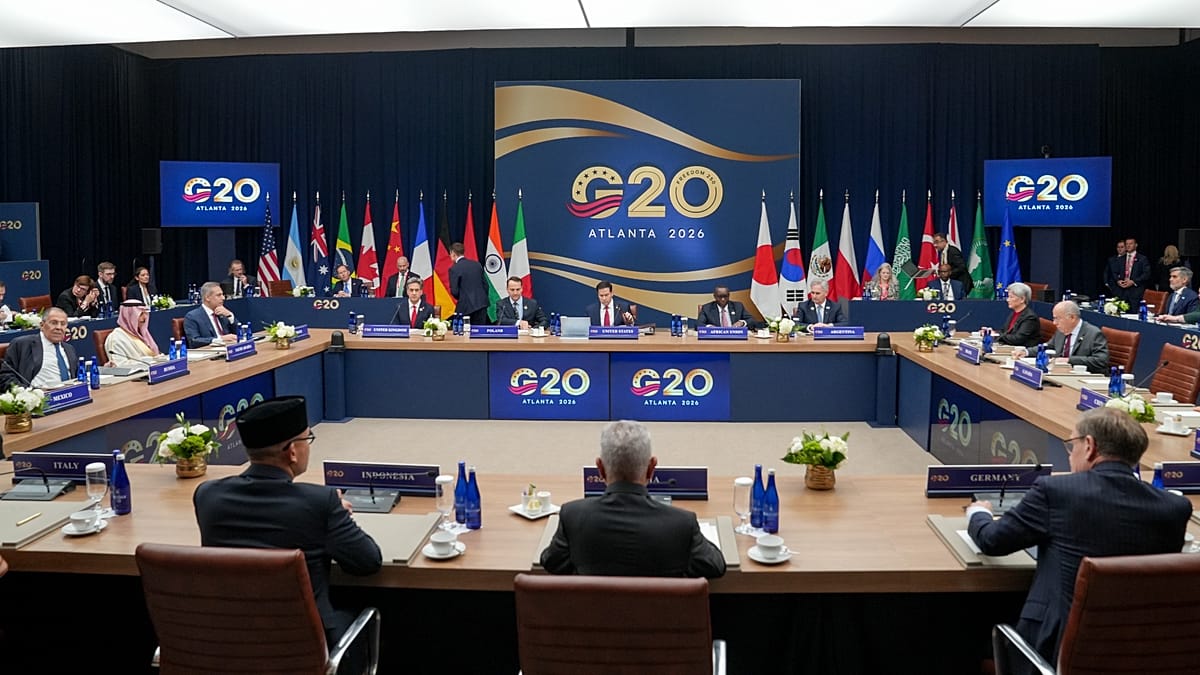
The United States called off the customary group photograph of G20 foreign ministers in Atlanta on Friday after a number of European diplomats balked at being seen alongside Russia's Sergey Lavrov and threatened to leave the room. Two US officials, speaking on condition of anonymity, said Secretary of State Marco Rubio decided to drop the photo session to prevent the gathering from descending into a public spectacle.
The move came as ministers from the world's largest economies opened two days of talks overshadowed by the war in Ukraine, the US-Israeli campaign against Iran, American tariff policy, and maritime disputes in the South China Sea. Rubio, chairing the meeting, struck a forward-looking tone, saying he hoped for “a productive meeting.”
European objections force a change of plan
Several EU foreign ministers had made clear they would not take part in the traditional photo if Lavrov were present. Polish Deputy Prime Minister and Foreign Minister Radosław Sikorski told reporters in Atlanta that the cancellation was “the right decision” by Washington. “I am not the only one who does not want to be photographed with Lavrov,” he said.
Germany's Foreign Minister Johann Wadephul echoed that sentiment, telling the German news agency dpa that “there is no normality with Russia” and that while ministers must “exchange the controversies at the table here,” they should also “not send falsely optimistic signals.” His remarks reflect a broader unease across European capitals about Moscow's continued participation in the G20, particularly as Russian forces intensify attacks on Ukrainian cities.
The dispute over the photo was not the first sign of friction. Even before the meeting, several G20 members had privately questioned why Russia had been invited, given its ongoing aggression. The episode highlights the difficulty of maintaining multilateral forums when one participant is widely seen as a pariah by many others.
The Atlanta meeting is a precursor to a G20 leaders' summit that President Donald Trump is due to host at his Miami golf club in December. That gathering is expected to be equally contentious, with European leaders likely to press for a unified stance on Ukraine and on curbing Russian influence. The EU's own deliberations on tightening restrictions on Russian diplomats reflect the broader mood in Brussels and national capitals.
For now, the foreign ministers' meeting in Atlanta will proceed as planned, with working sessions on economic resilience and geopolitical stability. But the cancellation of the photo—a staple of such summits—serves as a reminder that the G20's ability to project unity is increasingly strained. As Rubio put it, “We are in a critical moment—I would call it a moment of choosing, and I would say not just for my country, the United States of America, but frankly, for the world.”
European diplomats are also watching the separate track of US-Russia engagement. The recent visit of US envoy Steve Witkoff to Moscow for talks with Vladimir Putin, following a “positive” meeting with Ukraine's Volodymyr Zelenskyy, has raised hopes—and concerns—about a possible diplomatic opening. Meanwhile, Lavrov's reaffirmation of Russian support for Iran adds another layer of complexity to transatlantic discussions.
The G20's internal tensions are not limited to Russia. European ministers have also voiced frustration over US tariff policies and the administration's approach to the Iran conflict, which many in Europe see as dangerously escalatory. The recent attack on EU diplomats in the West Bank and the subsequent Belgian call for sanctions against Israel have further complicated the transatlantic agenda.
Despite the friction, the meeting in Atlanta is expected to produce a communiqué, though its language on Ukraine and Iran remains under negotiation. European officials say they will push for strong wording condemning Russia's actions and calling for a ceasefire in the Middle East. Whether the US will agree remains uncertain.
For now, the image of the G20 foreign ministers standing together—a symbol of collective leadership—has been replaced by a more fragmented reality. As one European diplomat put it, “We cannot pretend that everything is normal when Russia is bombing civilian infrastructure every day.” The cancellation of the photo may be a small gesture, but it speaks volumes about the state of global diplomacy in 2026.