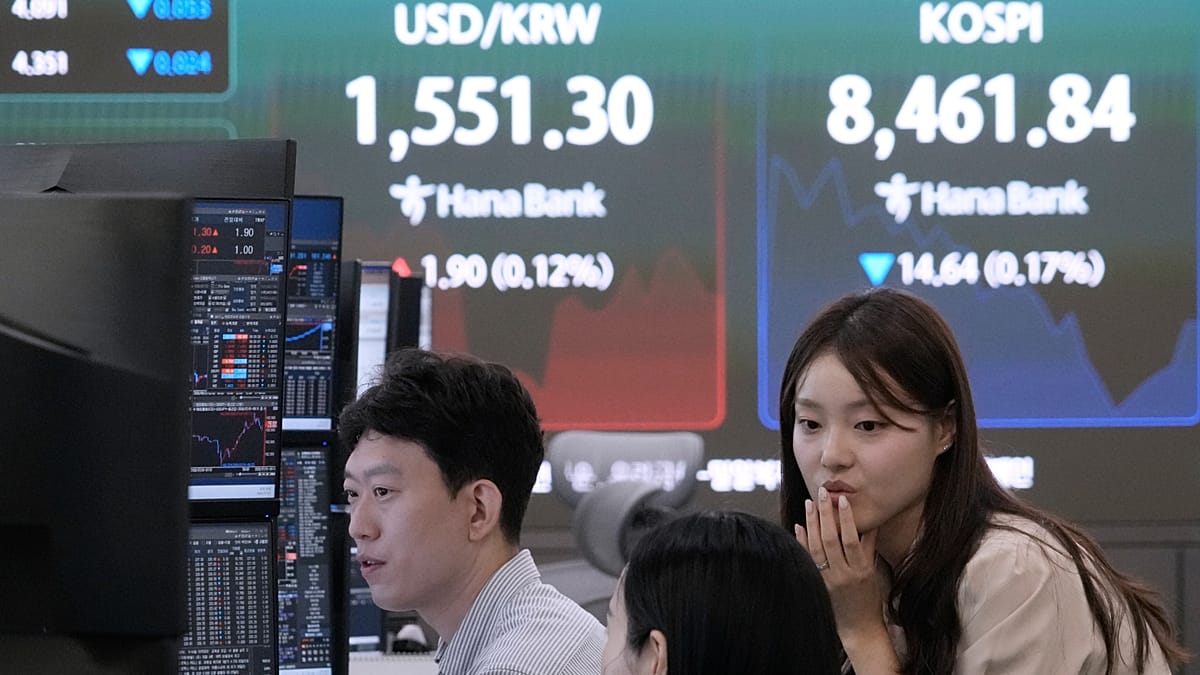
Asian equity markets declined broadly on Thursday, driven by a sharp sell-off in semiconductor shares that rippled across the region. European bourses opened flat, and US futures pointed lower as investors turned their attention to the upcoming US jobs report, which could shape the Federal Reserve's monetary policy trajectory.
Chip Stocks Drag Down Asian Benchmarks
The technology sector bore the brunt of the selling, with chipmakers that had powered much of this year's rally now under pressure. Concerns are mounting that the massive investments by Big Tech in artificial intelligence may lead to oversupply, prompting investors to take profits.
South Korea's Kospi index tumbled roughly 5%, its worst session in months. Memory chip giant SK Hynix plunged nearly 8%, while Samsung Electronics lost more than 6%. In Tokyo, the Nikkei 225 fell about 1.5%, with chip-equipment maker Tokyo Electron dropping around 5.6%. Taiwan's Taiex slipped 1.1% as TSMC, the world's largest contract chipmaker, gave up 1.8%.
The sell-off followed a rough session on Wall Street Wednesday, where Micron Technology dropped more than 10% and Intel sank around 9%. Despite these losses, Asian tech indices remain significantly higher year-to-date: the Kospi is up roughly 85% and the Nikkei 34% in 2026.
Not all markets were in the red. Hong Kong's Hang Seng rose about 0.8%, lifted by an 8.7% jump in electric-vehicle maker BYD after it reported a second straight monthly increase in sales. India's Sensex added 0.5%.
European Markets Open Flat
European indices began Thursday's session within a narrow range. The Euro Stoxx 50 and the broader Stoxx 600 both traded within 1% of their previous close. The UK's FTSE 100, Germany's DAX 30, France's CAC 40, and Spain's IBEX 35 each edged between 0.1% and 0.3% higher. Italy's FTSE MIB led the pack, rising about 0.4%.
The subdued start in Europe reflects caution ahead of the US employment data, which carries added weight under new Federal Reserve Chair Kevin Warsh. A strong reading could harden the case for keeping interest rates higher for longer, a scenario that would likely weigh on global risk appetite.
Meanwhile, the European Central Bank continues to advocate for deeper financial integration. ECB President Christine Lagarde has repeatedly stressed the importance of a capital markets union to strengthen the euro's global role and reduce reliance on US dollar-denominated markets. Lagarde pushes capital markets union as key to euro's future.
Oil Prices Extend Slide
Crude oil prices fell further on Thursday, trading below levels seen before the Iran war began in late February. Hopes that supplies through the Strait of Hormuz will steadily recover have weighed on prices. Brent crude, the international benchmark, eased about 1% to around $70.89 a barrel, while US West Texas Intermediate dropped 3% to roughly $69.
The decline in oil prices comes amid a broader risk-off mood in markets. Oil prices slide as US and Iran sign interim deal to end war, reopen Strait of Hormuz.
US Jobs Data in Focus
All eyes are now on the US employment report for June, released a day early due to the Independence Day holiday on Friday. Economists polled by Dow Jones expect around 115,000 jobs were added last month. The figure will be closely scrutinized by the Fed as it assesses the pace of economic growth and inflation.
According to economists at Capital Economics, demand for AI may continue to grow but at a slower pace than many anticipate, a caution that helped sour sentiment toward the sector. This view, combined with the upcoming jobs data, is keeping investors on edge.
For European markets, the outcome of the US report could influence the European Central Bank's own policy stance, particularly as it navigates the delicate balance between supporting growth and containing inflation. The ECB's recent moves have been closely tied to global financial conditions, and any shift in US rates would have ripple effects across the continent.