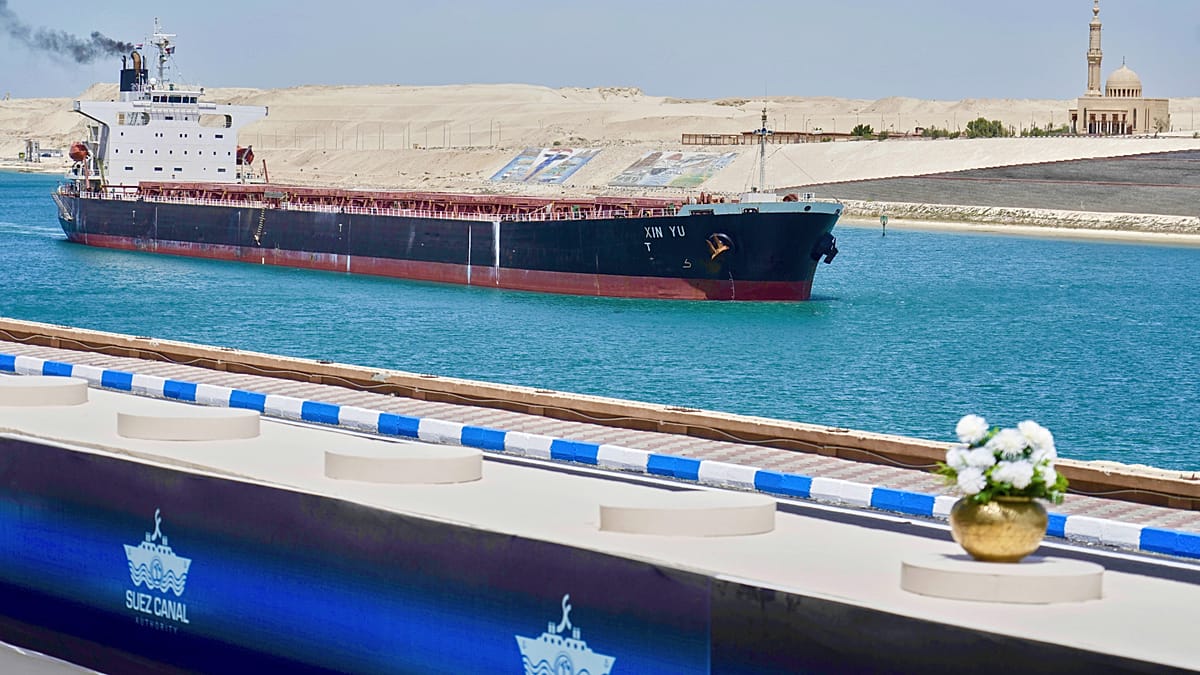
Danish shipping giant Maersk and German rival Hapag-Lloyd have moved another major Asia–Europe container service back through the Suez Canal, the latest sign of a cautious, piecemeal return to the waterway that has been largely avoided since late 2023.
The AE19 service, operated jointly under the Gemini Cooperation, links Asia, the Mediterranean, Saudi Arabia and Europe. It had been sailing around the Cape of Good Hope, adding weeks to transit times. The two carriers announced on Monday that the change would take effect immediately, starting with the westbound voyage of the Berlin Maersk.
Hapag-Lloyd told Euronews that the switch is expected to save around four weeks compared with the Cape route. Maersk said the decision followed an assessment of security conditions in the Red Sea. Hapag-Lloyd described it as a “targeted adjustment for one selected service, not a general network-wide return”.
The move is part of a slow rehabilitation of the Suez route. Maersk said AE19 is one of four services it has shifted from the Cape to Suez since early July, the others being AE15, MECL and WAF6. Nine other services that could benefit from the Red Sea and Suez corridor continue to sail around Africa, and Maersk declined to comment on potential future changes.
Why the return will be gradual
Shipping analysts caution that the restoration of a handful of services should not be mistaken for a broader return to the canal. Simon Heaney, senior manager for container research at maritime consultancy Drewry, told Euronews that the pace of Suez traffic's recovery remains closely tied to how the Strait of Hormuz crisis and the wider conflict in the Middle East play out.
“While the latter remains unresolved, we do not expect to see a meaningful return of Asia-to-Europe loops via Suez,” Heaney said.
Even if security improves, carriers are unlikely to move all services back at once. Heaney said the return would probably happen in stages, beginning with journeys from Europe that generally carry lower-value cargo. Carriers would need confidence that hostilities would not resume before committing more valuable shipments to the route.
There is also a commercial reason for moving slowly. Sailing around Africa requires more ships because each journey takes longer. If many services switch back to Suez simultaneously, those ships would be freed up just as carriers are already taking delivery of large numbers of new vessels.
“Carriers have to manage capacity wisely due to the large number of new ships being delivered,” Heaney said. “Shortening rotations en masse will see rates slide dramatically.”
For European importers, this means the benefits of returning to Suez are unlikely to arrive all at once. A few restored services may offer shorter journeys on selected routes, but normal transit times across the wider network will not return immediately.
An important route for Egypt and Europe
The Suez Canal provides the shortest maritime connection between Asia and Europe, avoiding the much longer journey around the Cape of Good Hope. The diversions have added time and fuel costs to voyages while depriving Egypt of an important source of foreign currency.
The Suez Canal Authority has repeatedly sought to encourage shipping companies to return. In June, its chairman, Admiral Osama Rabiee, said shorter transit times and operating savings were helping to attract some of the world’s largest container vessels back to the canal. He made the comments as the CMA CGM Vendôme, which has capacity for 24,000 twenty-foot containers, passed through Suez on a service between Asia and north-western Europe.
The voyage marked the first southbound Suez transit by the FAL 3 service since January. According to the authority, vessels operated by France’s CMA CGM made 104 journeys through the canal between January and May, with a total tonnage of 12.5 million tonnes.
For now, the return of AE19 is a modest step. It reflects the delicate balance carriers must strike between security, operational efficiency and commercial pressures. As the Middle East situation evolves, European shippers and Egyptian authorities alike will be watching closely for signs of a more substantial comeback.