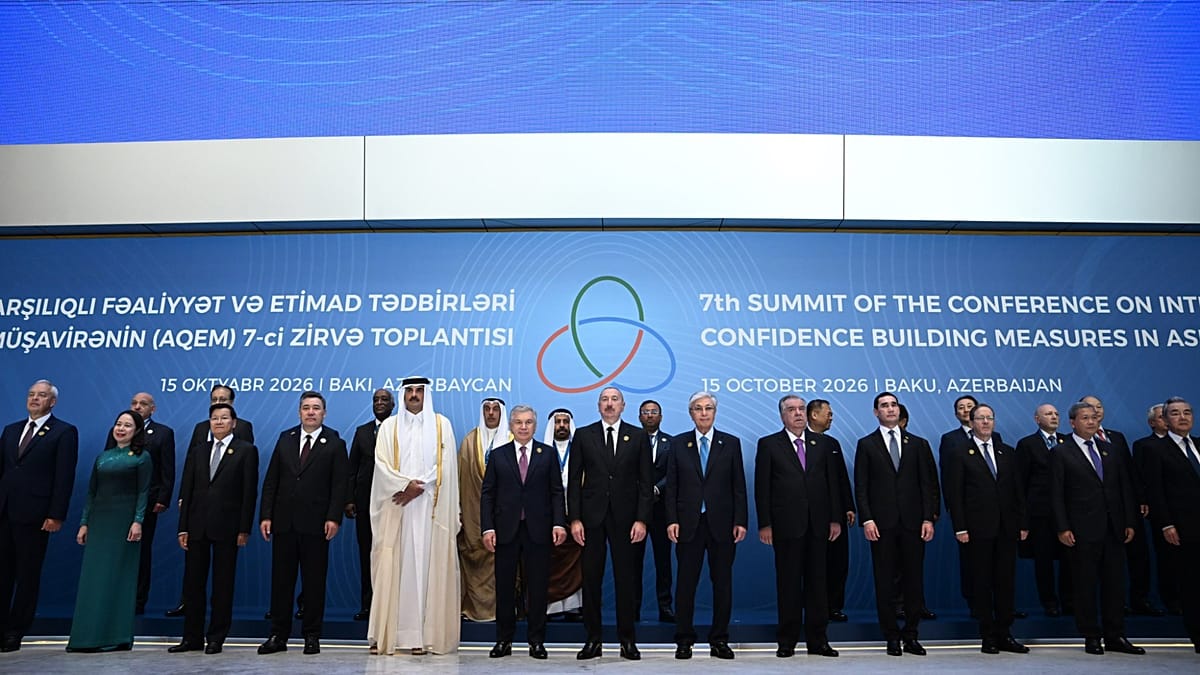
For the first time since the outbreak of the Iran war, senior officials from countries locked in political and military conflicts gathered in Baku on Thursday for the seventh summit of the Conference on Interaction and Confidence-Building Measures in Asia (CICA). Hosted by Azerbaijan, the meeting brought together Israeli President Isaac Herzog, Iran’s Deputy Foreign Minister Kazem Gharibabadi, Turkish Foreign Minister Hakan Fidan, Russian Foreign Minister Sergey Lavrov, Qatar’s Emir Sheikh Tamim bin Hamad Al-Thani, UAE Minister of State for Foreign Affairs Khalifa bin Shaheen Al Marar, and a Palestinian delegation led by Foreign Minister Varsen Aghabekian Shahin. Chinese Foreign Minister Wang Yi also attended, alongside leaders from Central Asia, South Asia, and Southeast Asia.
Azerbaijan’s role as a Eurasian bridge
In his opening address, President Ilham Aliyev framed Azerbaijan as a natural meeting point between continents. “Geographically situated at the intersection of Asia and Europe, Azerbaijan plays an increasingly important role as a connecting hub in the Eurasian space,” he said. He added that the country’s bilateral and multilateral cooperation across political, economic, transport, energy, and humanitarian fields “strengthens the security system in our region.”
The CICA forum is designed to promote peace and security through dialogue and mutual trust, with an agenda covering regional security, transport links, digital cooperation, and sustainable growth. The presence of such a wide range of leaders—many of whom are on opposing sides of ongoing disputes—underscores the summit’s significance as a rare platform for informal diplomacy.
Herzog’s visit and bilateral talks
Israeli President Isaac Herzog travelled to Baku on Wednesday, ahead of the summit, and held talks with President Aliyev, whom he called a friend. In social media posts, Herzog described Azerbaijan as “an important partner of Israel in our region” and said the visit aimed to strengthen ties in security, energy, and trade. He also noted plans to connect with the local Jewish community.
“The excellent relations between Israel and Azerbaijan are based on mutual respect, shared interests, and the deep historical ties that exist between our peoples,” Herzog wrote on X. “In our meeting today, we discussed ways to further deepen our strategic relations in many areas for the prosperity of both our countries.” He also mentioned discussions on recent regional events and a shared commitment to stability and security.
Herzog’s travel arrangements drew attention: he reportedly flew on an Azerbaijan Airlines commercial flight, likely to avoid Turkish airspace, which is closed to Israeli official aircraft. The Israeli president also held what he called “an excellent meeting” with Bahrain’s Foreign Minister Dr Abdul Latif bin Rashid Al Zayani, discussing the Abraham Accords and their role in Middle East security.
Regional dynamics and European implications
The summit comes at a time of heightened tensions across the Middle East and Asia, with the ongoing conflict involving Iran and Israel, as well as Russia’s war in Ukraine. Azerbaijan’s ability to convene such a diverse group highlights its growing diplomatic weight, particularly as it seeks to position itself as a key energy and transport hub between Europe and Asia. The country’s tourism push and regional investment plans are part of this broader strategy.
For European observers, the summit offers a glimpse into the shifting alliances and mediation efforts that could shape the continent’s energy security and migration patterns. The presence of Russian and Chinese foreign ministers alongside Western-aligned Gulf states suggests that Baku is becoming a venue for informal dialogue that bypasses traditional Western-led formats. As the EU grapples with its own energy and trade challenges, the outcomes of such meetings could have indirect but significant consequences.
The CICA summit is scheduled to continue through Friday, with working sessions on regional security and cooperation. Whether the rare face-to-face encounters will lead to concrete confidence-building measures remains to be seen, but the very fact that these leaders sat in the same room is itself a notable development in a fractured geopolitical landscape.