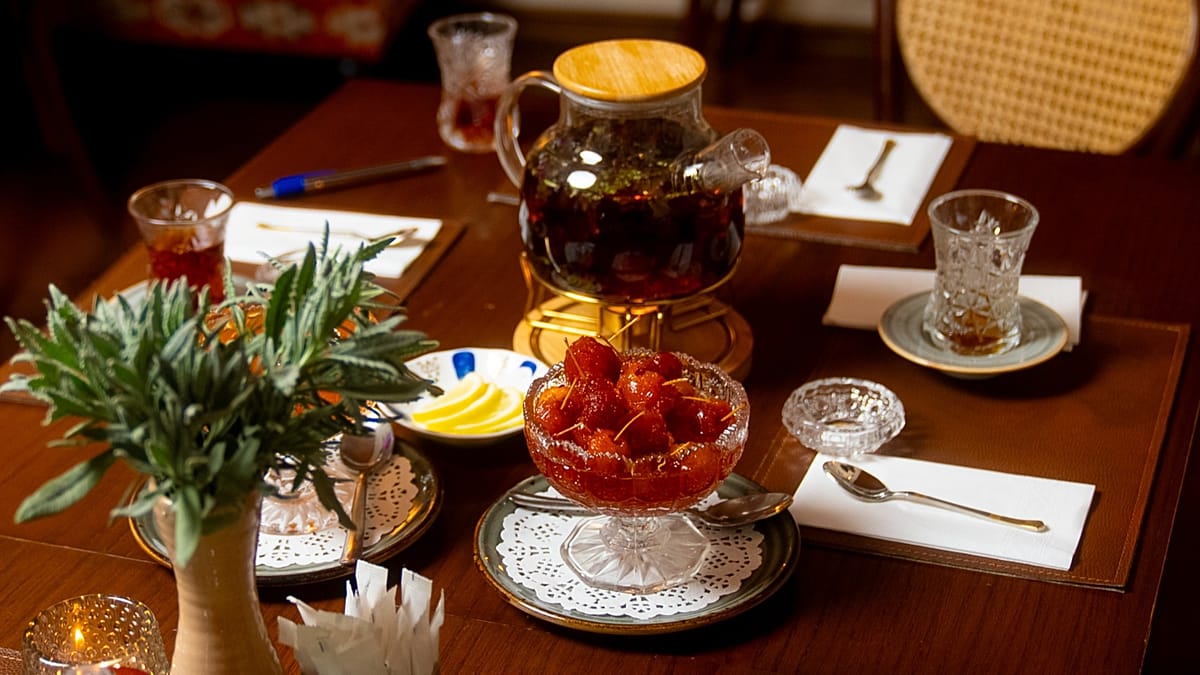
On International Tea Day, it is worth looking beyond the teacup to a tradition where the beverage is not merely a drink but a framework for social life. In Azerbaijan, chay (tea) arrives before anything else — before conversation, before negotiation, before comfort. It is poured from a slender armudu teapot into a pear-shaped glass, whose narrow waist and rounded base are not decorative but functional: the shape keeps the tea hotter at the bottom while cooling the rim for steady sipping.
But the defining feature of an Azerbaijani tea service is not the glassware alone. It is the jam. Presented in small crystal bowls, the preserves gleam like stained glass, with fruits such as strawberries, pears, apricots, and walnuts holding their structure intact. This is not jam for spreading on bread or stirring into tea. Instead, a small spoonful is tasted first, followed by a sip of hot chay. Sweetness meets bitterness in a deliberate balance.
“In Azerbaijan, jam is held apart, not mixed in. It is tasted independently before the tea follows,” explains Oktay Namazov, a local connoisseur. The sequence is codified: sweetness is controlled rather than dissolved, a subtle distinction that shapes the entire experience.
The Art of Jam-Making
At Kurban Said, a family-run restaurant in Baku, owner Sabina Ulukhanova continues recipes passed down through generations. The process is labor-intensive and unhurried. “You do it in two steps or three steps… first phase and then you do it another step next time, next day… it takes three days before you have this result,” she says of strawberry jam. For olive jam, she notes, “it takes more time than you do it from strawberry. So, it’s a process. It’s a very interesting process.”
Ulukhanova reflects on the meditative quality of the ritual: “It’s kind of meditation after a long day, after you come home, or you meet each other with your friends at some cafe or tea house, and you have this time for you with tea and jam. You don’t need any cake or something extra for you, just tea and jams. And your friends or your family and then everything is fine.”
Walnut jam, in particular, demands patience: the fruit is treated repeatedly before yielding its distinctive texture and flavor. The visual beauty of the preserves is part of their appeal — the curve of a pear, the structure of a strawberry, remains intact, unlike commercial spreads.
Tea with sweetness is not unique to the region. In Iran, sugar cubes dissolve slowly between sips. In Turkey, tea accompanies pastries and breakfast spreads. In parts of Russia, fruit preserves — varenye — accompany long conversations. But in Azerbaijan, the ritual is codified: jam is a separate course, tasted before the tea, not mixed in.
Tea here is served before meals, after meals, during business discussions, at casual visits, weddings, and funerals. The same glass, the same rhythm, crosses generations. As Ulukhanova puts it, “You always, myself, I can say for me, you have and then. Get this feeling at once. Yes, everything will be good.”
Across cultures, tea has long functioned as a marker of hospitality and social order. But in Azerbaijan, at this table, in this glass, sweetness is never rushed or diluted. It is measured, tasted, and followed by heat — a practice that offers a quiet counterpoint to the pace of modern life.