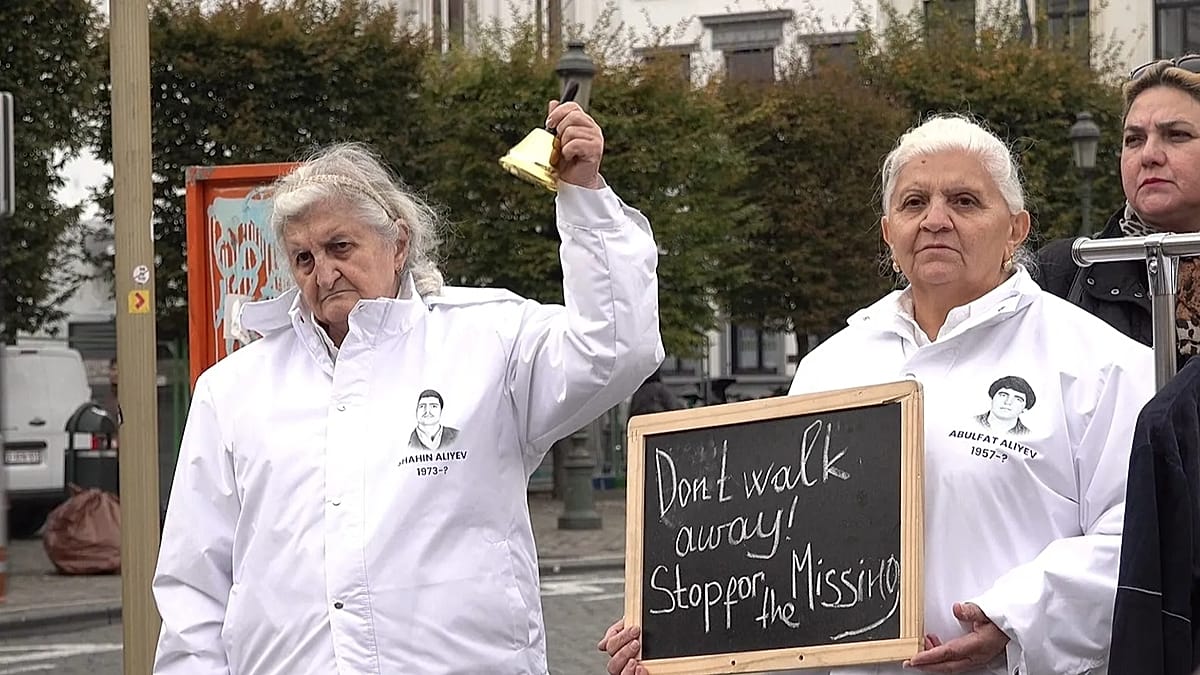
In a quiet but determined show of grief, families of more than 4,000 Azerbaijanis who disappeared during the first Karabakh war brought their demands to the heart of the European Union this week. Standing outside the European Parliament and the European Commission headquarters in Brussels, they urged EU institutions to help them uncover the truth about relatives who vanished decades ago.
The protest, organised by the Garabagh Missing Families Public Union, brought together men and women wearing white jackets, each bearing a photograph of a missing loved one, their date of birth, and a single question mark. The symbolism was deliberate: after more than three decades, these families still do not know whether their relatives are alive or dead.
A 30-year wait for answers
The first Karabakh war, which ended in 1994, left thousands dead and hundreds of thousands displaced. Among the unresolved legacies are the more than 4,000 Azerbaijanis—including children, women, and the elderly—who remain unaccounted for. The families say Armenia has never provided any information about their fate, and they now hope that the ongoing peace process between Baku and Yerevan can finally yield answers.
“My husband Azad Jabbarov went missing in Khojaly, and for 34 years we know nothing about him,” said Farida Jabbarova, one of the demonstrators. “Here, I represent him and more than 4,000 people who went missing and require justice for them and to receive information.”
The rally also displayed personal belongings of the missing—passports, photographs, and clothing—as tangible reminders of lives interrupted. For the families, these objects are all they have left.
Mass graves and the right to know
Recent discoveries have added urgency to their cause. According to the organisers, 32 mass graves have been found in the Karabakh region, but the families say they have received no international recognition or assistance in identifying the remains. DNA testing has so far identified 328 missing persons, and the remains of 273 victims have been returned to their families. But thousands of cases remain unresolved.
Konul Behbudova, head of the Garabagh Missing Families Public Union, explained the practical obstacles. “These territories are contaminated with mines and unexploded ordnance, that's why it's difficult to find them,” she said. The families are not only seeking information; they want to locate burial sites, recover remains, and finally have a grave to visit.
“Our goal is to find the places where these people were buried and find any information about their fate, to get their remains and be able to bury them and to have a place in the cemetery to visit them,” Jabbarova said.
European institutions under pressure
The families are calling on the EU to press Armenia to open its archives and disclose the locations of mass graves. They argue that the right to know the truth is a fundamental human right, and that after 30 years, international attention is long overdue.
The demonstration comes at a delicate moment in Armenian-Azerbaijani relations. The two countries have been engaged in peace talks, and the plight of the missing is now part of the broader reconciliation process. For the families, this is a glimmer of hope that the decades of suffering on both sides might finally lead to closure.
As the EU considers its role in the South Caucasus, the families' plea is a stark reminder that peace is not just about borders and treaties—it is also about healing the wounds of the past. Whether European institutions will respond with concrete pressure remains to be seen, but for the families in Brussels, the demand is simple: they want the truth.