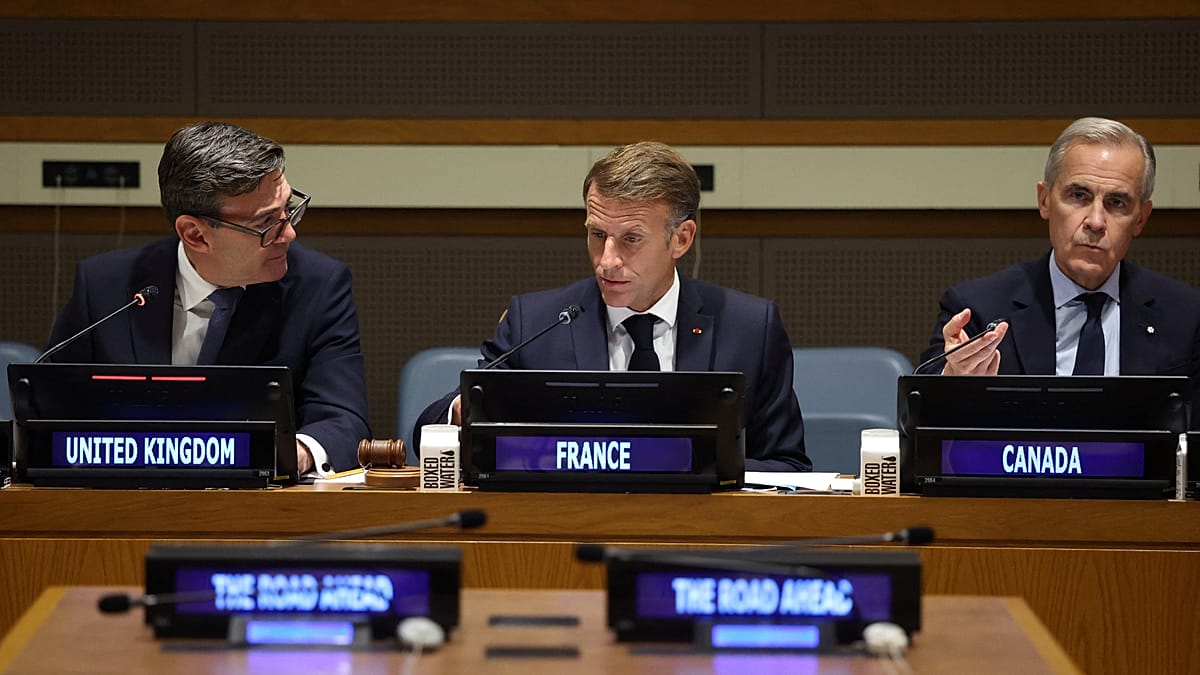
The European Union has extended an invitation to Canada that it has never made to any other country: associate membership. While the precise meaning of this status remains undefined, both Brussels and Ottawa are intent on transforming their shared values and increasingly close ties into a novel form of partnership in a world unsettled by Donald Trump's erratic foreign policy.
The experiment is being closely observed in London, where Prime Minister Andy Burnham is working to rebuild Britain's post-Brexit relationship with the EU. His efforts raise the question of whether a similar arrangement might eventually be on offer for the United Kingdom.
The offer, made by European Commission President Ursula von der Leyen last month, has sparked debate about whether associate membership is a substantive new category, an honorary title, or something in between. At a summit in Montreal next week, the two sides will begin to give the idea concrete form, seeking closer cooperation on trade, defence, technology, and energy without Canada formally joining the bloc.
While Canada is searching for a new framework, Britain is attempting to improve an existing one. EU and UK leaders are scheduled to meet next month to pursue a much-needed reset in their relationship.
“This is a moment to act with clarity and ambition. By aligning more closely - economically, technologically, and strategically - Canada and the EU are building an Alliance for the Future based on trust and shared values,” reads the latest draft of the EU-Canada joint statement, discussed by ambassadors on Wednesday.
Defining the partnership
Since von der Leyen invited Canada to become the EU's first “associate member,” officials in Brussels and Ottawa have been exploring what this privileged partnership could entail. Canadian Prime Minister Mark Carney prefers the term “Alliance for the Future,” sidestepping questions about the “associate membership” label and stressing that substance matters more than terminology.
The summit in Montreal on 29-30 October is the first real opportunity to flesh out the partnership. The latest draft uses “associate membership” and “Alliance for the Future” interchangeably. Crucially, the proposal envisages giving Canada a more regular seat at the EU's table, with participation in summits, ministerial meetings, and technical discussions. It calls for “early consultations on major policy and regulatory initiatives, with Canada’s participation in these processes as an associate member of the Union.”
Whether the term survives in the final text remains an open question. In any case, “the full scope of this associate membership will be defined by the 2027 Canada-EU Summit,” the conclusions read.
From trade to defence
The document nonetheless attempts to add substance. It builds on the 2016 Comprehensive Economic and Trade Agreement (CETA), which ten EU countries have yet to ratify, to remove remaining trade barriers and ensure reciprocal market access. “We will ensure mutually favourable treatment in our respective economic security measures, based on the principle of reciprocity in industrial sectors where both sides have agreed to align their external measures to ensure the same outcome,” the draft states.
On energy, the conclusions open the door to “the development of liquefied natural gas exchanges,” notably through a joint long-term feasibility study on LNG exports to Europe. On technology, Canada will join the EU’s supercomputer initiative, a new digital partnership will tackle issues like AI and digital identity, and an agreement to facilitate cross-border data flows is in the making.
Critical raw materials, one of Canada’s key assets for the EU, are also on the table. The two sides have agreed that the European Investment Bank will play a role in critical mineral projects, from extraction and processing to manufacturing and recycling. In defence, Canada is already part of several EU projects, including the Permanent Structured Cooperation and the Capability Coalition, and both sides intend to deepen that cooperation on maritime security, crisis management, and industrial cooperation.
The partners also envisage a cooperation framework to safeguard the information space and protect electoral integrity, with an early warning mechanism and a dialogue dedicated to foreign interference. Other areas under discussion include border security cooperation with EU agency Frontex, criminal justice, climate security, transport, and the Arctic.
Taken together, the proposals suggest a partnership extending far beyond conventional trade agreements, even if its institutional form remains uncertain. This comes as Canada faces pressure from the US, including tariffs on steel and autos, which has only strengthened the case for closer transatlantic ties.
Britain's search for a reset
The EU's growing closeness to Canada comes as Britain searches for a new relationship with the bloc, a decade after the Brexit referendum. The contrast is striking: while Ottawa is being offered an undefined but potentially far-reaching new status, London is still negotiating improvements to its relationship with Brussels, largely one sector at a time.
The next EU-UK summit, postponed from the summer following Keir Starmer's resignation and Burnham's arrival in Downing Street, offers an opportunity to make progress. While the UK government was already seeking to amend ties with the bloc, Canada's approach to the EU has definitively shattered one of the Brexiteers' key hopes: to turn the so-called Anglosphere into a free trade area encompassing the UK, US, Canada, Australia, and New Zealand.
“It is hardly surprising that Brexit has not delivered on that promise, and UK opinion polls have slowly started to shift in favour of rejoining,” Charles Tannock, a former Conservative MEP who campaigned for Remain, told Euronews. Since becoming Prime Minister, Burnham has repeatedly signalled that he wants to take the UK closer to the EU. He considers the status quo “not good enough” and has vowed to consider options ranging from following Canada’s example to re-entering the bloc.
The EU's overtures to Canada also come amid a broader transatlantic rift, as Trump's overtures to Putin have unsettled European allies. For the EU, deepening ties with like-minded partners like Canada is a way to hedge against an unpredictable US, while for Britain, the path forward remains less certain.