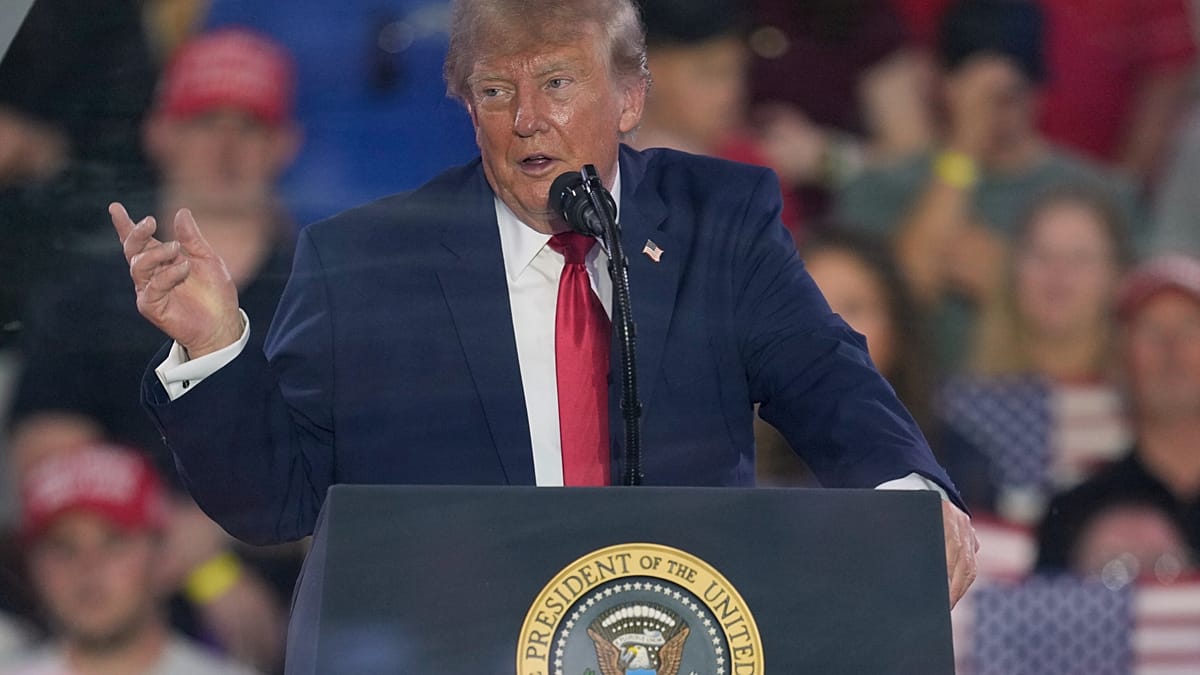
US President Donald Trump has once again floated the possibility of running for a third term in 2028, a move that would require overturning the two-term limit enshrined in the US Constitution. Speaking at a rally in Iowa, Trump acknowledged that the constitutional text offers little flexibility, but insisted that his case is exceptional because, as he repeated, the 2020 election was rigged against him.
“I’ve studied the wording for a long time,” Trump told the crowd, without specifying which legal avenue he believes could allow him to bypass the 22nd Amendment. He added that the election was “stolen” from him, an allegation that has been repeatedly dismissed by courts, election officials, and his own administration’s Department of Justice. No evidence of widespread voter fraud has ever been produced.
A constitutional hurdle with no clear path
The 22nd Amendment, ratified in 1951, states that “no person shall be elected to the office of the President more than twice.” Legal scholars across the political spectrum agree that amending the Constitution would require a two-thirds majority in both chambers of Congress and ratification by three-quarters of the states—an almost insurmountable hurdle in today’s polarized climate. Some have speculated about a possible reinterpretation, but no mainstream legal theory supports a third elected term.
Trump’s remarks come as he continues to dominate Republican politics, with potential 2028 contenders already positioning themselves. His suggestion is likely to fuel further debate about the health of American democratic institutions, a topic that resonates strongly in European capitals where the rule of law and constitutional checks are closely watched.
The president’s latest comments also coincide with a series of controversial moves that have unsettled transatlantic allies. His embrace of Vladimir Putin has raised alarms in Kyiv and across European foreign ministries, while his administration’s rhetoric on territorial integrity has sparked concern in Brussels and beyond.
European observers note that Trump’s willingness to challenge constitutional norms is not new. From his attempts to overturn the 2020 result to his pressure on election officials, his approach has consistently tested the boundaries of presidential power. The latest statement, however, goes a step further by openly questioning a core tenet of American governance.
In response, Democratic leaders have condemned the remarks as an attack on democracy. “The Constitution is not a suggestion,” said a senior Democratic senator, speaking on condition of anonymity. “The American people have already spoken twice. The idea of a third term is a fantasy that would require shredding the rule of law.”
Even some Republicans have distanced themselves, though few have publicly challenged the president. The silence reflects the tight grip Trump holds on the party’s base, a dynamic that European analysts watch with concern, given the potential for political instability in the world’s largest economy.
For Europe, the stakes are practical as well as symbolic. A prolonged period of constitutional uncertainty in Washington could delay decisions on trade, security, and climate policy—all areas where the EU has sought predictable engagement with the United States. The recent fraud probe into far-right groups in the European Parliament shows that democratic backsliding is not a uniquely American problem, but the scale of the US system makes its trajectory globally consequential.
Trump’s Iowa speech also touched on other themes, including his ongoing legal battles and his media disputes. A federal judge recently set a December 11 deadline for Trump’s deposition in a lawsuit brought by the BBC, a case that has drawn attention on both sides of the Atlantic. The president has also floated renaming the Atlantic Ocean the “American Ocean,” a proposal that was met with derision in European press.
As the 2028 election cycle begins to take shape, Trump’s hints at a third term are likely to remain a recurring theme. Whether they are a negotiating tactic, a way to keep the political class off balance, or a genuine intention, they underscore a fundamental question: can a democracy function when its leader openly challenges its foundational rules?
For now, the answer in Washington appears to be that the Constitution holds, but the debate is far from over. European leaders, who have long relied on American stability, will be watching closely—and hoping that the next chapter in US politics does not test the limits of their own patience.