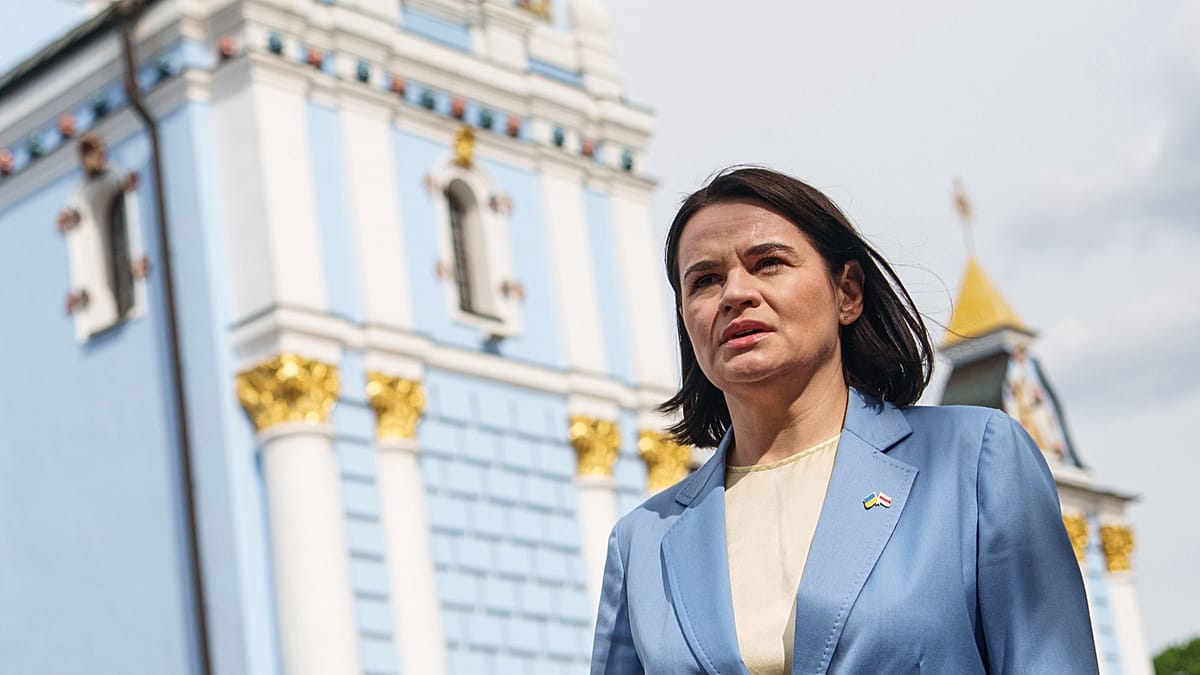
Belarusian opposition leader Sviatlana Tsikhanouskaya has sharply condemned Minsk's decision to designate Euronews as “extremist” media, arguing that the move effectively turns ordinary viewers into targets of state repression. In a statement released from Vilnius, where she lives in exile, Tsikhanouskaya said the ban is not merely an attack on journalism but a deliberate attempt to criminalize access to independent information.
“By labeling Euronews as extremist, the regime is sending a clear message: anyone who watches, shares, or even reads this outlet can be treated as an extremist,” Tsikhanouskaya said. “This is a direct threat to the safety of Belarusians who simply want to know what is happening in their own country.”
The Belarusian authorities added Euronews to its list of “extremist formations” earlier this week, a designation that carries severe legal consequences. Under Belarusian law, individuals found to be involved with such organizations can face up to seven years in prison, and even sharing content on social media can be grounds for prosecution.
Escalating crackdown on independent media
The ban is the latest step in a broader campaign by President Alexander Lukashenko's government to silence independent voices since the disputed 2020 presidential election and the mass protests that followed. Over the past four years, authorities have shuttered dozens of newsrooms, revoked journalists' accreditations, and forced many outlets to operate from abroad.
Euronews, which broadcasts in multiple languages across Europe, has been a rare window for Belarusians into international news and balanced reporting. Its coverage of the 2020 protests and the subsequent repression has made it a particular target. The broadcaster's website and social media channels are now blocked in Belarus, and its journalists are barred from entering the country.
Tsikhanouskaya's condemnation echoes sharp criticism from European officials, who have called the move an unacceptable assault on press freedom. The European Union has repeatedly urged Minsk to release political prisoners and respect fundamental rights, but Lukashenko's government has shown no sign of relenting.
“This is not just about Euronews,” Tsikhanouskaya added. “It is about the right of every Belarusian to access information without fear. The regime is trying to isolate us completely, but it will not succeed.”
The designation also has practical implications for Belarusians living abroad. Many in the diaspora rely on Euronews to follow developments at home, and the ban could deter them from engaging with the outlet for fear of repercussions when they travel to Belarus or have family there.
Human rights groups have documented a pattern of harassment against Belarusians who consume independent media. In recent months, authorities have raided homes, seized devices, and detained individuals for merely liking or commenting on opposition content. The Euronews ban is expected to intensify this climate of fear.
Tsikhanouskaya, who ran against Lukashenko in 2020 and now leads the democratic opposition in exile, has called on the international community to respond with concrete measures. She urged the EU to expand sanctions against Belarusian officials and to provide more support for independent media operating in the region.
“We need the world to stand with us,” she said. “Every time a media outlet is banned, every time a journalist is jailed, the international community must speak out and act. Silence only emboldens the regime.”
The Euronews ban comes amid growing concerns about media freedom across Europe, where press watchdog groups have noted a worrying trend of governments using legal tools to muzzle critical reporting. In Belarus, the situation is particularly acute, with the country ranking near the bottom of global press freedom indexes.
For now, Euronews continues to broadcast from its headquarters in Lyon, France, and its journalists remain committed to covering Belarus. But the ban means that millions of Belarusians will have to rely on circumvention tools or risk legal consequences to stay informed. Tsikhanouskaya's warning is a stark reminder that the cost of information is rising in Belarus—and that the regime is willing to make viewers into victims.