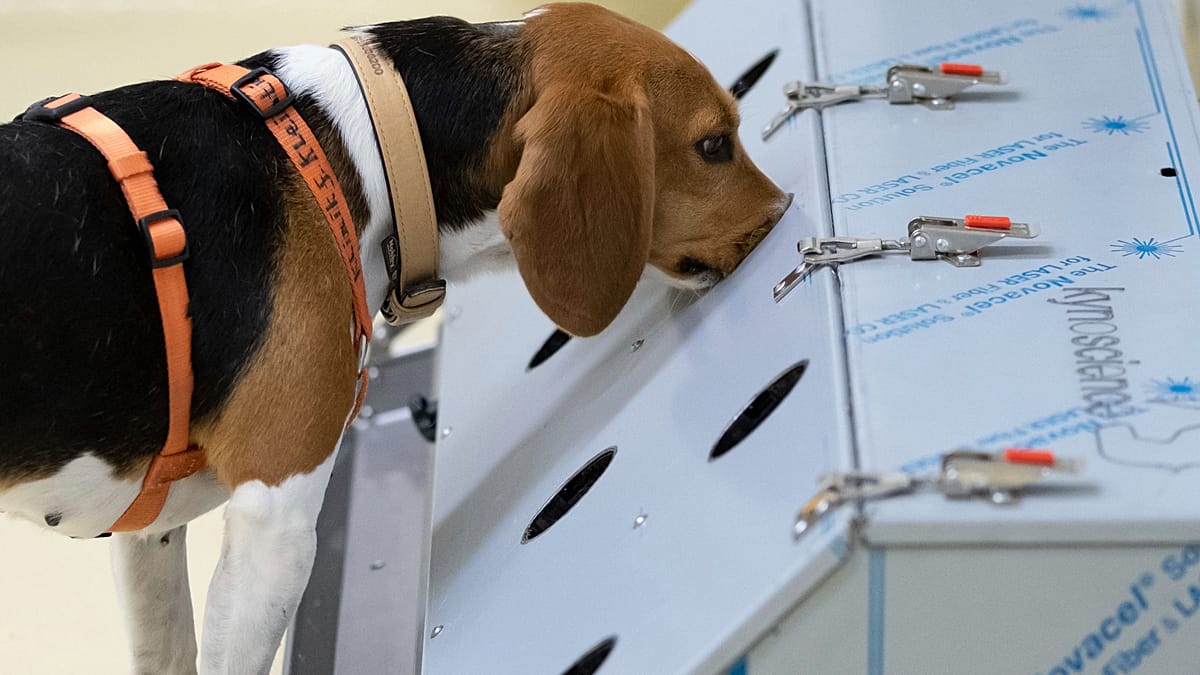
At a research facility on the outskirts of Bengaluru, a team of 15 dogs is learning to do something remarkable: detect the subtle chemical signatures of cancer in human breath. Wearing customised helmets and harnesses fitted with sensors, the animals' every sniff, breath, and brainwave is recorded and fed into an artificial intelligence system.
The Indian startup behind the project, Dognosis, believes this combination of canine olfaction and machine learning could offer a new, non-invasive way to screen for the disease—an approach that might one day complement conventional diagnostics.
How it works
The dogs are trained to recognise odour patterns associated with malignancy. As they sniff samples, sensors capture their breathing rate, brain activity, and movements. The AI then sifts through this data to identify consistent markers in the dogs' responses, effectively translating their instinctive reactions into a digital signal.
The process for patients is straightforward: they breathe into a cotton mask for about ten minutes. The sample is sealed and sent to the laboratory, where the dogs—and the AI—do their work. Patients never meet the animals.
Dognosis reports that a recent study involving more than 1,500 participants across six hospitals achieved an accuracy rate above 90% for seven types of cancer. However, this is a company-reported result and has not been peer-reviewed or independently verified.
Oncologist Santhosh Kumar Devadas, who was not involved in the study, called the findings "promising, as an early signal." But he cautioned: "They need to do the study with a much larger group before we make any definitive conclusions."
The potential impact is significant in India, where many cancers are detected only at advanced stages, when treatment options are limited. A simple, low-cost screening tool could help identify patients who need further testing, potentially saving lives.
Dognosis plans to conduct larger trials as it works towards regulatory approval. The company envisions its technology being used as an initial screening step, flagging individuals who should undergo more invasive procedures like biopsies or imaging.
While the approach is still experimental, it taps into a growing body of research on the diagnostic power of animal scent detection. Earlier studies have shown that dogs can identify certain cancers with remarkable accuracy, though translating that ability into a reliable clinical tool has proven challenging.
For now, the Bengaluru lab remains a proof-of-concept. But if larger studies confirm the early results, the combination of canine noses and artificial intelligence could become a valuable addition to the cancer screening toolkit—not just in India, but potentially in Europe and beyond.