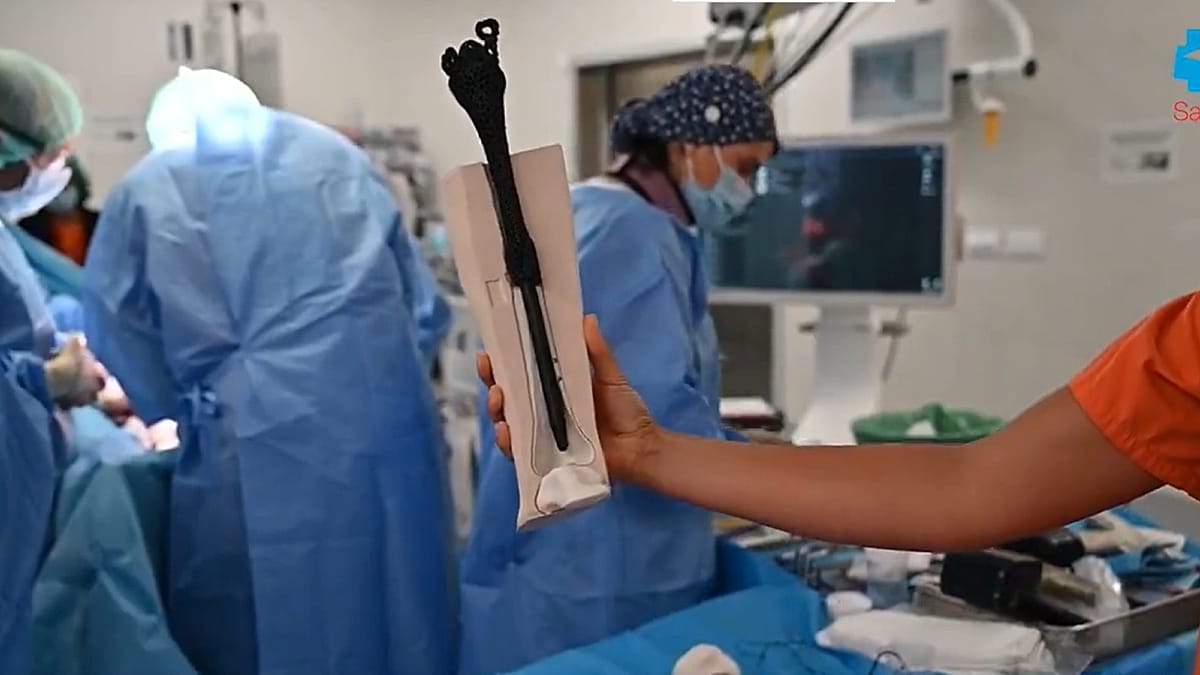
In a breakthrough for regenerative surgery, Madrid's Gregorio Marañón Hospital has avoided a leg amputation by implanting the world's first personalized metamaterial bone prosthesis. The patient, 38-year-old Pierre Chazel, had a high-grade sarcoma in his tibia and faced the loss of his leg after conventional treatments failed. The implant, developed with engineers from the Polytechnic University of Madrid (UPM), uses a titanium lattice structure produced by 3D printing—a technology originally conceived for aerospace—to replicate the mechanical behavior of natural bone.
Unlike standard prostheses, which replace bone with a solid metal piece, this implant consists of a network of millimetre-scale titanium rods that distribute loads in a manner similar to bone tissue. This design not only provides structural support but also encourages the patient's own bone to grow into and integrate with the implant, reducing the risk of rejection and long-term complications. The result is a device that weighs just 300 grams yet can withstand forces exceeding 500 kilograms, whereas conventional prostheses weigh several kilograms and typically bear only 100–150 kilograms.
Tailored to each patient
The path to this implant began when Chazel, after an infection and severe bone density loss, could no longer support a conventional prosthesis. The medical team at Gregorio Marañón decided to design an implant specifically for his anatomy. Using his radiological images, they created a digital twin of his healthy leg and simulated the loads the tibia endures during walking, climbing stairs, or stumbling. Based on these data, they designed the internal structure of the prosthesis and placed screws in areas with the best bone quality, allowing the procedure to be planned with millimetre precision.
A year after the operation, Chazel is already walking. After nearly two years without bearing weight on the leg, he says he has finally begun to regain his mobility. The hospital has already performed a second similar procedure and is preparing two further personalized implants—one for a wrist and another for a sternum. The goal is to expand this technology to offer hyper-personalized medicine within Spain's public health system.
This innovation arrives as Spain grapples with broader healthcare and environmental challenges. The country recently established a scientific panel to guide climate policy amid record wildfires, and Madrid has faced its worst wildfire season, forcing mass evacuations. The hospital's success underscores the potential of advanced manufacturing to transform patient care, even as the region contends with other pressing issues.
The metamaterial approach represents a significant departure from conventional implant design. By mimicking the anisotropic properties of bone, the prosthesis can better handle the complex, multidirectional forces that occur in daily life. This could reduce the need for revision surgeries and improve long-term outcomes for patients with bone tumors or severe trauma.
For now, the procedure remains highly specialized, but the team at Gregorio Marañón is optimistic about scaling it up. As they refine the digital twin and simulation techniques, they hope to make such personalized implants more accessible across Europe. The success of this case offers a glimpse into a future where amputation becomes a last resort rather than a standard response to bone cancer.