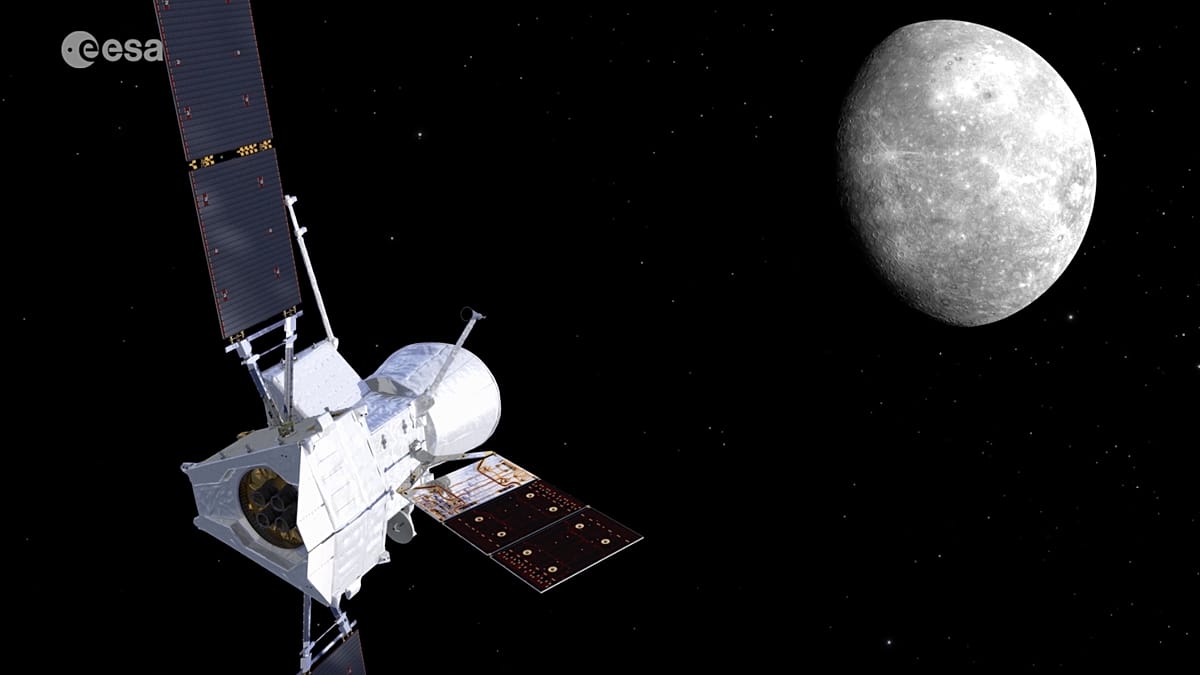
Eight years after departing Earth, the European Space Agency's BepiColombo mission is approaching its most decisive phase: entering orbit around Mercury, a dense, metallic world with its own magnetic field and one of the most punishing environments in the solar system. The planet's proximity to the Sun makes it notoriously difficult to study, both from Earth and from spacecraft, due to intense gravitational pull and radiation.
"Mercury is a challenging destination. It's very difficult to reach, it's very difficult to operate there," said Santa Martinez, ESA mission manager. "The main two aspects are really the extreme temperatures that go from -180 to 450°C, and also the solar radiation, which can be up to ten times what we have on Earth."
On 3 September, at 2:00 pm CEST, the spacecraft will split in two. The Mercury Transfer Module (MTM), which has carried the mission on a circuitous eight-year journey, will drift away, while two science probes—ESA's Mercury Planetary Orbiter (MPO) and Japan's Mercury Magnetospheric Orbiter (Mio)—will continue together. The MTM, now passive and uncontrollable, will tumble past Mercury and spend the rest of its days in interplanetary space.
Flight Director Ignacio Tanco, based at ESA's ESOC control centre in Darmstadt, Germany, described the operation as "working on a knife edge," likening it to "operating with a very hot pizza oven running right on your back." His primary concern is the solar panels, which must be precisely angled: too far from the Sun and power drops; too close and they risk overheating. "There's a lot of stuff that is going to be new on Thursday that the teams must prepare for," he said, noting that the separation effectively launches a new spacecraft already orbiting another planet, with an 11-minute radio delay each way.
Martinez acknowledged the risks. "We know that it's likely that not everything is going to go according to the nominal plan," she said. "But we are ready, we are flexible, and we need to be prepared for the unexpected."
A complex arrival sequence
Thursday's separation is only the first step. For weeks, MPO and Mio will remain locked together, flying free of the propulsion module for the first time, with instruments and cameras previously blocked by the MTM finally getting a clear view of space. The next major milestone comes in late November and early December, when mission controllers fire a critical sequence of chemical thruster burns to lower the spacecraft's orbit and bring it into Mercury's gravitational grip.
Once captured, MPO and Mio will separate into two fully independent spacecraft, each with its own orbit and its own team on Earth. Engineers will spend months commissioning systems and fine-tuning orbits, a process that runs into March 2027. The dedicated science phase begins in April 2027.
Flying to Mercury is far more demanding than reaching Mars. A spacecraft falling towards the Sun accelerates, pulled by solar gravity, so BepiColombo must match Mercury's velocity almost exactly to be captured. That is why the mission has spent eight years and nine planetary flybys of Earth, Venus, and Mercury itself, using an ion engine to bleed off speed gradually rather than taking a direct route.
Mercury's unsolved mysteries
Mercury is nearly impossible to observe in detail from Earth because of the Sun's glare. "To study the planet in any detail, we have to go there with a spacecraft," said Geraint Jones, BepiColombo project scientist. Among the key questions is Mercury's unusual density: the planet is surprisingly heavy for its size, likely due to an oversized iron core that makes up 60% of its volume, but scientists do not yet know why. Understanding this could shed light on how rocky planets form and evolve, including our own.
The mission's findings could also inform broader questions about planetary magnetic fields and the effects of extreme solar radiation on planetary surfaces. As BepiColombo prepares for its final approach, the team in Darmstadt remains vigilant, ready for the unexpected. "We are ready, we are flexible," Martinez reiterated, "and we need to be prepared for the unexpected."