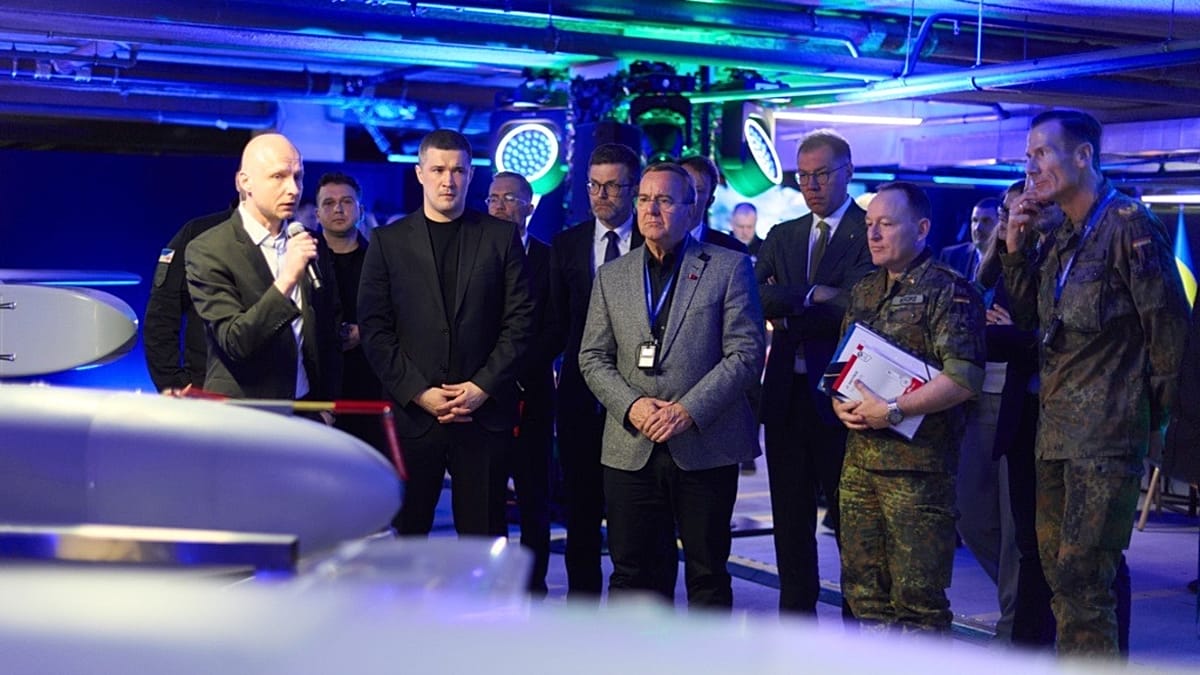
German Defence Minister Boris Pistorius made a surprise visit to Kyiv on Monday, where he and Ukrainian Defence Minister Mykhailo Fedorov signed an agreement to launch 'Brave Germany,' a joint programme aimed at developing new defence technologies and supporting innovative start-ups. The initiative marks a significant deepening of the strategic partnership between Berlin and Kyiv, with both sides committing to co-develop advanced weapons systems.
According to Ukrainian news outlet Ukrinform, Fedorov declared that Germany had become 'the world's leading provider of security support for Ukraine,' noting that Berlin accounts for roughly a third of all assistance provided to the country. Pistorius, speaking to German news agency dpa, emphasised that the trip would focus on expanding joint arms projects and developing new weapons systems as part of the countries' strategic partnership. 'Germany and Ukraine are strategic partners and both sides benefit from this cooperation. A number of new projects will come out of it,' he said.
The core of the agreement centres on the joint development of cutting-edge unmanned systems across all ranges, particularly in the area of deep strike. 'In doing so, we are strengthening the security of both our countries,' Pistorius added. This follows a visit by Fedorov to Berlin last month, where the two sides agreed on a new €4 billion defence package. That package includes funding for several hundred Patriot missiles and 36 IRIS-T launchers to bolster Ukraine's air defences, alongside €300 million in investment for Ukrainian deep-strike capabilities. It also covers the joint production of AI-enabled medium-range strike drones, with an initial batch of 5,000 earmarked for the Ukrainian armed forces.
Germany's Deep-Strike Gap
Despite Germany's massive military spending drive, the Bundeswehr still lacks one crucial capability: deep strike. This refers to the ability to carry out precision strikes against high-value military or infrastructure targets located hundreds—or even thousands—of kilometres behind the frontlines. Former Chancellor Olaf Scholz had agreed with then US President Joe Biden that American Tomahawk cruise missiles would be stationed in Germany as part of NATO's deterrence strategy against Russia. However, after US President Donald Trump announced plans to withdraw around 5,000 American troops from Europe, the Tomahawk deployment has been thrown into doubt. The missiles were originally due to arrive in Germany in 2026, but that now appears increasingly unlikely.
According to a report by the Financial Times, Pistorius is planning a trip to Washington to try to convince the Trump administration to sell Germany Tomahawk cruise missiles and the Typhon launch systems needed to fire them. The visit depends on whether Pistorius can secure a meeting with his US counterpart, Defence Secretary Pete Hegseth. Following tensions sparked by Chancellor Friedrich Merz's comments on Trump's war in Iran, that meeting is said to be 'far from certain.' At present, the Bundeswehr only has one weapon system that could be considered part of the lower end of the deep-strike category: the Taurus cruise missile, which has a range of more than 500 kilometres.
Ukraine may help close Germany's deep-strike gap. Kyiv unveiled a potential long-range option last year: the FP-5 'Flamingo.' This ground-launched missile has a wingspan of around six metres, weighs roughly 6,000 kilograms, and can carry a payload of up to 1,150 kilograms. Ukrainian officials have described it as the country's first domestically produced 'heavy missile system.' According to military and security analyst Fabian Hoffmann in his blog Missile Matters, the system's warhead carries more than 1,000 kilograms in total weight, equivalent to an estimated 450-550 kilograms of explosives. That would make it significantly more powerful than the Ukrainian drones and smaller cruise missiles used so far.
The Flamingo's high terminal speed, combined with its heavy weight, allows the warhead to penetrate much deeper into a target before detonating, significantly increasing its destructive power. Its large explosive payload also gives it a much wider lethal radius. According to Hoffmann, the impact radius is estimated at around 21 metres against heavily fortified targets. It remains unclear which specific weapons systems Germany and Ukraine are planning to develop under the new investment and cooperation agreements, but the Flamingo could be a candidate.
At Monday's signing ceremony in Kyiv, Fedorov said Germany had begun financing 'mid-strike and deep-strike capabilities, which are hugely important for us.' He added, 'As our president says, these are our "long-range sanctions." Mid-strike capabilities allow us to disrupt the enemy's logistics. It also shows the quality of support and financing being directed towards the areas that matter most right now.'
The 'Brave Germany' programme underscores a broader European trend of increasing defence cooperation and investment, as seen in the European Parliament's push for a 10% boost to the 2028-2034 EU budget, prioritising cohesion and defence. However, challenges remain, as highlighted by the EU Defence Chief's warning that Russia still outpaces Europe in military production.