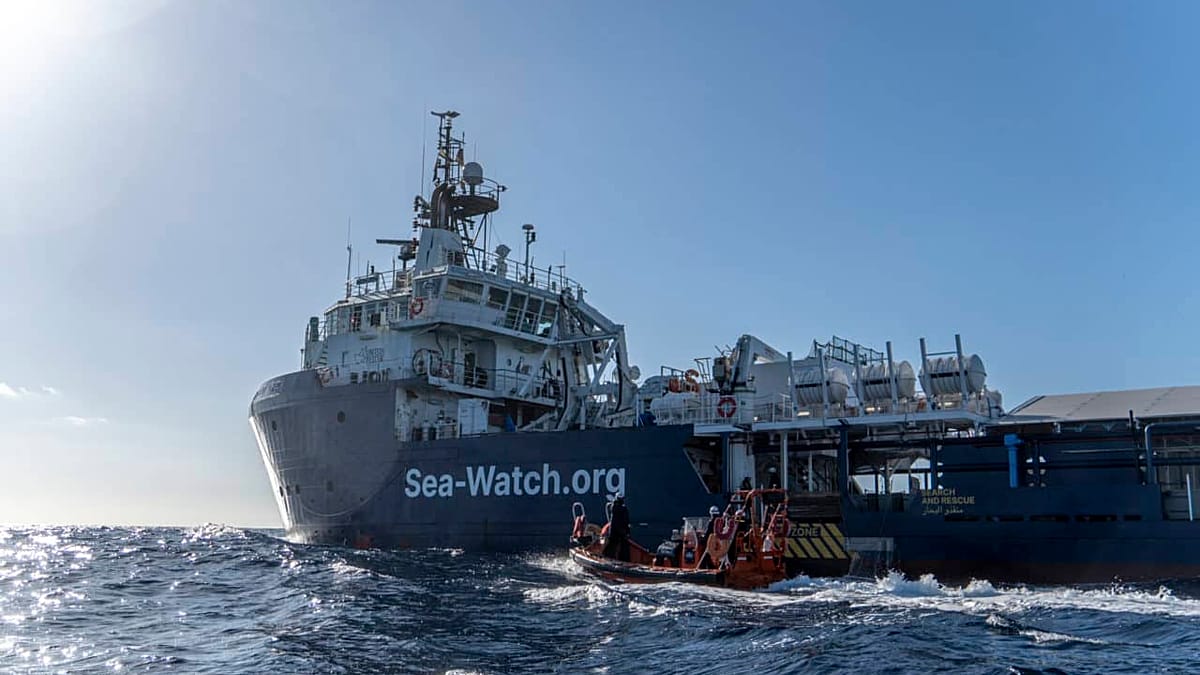
The detention of a German civilian rescue vessel in an Italian port has sharpened a long-running disagreement between Berlin and Rome over migration policy in the central Mediterranean. Italian authorities held the Sea-Watch 5 for 45 days and imposed a €7,500 fine on the German organisation that operates it, reigniting debate about the role of private ships in rescue operations.
The vessel had rescued six people on 13 August, and its crew reported encountering an unidentified armed boat and documenting the deaths of eight individuals. Italy's Interior Ministry justified the detention by saying the crew had failed to inform the Libyan coastguard about the rescue. Sea-Watch disputes this, arguing that the Italian Maritime Rescue Coordination Centre never instructed them to contact Libyan authorities. Spokesperson Giulia Messmer said the Libyan coastguard was already present at the scene and had communicated with the crew by radio. The organisation plans to appeal the detention in the coming week.
A decade of friction over civilian rescues
The clash is the latest chapter in a dispute that dates back more than a decade. Sea-Watch was founded in 2015, shortly after Italy ended its large-scale naval search-and-rescue mission Mare Nostrum, which was replaced by Triton, an EU border operation with a more limited rescue mandate. German civilian rescue efforts gained international attention in 2019 when Carola Rackete, captain of the Sea-Watch 3, docked in Lampedusa without permission while carrying dozens of rescued migrants. Rackete later served as a Member of the European Parliament for Germany's Left party before resigning in 2025.
Since Giorgia Meloni became prime minister in October 2022, Italy has tightened rules governing private rescue vessels. The 2023 Piantedosi decree requires rescue ships to proceed without delay to an assigned port after a rescue, a policy NGOs criticise because those ports can be hundreds of kilometres away, preventing ships from staying at sea to respond to further emergencies. In December 2024, Italy extended liability beyond captains to shipowners and operators in cases of repeated violations within five years. According to Sea-Watch, Italian authorities have detained civilian rescue ships 44 times since 2023, keeping them out of operation for a combined total of more than 960 days.
Who funds the rescue fleet?
Several German organisations operate in the central Mediterranean, including Sea-Watch, Sea-Eye, and SOS Humanity, alongside the smaller RESQSHIP. Some vessels, including Sea-Watch 5 and Humanity 1, also serve as alliance ships for United4Rescue, a charity founded in 2019 that raises and distributes donations. Sea-Watch reported income of around €13.5 million in 2025, almost entirely from donations from nearly 59,200 supporters. United4Rescue raised about €1.5 million in 2024 from roughly 4,000 individual donors, organisations, and municipalities.
Until recently, German state funding also played a role. In 2022, the Bundestag, under then-foreign minister Annalena Baerbock, approved €8 million for the years 2023 to 2026. In spring 2025, the new foreign minister Johann Wadephul (CDU) halted this funding, arguing that sea rescue was not the task of his ministry. Other European organisations are also active, including the Franco-German SOS Méditerranée with the Ocean Viking, the Spanish Proactiva Open Arms, and the Italian Mediterranea Saving Humans. Despite this, Italian Interior Ministry data shows that more than half of all migrants brought to Italy on private ships since October 2022 have been rescued by German organisations.
Do rescue ships encourage crossings?
German Chancellor Friedrich Merz has argued that sea rescue should be a state responsibility, not a private one. Speaking on German television in 2025, Merz said sea rescue was “not a task for private enterprise.” Critics, including politicians from the CDU/CSU and the Alternative for Germany (AfD), accuse rescue organisations of encouraging dangerous crossings and indirectly assisting people-smuggling networks. The organisations reject these accusations, insisting their operations save lives on one of the world's deadliest migration routes.
A central point of contention is where rescued people should be taken. NGO vessels generally bring them to European ports rather than returning them to Libya, which the United Nations does not consider safe for migrants. This stance puts them in direct conflict with Italian policy, which has increasingly sought to prevent departures and facilitate returns. The dispute is not limited to Italy and Germany; it reflects broader European tensions over migration management, as seen in Meloni's return push and the challenges faced by other southern member states. Meanwhile, Libyan groups have escalated threats against rescue ships, adding another layer of danger to an already volatile situation.
As the legal and political battles continue, the human cost remains stark. The Mediterranean remains one of the deadliest migration routes in the world, and the question of who is responsible for saving lives at sea shows no sign of being resolved. For now, the standoff between Berlin and Rome over the Sea-Watch 5 serves as a reminder of the deep divisions within the European Union on migration policy.