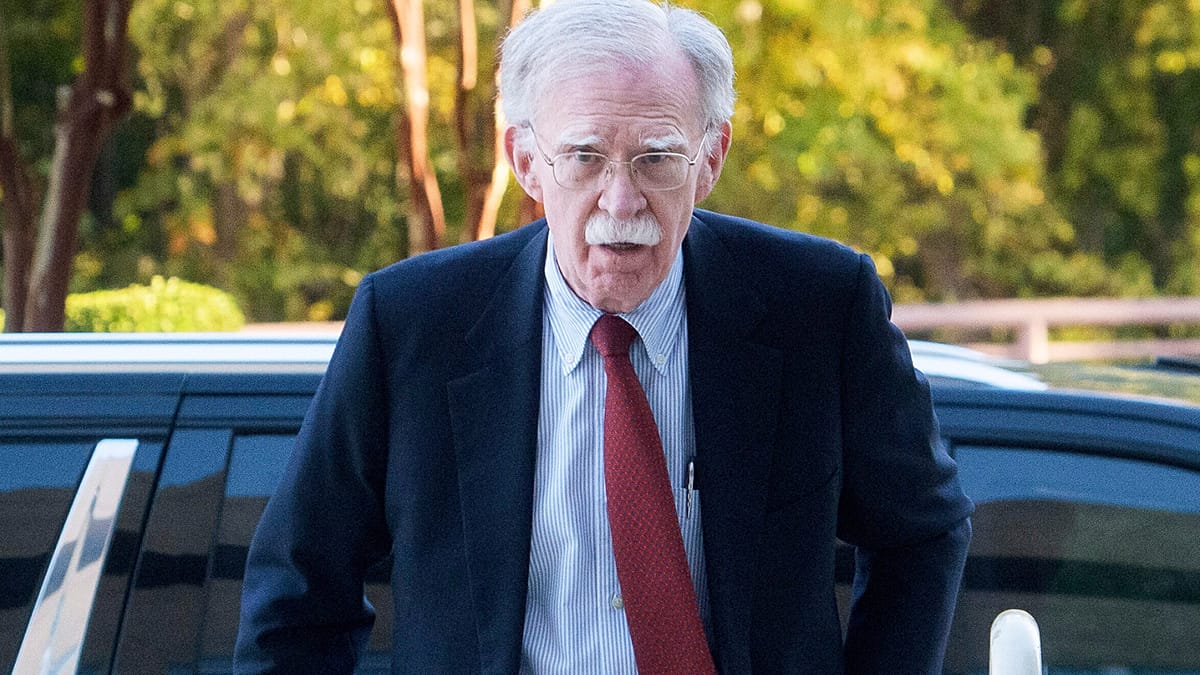
Former US National Security Adviser John Bolton has accused Iran of outmaneuvering President Donald Trump in negotiations over a nuclear framework agreement, arguing that Tehran secured far better terms by exploiting Trump's focus on lowering energy prices. Speaking to Euronews at the G7 summit in Évian, Bolton—who served in the Trump administration during its first term—described the deal as a strategic misstep that prioritizes economic concerns over geopolitical stability.
“They’ve played him like a violin,” Bolton said. “That’s why they’ve got the deal that they want.” He argued that Trump’s primary motivation was not the non-proliferation details but rather ensuring the reopening of the Strait of Hormuz to bring Gulf oil onto international markets and reduce gasoline prices for American consumers. “Trump isn’t thinking about the geo-strategic implications of the deal. He’s thinking of one thing. He wants the strait open. He wants Gulf oil on international markets. He wants the price of gasoline at the pump down. That’s all he cares about,” Bolton added.
Strategic Leverage Squandered
Bolton contended that the United States sacrificed its strongest bargaining chip by agreeing to negotiate with a weakened Iran. He noted that Washington had significantly degraded Iran’s military and leadership capabilities through US and Israeli strikes, killing hundreds of senior officials. Yet, rather than pressing for maximum concessions, Trump signaled a willingness to halt further military action before the US midterm elections, a move Bolton said Tehran interpreted as desperation. “That takes away the biggest weapon we have, the biggest leverage we have over Iran. That’s all they will understand,” he said.
The former adviser also expressed skepticism about Iran’s commitment to forgoing nuclear weapons, pointing to its long-standing membership in the Nuclear Non-Proliferation Treaty since 1970. “Iran has been committed to not getting nuclear weapons for 56 years now since it joined the Nuclear Non-Proliferation Treaty in 1970. They just don’t mean it,” Bolton said. He dismissed the White House’s assertion that a change in Iran’s leadership—following the deaths of top officials—represented a fundamental shift. “The change of leadership is only because we’ve killed the top four or five hundred people in the existing regime and you’re down now to their seconds and deputies. So, yeah, it’s different people, but it’s the same fanatic regime,” he argued.
Lack of Transparency Raises Questions
Bolton highlighted the absence of a published text for the framework agreement as a major red flag. “If it were a great deal, it would be out in public. And I think that tells you pretty much what you need to know,” he said. Key unresolved issues include the specifics of Iran’s uranium enrichment program, the scope of sanctions relief, and the practical mechanisms for reopening the Strait of Hormuz. Without a transparent document, Bolton warned, the deal’s details could undermine its stated goals.
The G7 summit in Évian has placed the Iran deal at the center of discussions, with European leaders weighing their role in ensuring freedom of navigation through the Strait. French President Emmanuel Macron said European countries would contribute to securing the waterway, though Trump suggested the US would not require “much help” following the agreement. Bolton expressed doubt about the effectiveness of a European naval force, questioning whether it would resemble a UN peacekeeping mission that merely observes violations. “Is it going to be like a UN peacekeeping force that just waves as the ceasefire is violated? Nobody’s ever addressed that question,” he said.
The broader implications for Europe are significant. The deal could affect energy markets, with lower oil prices potentially benefiting European consumers but also reducing incentives for diversification. Moreover, the agreement’s terms may influence European security dynamics, particularly for nations like France and the United Kingdom that have naval assets in the region. The European Parliament recently approved an EU-US trade deal amid renewed tariff threats, highlighting the interconnected nature of transatlantic relations. As the G7 summit continues, European leaders must navigate a complex landscape where US strategic decisions have direct consequences for the continent’s energy security and geopolitical stability.