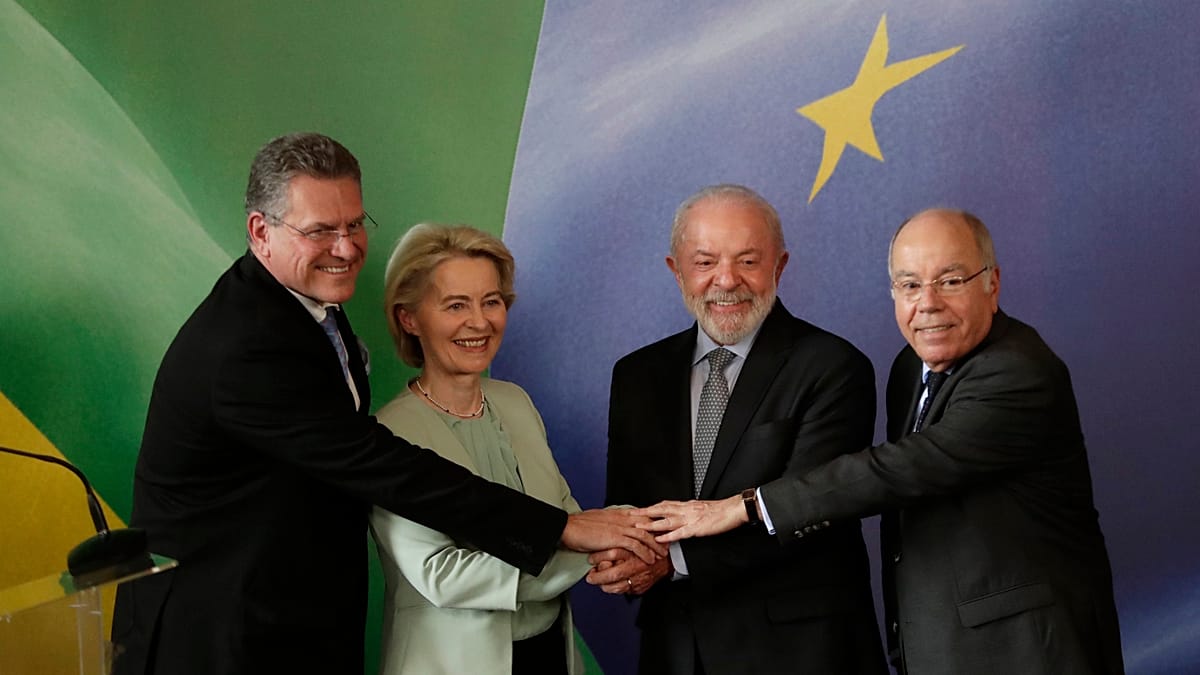
Brazil’s ambassador to the European Union, Pedro Miguel da Costa e Silva, has expressed surprise at the bloc’s decision to ban imports of Brazilian meat products, a move that comes just days after the EU-Mercosur free-trade agreement provisionally entered into force on 1 May. In an interview with Euronews, da Costa e Silva confirmed that Brasília has opened a technical dialogue with the European Commission to seek a reversal of the ban.
The ban, voted by a committee of EU national experts, targets meat and animal-derived products from Brazil over the use of antimicrobials to stimulate growth in livestock. It will take effect from 3 September 2026 and covers live food-producing animals, beef, poultry, eggs, aquaculture products, and honey. Brazil is the first country to be removed from the EU’s list of third countries deemed compliant with the bloc’s antimicrobial regulations.
“The decision came as a surprise to us yesterday,” da Costa e Silva told Euronews. “We have started a technical dialogue with the Commission to reverse Brazil’s exclusion from the list.” He added that his team had already met with the European Commission’s health directorate general to “obtain explanations” about the decision.
Trade Tensions Amid Mercosur Implementation
The timing of the ban has raised eyebrows in Brasília, as it coincides with the provisional entry into force of the EU-Mercosur trade agreement, which aims to liberalise agricultural trade between the EU and the South American bloc comprising Brazil, Paraguay, Uruguay, and Argentina. The deal has long been contentious among European farmers, who argue that lower production standards in Mercosur countries could create unfair competition.
European farmers have warned that the agreement could flood the EU market with cheaper agricultural products produced under less stringent environmental and animal welfare rules. The ban on Brazilian meat imports, however, is grounded in food safety concerns rather than trade protectionism. EU Commission spokesperson Eva Hrncirova explained: “To be included in the list of third countries authorised to export to the Union, Brazil must ensure compliance with the Union requirements on the use of antimicrobials for the entire lifetime of the animals that the exported products originate from.”
The EU has been tightening its rules on antimicrobial use in livestock to combat the growing threat of antimicrobial resistance (AMR), a public health priority for the bloc. The ban reflects the EU’s commitment to the precautionary principle, even if it strains trade relations with a key partner.
For Brazil, the ban represents both an economic and diplomatic setback. The country is one of the world’s largest exporters of beef and poultry, and the EU is a significant market. The Brazilian ambassador’s surprise suggests that the diplomatic channels may not have fully anticipated the speed or scope of the EU’s regulatory action.
The broader context of EU trade policy is also relevant. The bloc has been actively pursuing trade deals with partners such as India and Australia to strengthen its role in a multipolar world. The EU-India trade deal, for instance, has been framed as a way to bolster Europe’s economic resilience. Meanwhile, the EU has also turned to US jet fuel imports amid Middle East disruptions, highlighting the bloc’s efforts to diversify supply chains.
Brazil’s reaction to the ban also echoes its ambassador’s earlier remarks rejecting a Europe-led global order and calling for a multipolar rebuilding of international institutions. This latest dispute may further complicate EU-Brazil relations, especially as both sides navigate the implementation of the Mercosur agreement.
The ban is set to take effect in September 2026, leaving a window for negotiations. Whether Brazil can meet the EU’s antimicrobial standards in time—or whether the Commission will grant an exemption—remains to be seen. For now, the technical dialogue offers a path forward, but the underlying tensions over agricultural standards and trade liberalisation are unlikely to disappear.