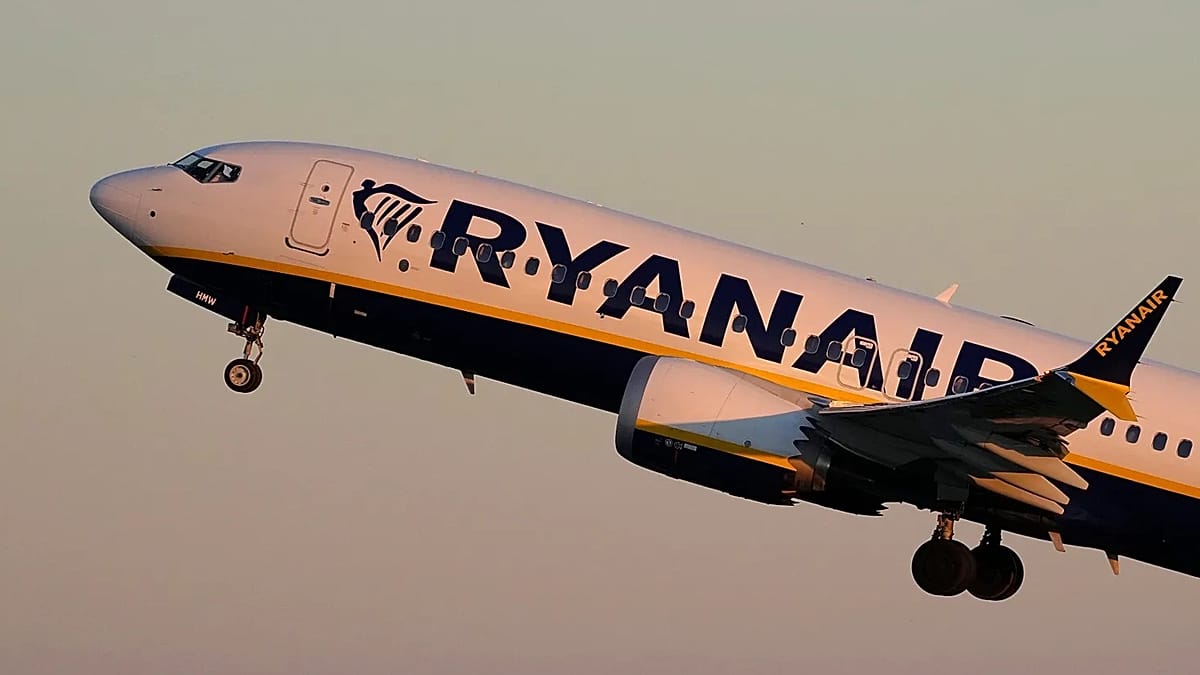
Ryanair has launched a blistering attack on Fraport Greece, the German-owned operator of 14 regional airports, accusing it of hoarding a tax cut intended to lower costs for airlines and passengers. The Irish low-cost carrier, which recently announced the closure of its three-aircraft base at Thessaloniki’s Macedonia Airport for the 2026 winter season, is now calling on the Greek government to dismantle what it terms a “German monopoly.”
Tax Cut Dispute
At the heart of the row is a 75% reduction in the Airport Modernisation and Development Fee, a levy imposed by the Greek state. Ryanair claims that instead of passing this saving on to airlines and travellers, Fraport Greece has kept it to boost profits for its Frankfurt-based parent company. “Fraport’s monopoly kept this tax cut for itself in order to further increase its German shareholder’s profits,” the airline said in a statement.
Fraport Greece, which manages airports including those in Thessaloniki, Corfu, and Rhodes, has dismissed the allegations as unfounded. In a statement on Friday, the operator said it had only learned of Ryanair’s base closure on the same day and noted that the announcement was made in Athens, not in the directly affected city of Thessaloniki. It described Ryanair’s claims about charges and fees as a “pretext” for the airline’s own strategic decisions.
Competitiveness Concerns
Ryanair argues that Fraport’s pricing makes Greek aviation uncompetitive compared to other European destinations. “Fraport Greece’s monopoly has made Greek aviation hopelessly uncompetitive compared to other European countries, such as Albania, regional Italy, Slovakia and Sweden, which are actively reducing airport charges and abolishing taxes to support growth,” the airline stated. The carrier has been expanding in those markets, while cutting back in Greece.
The dispute highlights broader tensions in European aviation, where airport operators and airlines often clash over fees. Ryanair’s CEO, Michael O’Leary, has been a vocal critic of high charges across the continent, recently calling for a two-drink limit at airports to curb disruptive behaviour. The airline’s stance in Greece echoes similar battles in other EU member states, where it has threatened to reduce services if costs are not lowered.
Fraport Greece, for its part, insists that the reduction in Ryanair’s winter services is purely a business decision. “The reduction of Ryanair’s winter services at Macedonia airport is exclusively linked to the airline’s own strategy, business model and profitability criteria,” the operator said. It added that Ryanair remains an important partner among more than 40 airlines currently operating at Thessaloniki.
Broader Implications
The standoff comes as Greece seeks to boost year-round tourism and improve connectivity, especially to its northern regions. The government’s decision to cut the modernisation fee was part of that effort, but Ryanair’s accusations suggest the policy is not reaching its intended beneficiaries. The airline is now calling on Athens to “break the monopoly of Fraport Greece,” which it says would introduce much-needed competition to the Greek aviation market.
This is not the first time Ryanair has clashed with a European airport operator. The airline has previously threatened to pull routes from airports in Germany, Italy, and Portugal over fee disputes. However, the situation in Greece is particularly acute because Fraport holds a long-term concession for the 14 regional airports, giving it significant market power.
For travellers, the dispute could mean fewer low-cost options to and from Thessaloniki, a city of over one million people that relies heavily on tourism and business travel. The closure of Ryanair’s base will reduce capacity on key routes, potentially driving up prices for passengers. Meanwhile, the Greek government faces pressure to intervene, though it has so far remained silent on the matter.
As the winter season approaches, the battle between Ryanair and Fraport Greece is likely to intensify. The outcome could set a precedent for how airport charges are regulated in Greece and across Europe, where similar monopolies exist in countries like Italy and Portugal. For now, Ryanair is betting that public pressure and government action will force Fraport to change its pricing strategy.