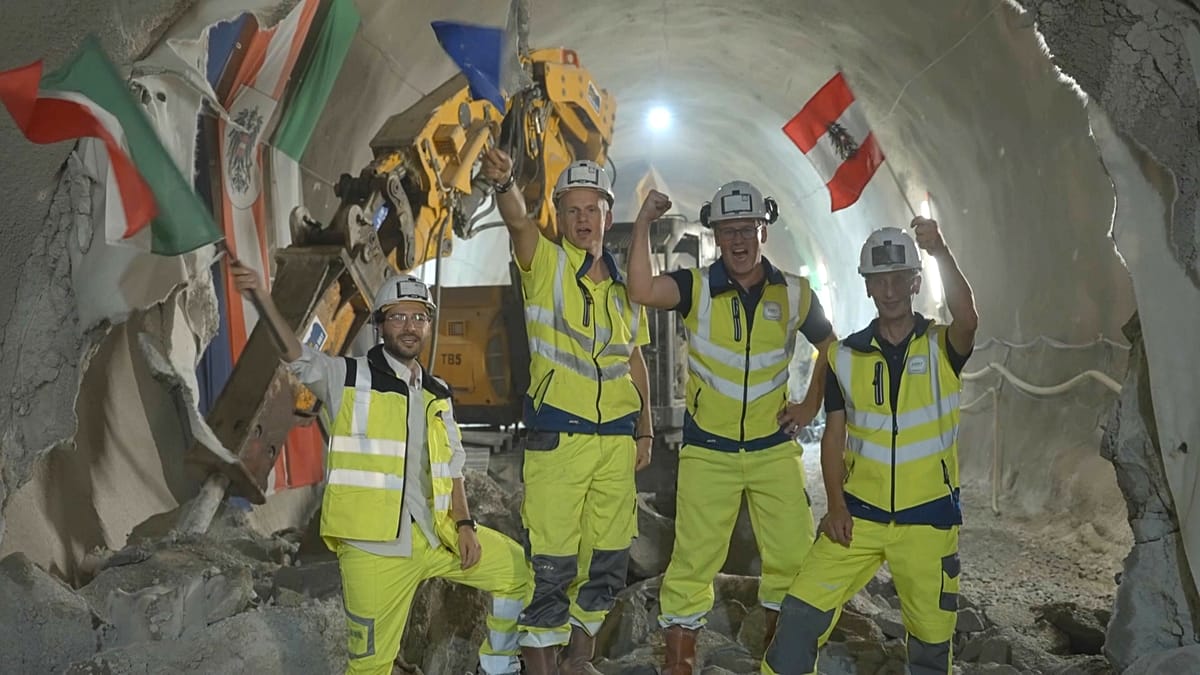
Deep beneath the Alpine massif, near the Tyrolean village of Steinach am Brenner, one of Europe's largest construction sites is taking shape. Here, massive tunnel boring machines are carving out the Brenner Base Tunnel, a 64-kilometre railway link that will become the longest underground railway line in the world. The tunnel is the central piece of the trans-European railway corridor connecting southern and northern Europe, from Verona to Munich and beyond.
An Engineering Milestone for the Continent
Project manager Sebastian Reimann describes the scale of the undertaking: “Europeans can be proud of what they are creating here. This is a joint effort by Europeans.” His colleague Andreas Ambrosi adds that “eleven nations from all over Europe work here. And top European companies work here. Herrenknecht alone has eight tunnelling machines in use.”
Herrenknecht, a German company based in Schwanau, is a global market leader for large tunnel boring machines. Its equipment delivers 6,000 horsepower; some machines are nearly 20 metres high and several hundred metres long. The company employs around 5,000 people worldwide and reports an annual turnover exceeding EUR 1 billion. Herrenknecht's machines have bored beneath the Yellow River in China, the Panama Canal, and the Himalayas, as well as through the Alps.
Founded half a century ago by engineer Martin Herrenknecht, the firm has become a symbol of German industrial prowess. In an interview with Euronews, Herrenknecht addressed the competitive pressures facing European manufacturers. Asked whether Brussels should adopt a European preference in public procurement, he replied: “That’s the only option. If you look at how we are being pressured by the Chinese through price dumping. Here, a welder earns EUR 50 (gross per hour); in China, EUR 15. China operates with dumping steel prices. Half the price! We cannot stimulate the economy (in Europe) under such conditions.”
When asked about protective tariffs, Herrenknecht was blunt: “Without tariffs against China, Europe will collapse. Brussels is discussing whether to set up a world trade organisation without China and Russia. But those in Brussels keep debating and take no action.”
The Brenner Base Tunnel is not just a national project for Austria and Italy; it is a European infrastructure priority. The tunnel will dramatically reduce travel times for freight and passengers between the two countries, shifting traffic from road to rail and cutting carbon emissions. It is part of the broader EU push to modernise continental transport links, a goal that has gained urgency amid debates over energy security and climate policy. For context, the EU's energy mix is under scrutiny as member states balance nuclear power, renewables, and green hydrogen investments.
The project also highlights the resilience of European engineering in a volatile global environment. While geopolitical tensions—such as the ongoing conflict in Ukraine, where Kyiv recently set a record by shooting down 33,000 Russian drones in a single month—disrupt supply chains, the tunnel's construction continues. European banks, including Deutsche Bank, Santander, and UBS, have posted record profits amid market volatility, partly driven by energy and defence spending.
For the residents of Steinach am Brenner, the tunnel is a daily reminder of Europe's capacity for large-scale cooperation. The village, once a quiet Alpine community, now hosts workers from across the continent. When completed, the Brenner Base Tunnel will stand as a testament to what European nations can achieve together—a world record made in Europe, deep under the Alps.