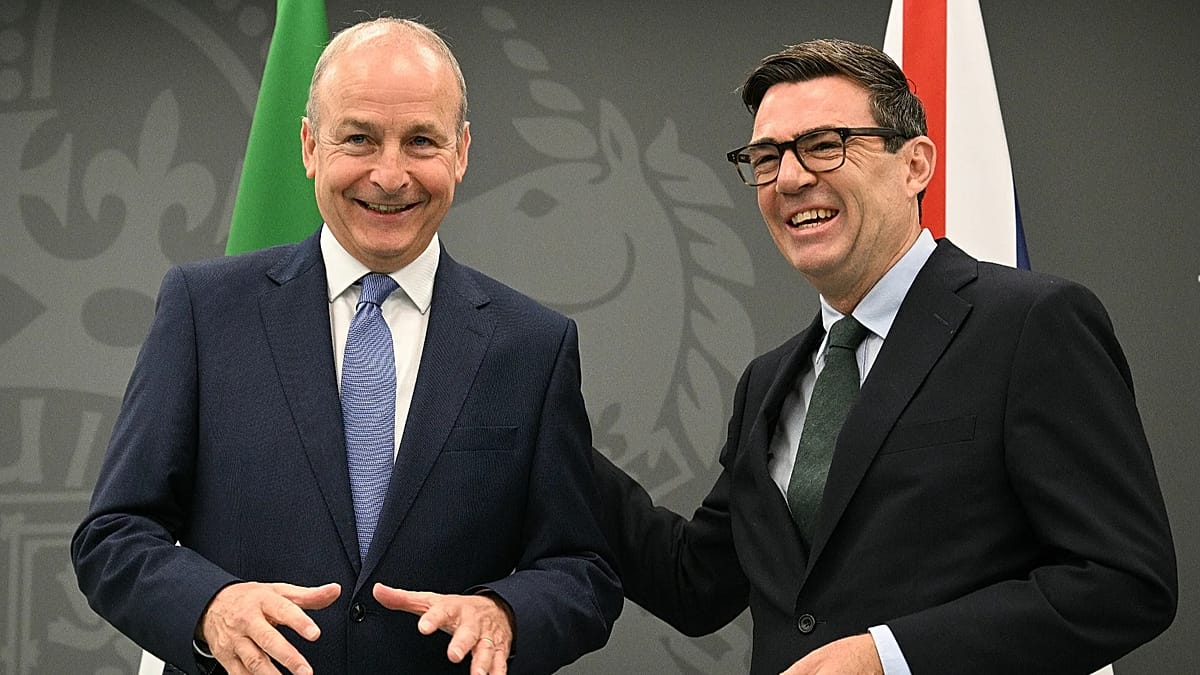
British Prime Minister Andy Burnham used his first meeting with a foreign leader in his new regional office to pledge further efforts to strengthen the United Kingdom's relationship with the European Union. The talks with Irish Taoiseach Micheál Martin took place in Manchester on Friday, at the newly established No10 North, part of Burnham's push to decentralise government.
According to a Downing Street spokesperson, Burnham "underlined the UK's desire to work closely with Ireland during its presidency of the European Union as the UK seeks a closer relationship with Europe." The two leaders also reaffirmed their commitment to the Good Friday Agreement, the cornerstone of peace in Northern Ireland, and discussed shared objectives including EU cooperation, security, and boosting bilateral trade.
Speaking from No10 North, Burnham stressed the importance of the UK-Ireland relationship: "The relationship between the UK and Ireland matters so much on every single level." He told reporters that the government was "looking forward" to a long-awaited UK-EU summit later this year and that it was "wanting to take further steps to deepen the relationship with Europe."
The summit, originally scheduled for July, was postponed after the resignation of former Prime Minister Keir Starmer. It is expected to focus on key elements of Starmer's so-called "Brexit reset," including a potential youth mobility scheme that would allow young Europeans to live and work in the UK and vice versa.
Martin, whose country holds the rotating presidency of the EU Council, said: "We look forward to discussing with you even stronger and closer relationships between the European Union and the United Kingdom, which will be of benefit to the European Union and indeed to Ireland, quite frankly."
From Brexit critic to pragmatic leader
Burnham has long been a vocal critic of Brexit, having called for the UK to rejoin the bloc in the past. However, during his campaign for the Makerfield by-election in May, he softened his stance. "My view is that Brexit has been damaging," he said at the time. "But I also believe the last thing we should do right now is rerun those arguments."
His comments came as the UK's 2016 decision to leave the EU resurfaced in political debate, with Labour figures jockeying for position amid party turmoil following disastrous local election results. Starmer had pledged to "put Britain at the heart of Europe" as his government cautiously rebuilt ties with Brussels, but some senior Labour figures pushed for a more radical approach as a leadership contest loomed.
Wes Streeting, now the UK's Defence Secretary, described the UK's departure from the EU as a "catastrophic mistake." Speaking at the Labour Party's Progress conference in May, he said: "It's left us less wealthy, less powerful and less in control than at any point before the industrial revolution." He added: "We need a new special relationship with the EU, because Britain's future lies with Europe, and one day, one day, back in the European Union."
Burnham's meeting with Martin is seen as a signal of his intent to pursue a more pragmatic, incremental approach to EU relations, focusing on practical cooperation rather than reopening old wounds. The UK-EU summit later this year will be a key test of whether that approach can deliver tangible results.
Analysts note that Ireland, as the only EU member state sharing a land border with the UK, has a unique stake in the relationship. Dublin has consistently called for a close UK-EU partnership, not least to protect the delicate balance of the Good Friday Agreement and the smooth functioning of the Northern Ireland Protocol.
The meeting also highlighted Burnham's broader agenda of devolution, with No10 North intended to bring government closer to communities outside London. By hosting Martin there, Burnham underscored his commitment to a more regionally balanced approach to international diplomacy.
As the UK and EU prepare for the summit, the tone from both sides appears constructive. Whether that translates into concrete agreements on youth mobility, security cooperation, or trade remains to be seen. But for now, Burnham's message is clear: the UK is open to a deeper relationship with Europe, one step at a time.