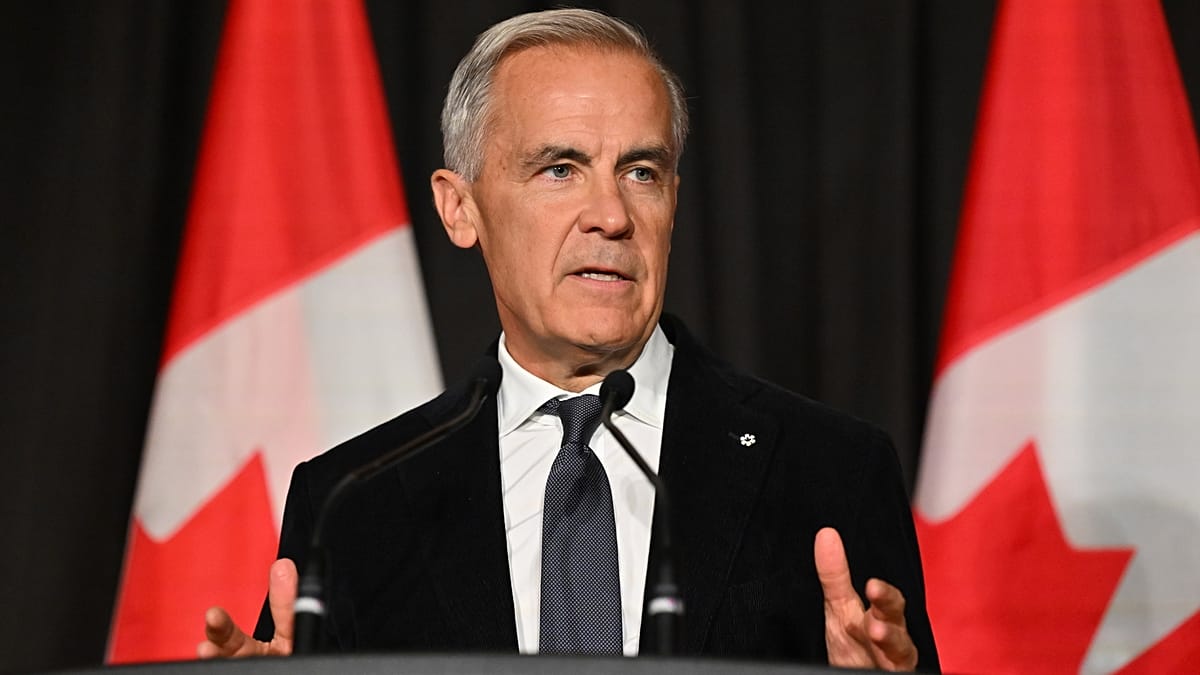
Canadian Prime Minister Mark Carney is stepping up his outreach to Brussels, with expectations building ahead of his address to the European Parliament in Strasbourg later this week. According to a report in the Wall Street Journal on Sunday, Ottawa is exploring the idea of becoming an "associate" member of the EU — a status that does not yet exist but has been floated for other partners.
Speaking overnight, Carney denied that Canada was seeking full membership, but confirmed that he wanted to "begin discussions for (a) unique alliance with the European Union." The concept, which has no formal precedent, was first suggested by German Chancellor Friedrich Merz in May as a possible framework for Ukraine. Under that model, a partner country would participate in EU summits and ministerial meetings without voting rights, benefit from the bloc's mutual assistance clause, and be eligible for EU funding programmes.
Carney's overture is the clearest signal yet that Ottawa views Europe as a counterweight to its deteriorating relationship with Washington. US President Donald Trump has made Canada a primary target in his tariff war and has repeatedly mused about making it the 51st state. The Canadian leader's visit to Strasbourg and his subsequent meeting with French President Emmanuel Macron in Saint-Pierre-et-Miquelon next Sunday underscore the diplomatic push.
Yet translating shared values into deeper cooperation has proven difficult. A decade after the EU-Canada Comprehensive Economic and Trade Agreement (CETA) was signed, it remains only partially ratified, with several chapters still not in force due to opposition in some member states.
Latvia's PM: prepare for the worst
Meanwhile, Latvia's Prime Minister Andris Kulbergs has told Europe Today that Europe must "prepare for the worst" to ensure peace, even though he does not believe Russia has the capacity to open a "second front" against NATO. "The one who prepares for the worst has peace," Kulbergs said in an interview in Riga. "There cannot be any weakest link. We all have to remain strong."
His comments come amid mounting evidence of Russian hybrid attacks on Baltic states, including a drone strike on a passenger train just two kilometres from the Polish border on Sunday. Kulbergs also weighed in on Ukrainian President Volodymyr Zelenskyy's warning of a €23 billion gap in Ukraine's defence budget, arguing that the West is caught in a vicious cycle: Western-made components end up in Russian missiles, and then Western governments spend billions to help Kyiv defend against them. He called for a "full ban" on Russia's access to the technology needed to produce such weapons.
The war's proximity to NATO's eastern flank is becoming increasingly uncomfortable, and Kulbergs's remarks reflect a growing sense of urgency among Baltic leaders.
Trump's Irish reunification comments stir controversy
Across the Atlantic, Trump's apparent endorsement of Irish reunification during his weekend visit to Ireland has caused ripples on both sides of the Irish Sea. After a bilateral meeting with Taoiseach Micheál Martin in Dublin, Trump said he "would love" to see a united Ireland, adding that "it would happen eventually." He later doubled down on the remarks and also pledged to remove a 15% US tariff on Irish whiskey.
The UK government responded cautiously, with a spokesperson pointing to a previous statement by Prime Minister Andy Burnham, who said he was unaware of majority public support for a referendum and that "until that changes, there will not be one." The opposition was less restrained: Conservative leader Kemi Badenoch accused Trump of "shooting from the hip as usual, just like he did with Greenland and Canada becoming the 51st state," and called the comments "deeply unhelpful."
The episode has reignited debate about the future of Northern Ireland, though it remains unclear whether Trump's remarks reflect official US policy.
EU sanctions deadline looms
In Brussels, EU ambassadors are reconvening in an eleventh-hour effort to renew the bloc's sanctions regime against Russia, with a deadline just 48 hours away. According to four EU diplomats, France has joined Slovakia in seeking the delisting of Russian-Uzbek businessman Alisher Usmanov, a move that has caused "huge frustration" among other member states. A French diplomatic source insisted the issue was related to "national security" and reaffirmed France's commitment to maintaining pressure on Moscow.
The internal discord comes at a critical moment, as the EU seeks to present a united front against Russian aggression. The outcome of the negotiations will be closely watched in Kyiv and across the continent.
Elsewhere, former Hungarian Prime Minister Viktor Orbán made a return to the political stage with an annual closed-door speech in the village of Kötcse, vowing to intensify resistance against Péter Magyar's government. Orbán denied corruption allegations and accused Magyar of helping Brussels "colonise" the country. Despite his unpopularity — polls consistently rank him as Hungary's most disliked politician — Orbán appears to be betting on public frustration over rising energy prices and the budget deficit to create an opening for his comeback.
In Sweden, preliminary results from Sunday's parliamentary election show the centre-left bloc, led by Social Democrat Magdalena Andersson, edging ahead with 176 seats against the right-wing bloc's 173 in the 349-seat Riksdag. The narrow margin leaves the final outcome uncertain, with implications for the country's future direction on issues ranging from energy policy to NATO integration.