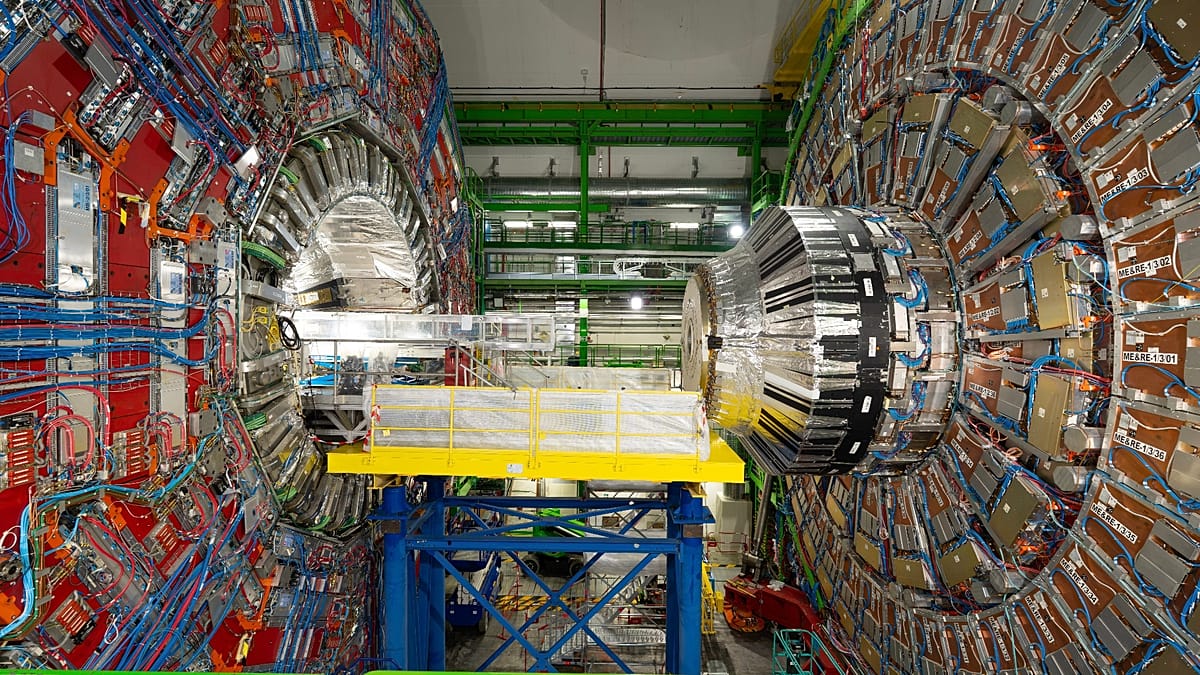
At the European Organization for Nuclear Research (CERN) near Geneva, physicists have recorded evidence of a particle transformation so rare that it was expected to happen just once in every ten billion collisions. The result, obtained with the Large Hadron Collider (LHC), offers a first direct look into what researchers call the 'zeptoverse' – a realm of subatomic phenomena at scales so small they challenge the imagination.
A needle in a proton haystack
The LHC smashes protons together at nearly the speed of light, generating a cascade of short-lived particles. Among them are 'beauty' particles, which contain a bottom quark and decay within fractions of a second. By tracking millions of these events, the international collaboration has now identified a process in which a beauty particle transforms into a pair of other particles – a transition so improbable that it had never been confirmed before.
According to the team, the observed decay matches theoretical predictions with a statistical significance that crosses the threshold for a discovery. The result is a testament to the precision of modern detectors and the sheer volume of data the LHC has accumulated over its runs.
Why the zeptoverse matters
The 'zeptoverse' refers to measurements at the zeptoscale – a unit of time and length so small that a zeptosecond is a trillionth of a billionth of a second. This is the domain where physicists hope to spot deviations from the Standard Model, the theoretical framework that describes known particles and forces. Any anomaly could point to new physics beyond our current understanding.
One of the most tantalising prospects is that such rare processes might reveal the nature of dark matter and dark energy, which together are thought to make up about 95% of the universe's total mass-energy content. Although the new measurement does not directly detect dark matter, it narrows the parameters for theoretical models that try to explain it.
European collaboration at its core
CERN is one of the world's largest and most successful scientific collaborations, bringing together researchers from its 23 member states, including France, Germany, Italy, Spain, and the UK, as well as observers such as the United States and Japan. The LHC itself is a ring of superconducting magnets buried 100 metres underground, straddling the Franco-Swiss border near Geneva.
The discovery is a reminder of the value of sustained investment in fundamental research, even as debates over science funding continue in Brussels and national capitals. For the scientists involved, it is also a personal triumph after years of sifting through petabytes of collision data.
"This is exactly the kind of result that keeps us going," said one physicist involved in the analysis, speaking on condition of anonymity because the paper is still under review. "It's a tiny crack in the door, but it could lead to a whole new wing of the house."
The team now plans to collect more data in the LHC's next run, which is scheduled to begin after a long shutdown for upgrades. With increased luminosity, the chances of catching even rarer decays will improve, potentially opening the zeptoverse wider.
For now, the result stands as a testament to human curiosity and the power of international cooperation – a theme that resonates well beyond the laboratory, as Europe looks to maintain its edge in high-tech industries and research.