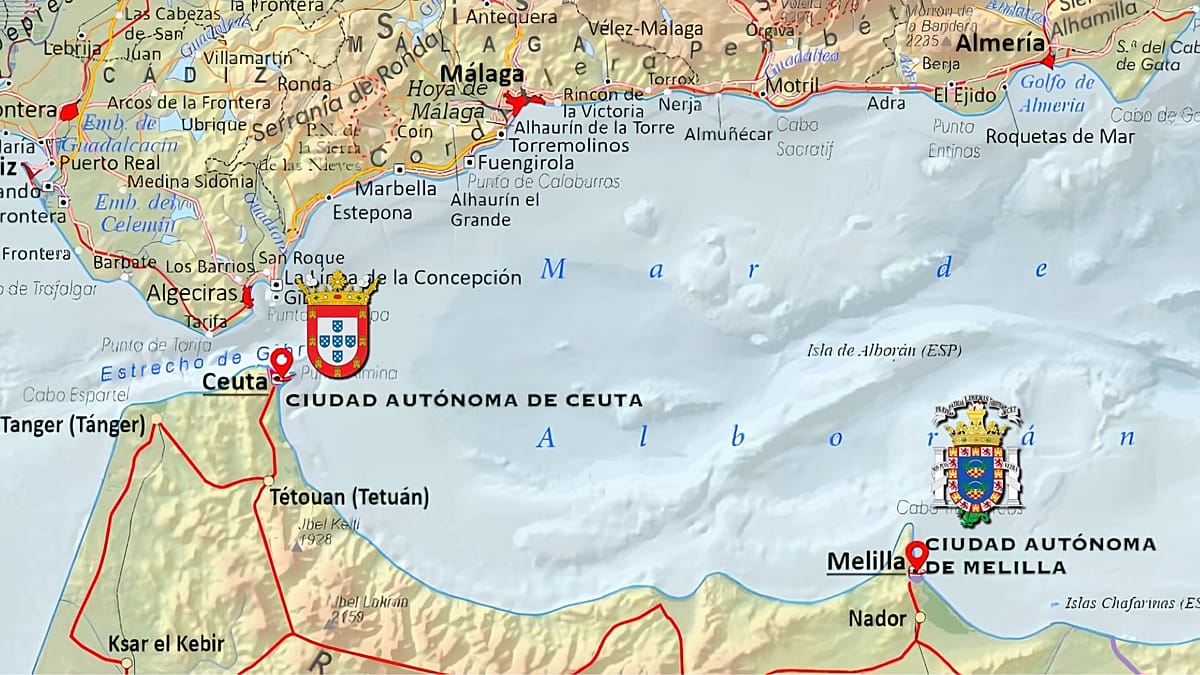
When Spain's Defence Minister Margarita Robles declared that Ceuta and Melilla are "quintessentially Spanish and untouchable," she was responding to a surge of migrants who stormed the border last July. Her words reflect a sovereignty dispute that periodically resurfaces, driven by Moroccan claims and migratory pressures. Yet the narrative that these two cities are "colonial remnants" is contradicted by history, international law, and the United Nations itself.
A history that predates colonialism
To understand why Ceuta and Melilla are Spanish, one must look back to the 15th and 16th centuries, a time when the modern concept of colonialism did not exist. Melilla was incorporated into the Crown of Castile on 17 September 1497, following an expedition led by Pedro de Estopiñán, authorised by the Catholic Monarchs, Isabella and Ferdinand. The objective was defensive: to secure the Strait of Gibraltar and protect the Iberian coast from Barbary piracy.
Ceuta's path was different. It was conquered by Portugal in 1415, and came under Spanish sovereignty in 1580 through the dynastic union under Philip II. When Portugal regained independence in 1640, Ceuta chose to remain with Spain, a decision ratified in the Treaty of Lisbon in 1668. Both cities have now been Spanish for between 358 and 529 years, uninterrupted, and have never been part of the Moroccan state.
Morocco's existence at the time
Critically, the Moroccan state as we know it did not exist when these cities were incorporated. The Alaouite dynasty, which rules Morocco today under Mohammed VI, only began in 1666. That means Melilla had been Castilian for over 160 years before the founding of the dynasty that underpins modern Morocco.
The 19th-century expansion nuance
Historians point out that about 90% of the current urban area of both cities stems from territorial extensions during the 19th and early 20th centuries, coinciding with European expansion in Africa and the Spanish Protectorate in Morocco (1912-1956). However, these extensions were formalised through border treaties, and the original sovereignty was established centuries earlier. Neither Ceuta nor Melilla ever formed part of the Protectorate; they remained national territory under full Spanish sovereignty throughout.
The UN's position
The strongest legal backing for Spain's position comes from the United Nations. In 1975, Morocco formally requested that Ceuta and Melilla be added to the UN's list of "territories pending decolonisation"—a list that includes Western Sahara, which Morocco occupies. The UN rejected the request. To this day, the UN does not consider them colonies, and strategic allies like the United States formally recognise them as part of Spain's sovereign territory.
Since 1995, Ceuta and Melilla have been Autonomous Cities, fully integrated into the European Union and represented in the Spanish Congress and Senate. Their status is not a colonial relic but a permanent part of Spain's territorial integrity.
As migration pressures continue, the debate over these enclaves is unlikely to fade. But the legal and historical record is clear: Ceuta and Melilla are Spanish, and no amount of political rhetoric can change that.