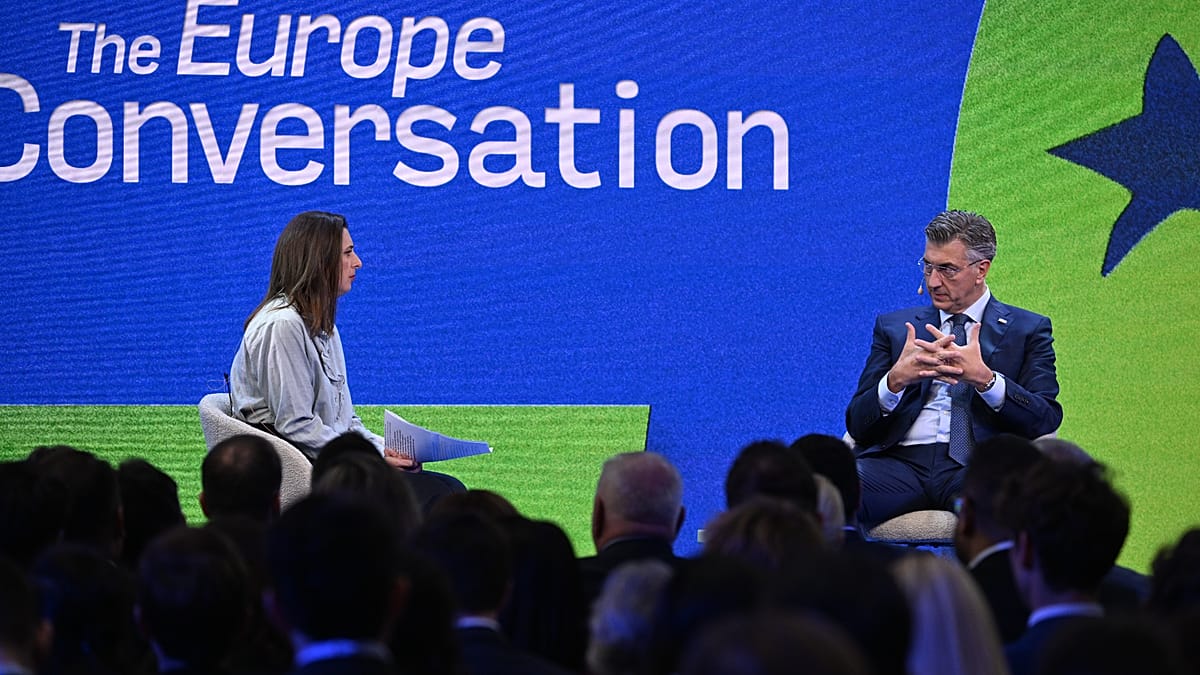
Speaking at the Euronews Enlargement Summit in Brussels on Tuesday, Croatian Prime Minister Andrej Plenković issued a stark warning: France's next presidential election, scheduled for 2027, could fundamentally disrupt the European Union's plans to admit new members.
Plenković pointed to the strong polling performance of Eurosceptic candidates on both the far right and far left, including Marine Le Pen and Jean-Luc Mélenchon, as a sign that the political climate in Paris may turn against further expansion. "The political events may affect the enlargement more substantially than anybody can imagine today," he said, adding that "some of the electors and parties are clearly opposing the process."
His remarks come at a delicate moment for the EU's enlargement agenda. Nine countries are currently in various stages of accession negotiations: Albania, Bosnia and Herzegovina, Georgia, Moldova, Montenegro, North Macedonia, Serbia, Turkey, and Ukraine. The bloc has sought to reinvigorate the process, but Plenković's comments highlight the fragility of that momentum.
France's constitutional hurdle
Beyond the rise of Euroscepticism, Plenković drew attention to France's constitutional requirements for approving new members. Under French law, EU enlargement treaties generally require a referendum. However, an alternative path exists: ratification by a three-fifths majority in the French Congress, a joint session of both parliamentary chambers.
That parliamentary route, Plenković suggested, could prove just as difficult given the deep political divisions in the country. He recalled the 2005 referendum on the European Constitution, which French voters rejected. In his view, that episode demonstrated how voters can be "manipulated" by "false information" and may cast their ballots based on "the current situation in France" rather than the merits of the question at hand.
Plenković's warning is not merely theoretical. A change of leadership in the Élysée in 2027 could alter the entire trajectory of enlargement, he argued. "The political events may affect the enlargement more substantially than anybody can imagine today," he reiterated.
Unrealistic timelines
The Croatian prime minister also questioned the ambitious timelines set by some candidate countries. Montenegro hopes to join by 2028, Albania aims to conclude negotiations by the end of 2027, and Moldova has set its sights on early 2028. Plenković called this timetable "not very smart," noting that "something always unpredictable happens and things get postponed."
His skepticism reflects a broader debate within the EU about the pace and conditions of enlargement. Some member states, particularly in the Western Balkans, have grown frustrated with the slow progress, while others worry about admitting new members before they meet all criteria.
The summit in Brussels, which brought together leaders from candidate countries and EU officials, was part of a renewed push to keep enlargement on the agenda. But Plenković's intervention serves as a reminder that the process is as much about internal politics as it is about the readiness of applicants.
As the EU navigates this complex landscape, the outcome of the French election will be closely watched. For now, Plenković's message is clear: the road to enlargement is long, and the obstacles are not only in the Balkans or Kyiv, but also in the heart of Western Europe.