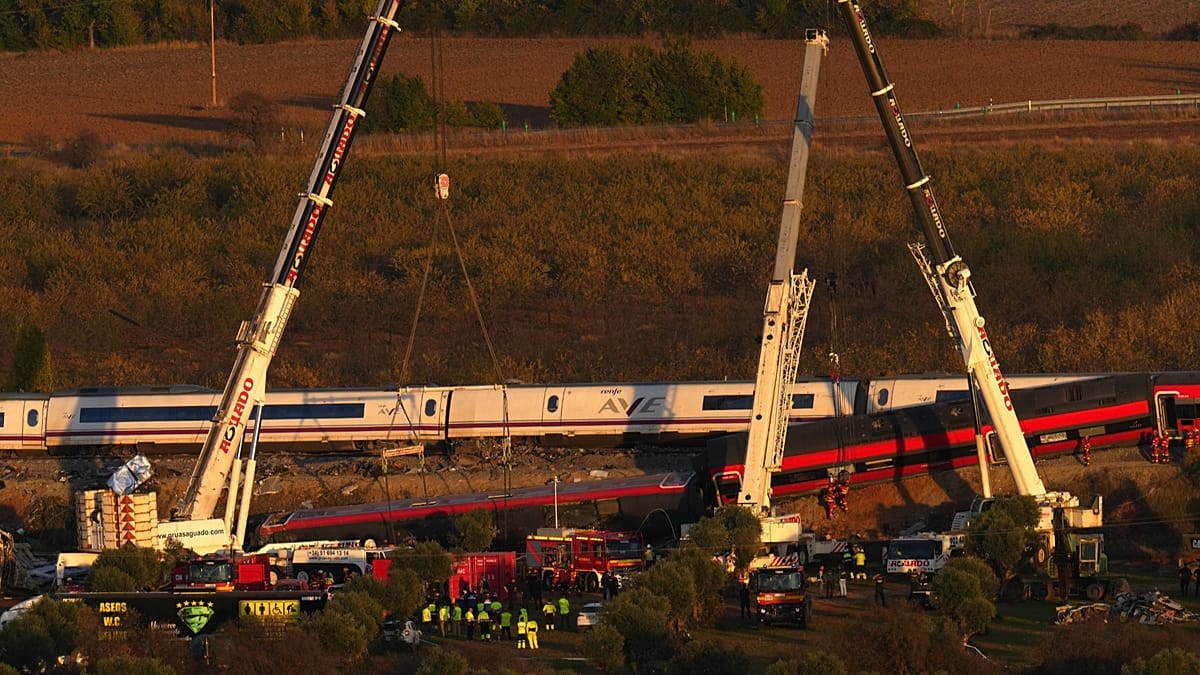
Spanish authorities have confirmed the identities of all 69 people killed in last week's high-speed train collision near the central village of Urda, bringing a painful chapter of uncertainty to a close for the victims' families. The announcement came late Monday from the legal body overseeing the identification process, which had been working around the clock to match remains, sometimes from individual body parts.
The three latest victims confirmed were two Australians and a Japanese citizen, according to the joint police and forensics team. The full list of the deceased includes 54 Spanish nationals and 15 foreigners: four US citizens, two Australians, two Japanese, and one each from Argentina, Canada, France, Mexico, Portugal, Tunisia, and the Czech Republic.
The crash, which occurred on Wednesday, has been described as one of Europe's deadliest rail accidents this century. It happened when a Renfe-operated service ploughed into the back of a stationary Iryo train just outside Urda, roughly 130 kilometres south of Madrid. The collision raised immediate questions about the safety of Spain's high-speed network, especially after a separate crash in Andalusia in January that killed 46 people.
Safety system failure and control centre decision
Investigators have revealed that an automatic safety system failure halted all trains on a 63-kilometre stretch of track. However, a control centre authorised the Renfe service to resume its journey while the other train was still stationary on the line. That decision is now under scrutiny as part of the official inquiry.
The tragedy has prompted a swift political response. Transport Minister Óscar Puente told a press conference on Tuesday that Spain would work "tirelessly" to restore public confidence in high-speed rail travel. He also announced a €30 million aid package for the families of the dead and the dozens of injured passengers.
"We pledge to work tirelessly to achieve and regain the public's trust in high-speed rail," Puente said, as he presented a series of new safety measures. These include enhanced training for control centre staff, additional redundancies in the signalling system, and a full audit of all high-speed lines.
The accident has also reignited a broader debate about rail safety across Europe. Unions have called for an overhaul of the sector, arguing that privatisation and cost-cutting have eroded safety margins. Unions push for rail safety overhaul as they demand greater investment in infrastructure and stricter oversight of private operators.
For the families of the victims, the identification process has been agonising. Many waited days for confirmation, with forensic teams working in difficult conditions. The confirmation of the final three victims brings some closure, but the emotional toll remains immense.
The crash has also cast a shadow over Spain's political landscape. It comes just one month before a general election scheduled for 29 November, in which Socialist leader Pedro Sánchez will seek to overcome unfavourable polls and extend his eight-year premiership. The government's handling of the disaster and its aftermath is likely to be a key issue in the campaign.
In the meantime, the village of Urda and the surrounding region of Castilla-La Mancha are in mourning. Memorial services have been held, and flags have flown at half-mast across the country. The Czech and US victims have been remembered in their home countries, with diplomatic missions offering support to their families.
As Spain begins to grapple with the aftermath, the focus is on ensuring such a tragedy never happens again. The transport ministry has promised a comprehensive review of safety protocols, and the judiciary has opened a formal investigation into the crash. The coming weeks will be critical in determining whether the reforms go far enough to restore public trust.
For now, the nation mourns. The high-speed rail network, once a symbol of Spanish modernity, now carries the weight of this disaster. The road to recovery will be long, but the commitment to safety is clear.