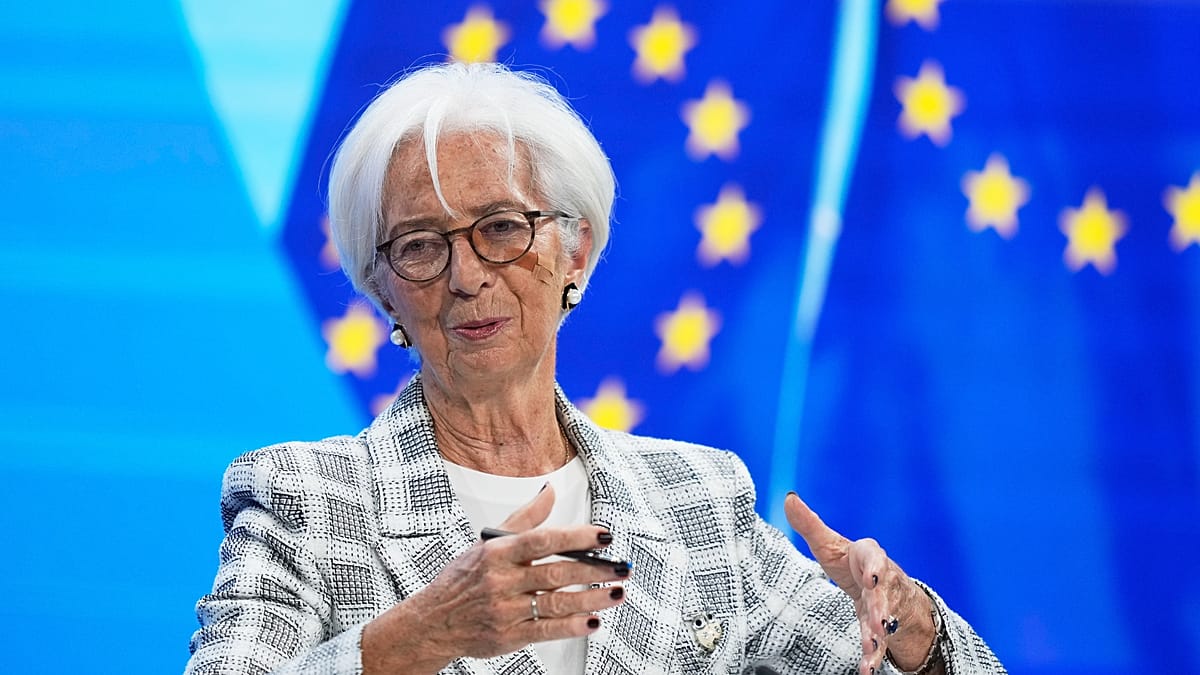
The formal contest to lead the European Central Bank is now under way. Eurozone governments have until Friday to put forward candidates to replace Christine Lagarde, and the bloc's finance ministers will assess the nominations at their next meeting on 9 November, a Eurogroup spokesperson confirmed.
The procedure was triggered after Lagarde informed European Council President António Costa of her intention to step down early. According to the spokesperson, the Council of the EU has initiated the appointment process, which involves a recommendation from EU leaders and national ministers. Only eurozone countries vote on the recommendation, which is why the Eurogroup, chaired by Greek Finance Minister Kyriakos Pierrakakis, is handling the initial screening. Pierrakakis has asked member states to submit their choices by Friday, and the Eurogroup will take stock on 9 November.
To succeed, a candidate must secure the backing of at least 16 of the 21 eurozone countries, representing at least 65% of the bloc's population. After the Eurogroup's input, EU leaders will make the final decision, following opinions from the European Parliament and the ECB's Governing Council.
Why Lagarde is leaving early
Lagarde announced last week that she would leave on 7 February 2027, cutting her eight-year term short by nearly nine months. Speaking in Frankfurt, she said the early exit would allow her to speak freely beyond monetary policy. "I don't think that I can remain neutral," she said. "I'm interested in the truth, and I see the truth being very often damaged, contradicted by misrepresentation." She declined to comment on whether she would endorse a candidate in France's presidential election in April 2027.
As reported earlier, her timing has been linked to the French vote, with an early departure giving President Emmanuel Macron and German Chancellor Friedrich Merz a say in her replacement while the far right polls strongly. Lagarde promised "perfect continuity of business," describing the ECB as "solid, strong like a rock." The central bank kept its deposit rate at 2.5% on the same day, and she will chair two more rate-setting meetings in December and February.
The frontrunners
Two names dominate the race, both publicly backed by their governments in September. One is Pablo Hernández de Cos, general manager of the Bank for International Settlements (BIS) and former governor of the Bank of Spain. Spanish Prime Minister Pedro Sánchez endorsed him in a Bloomberg interview, marking Spain's first-ever bid for the ECB presidency. Unusually, opposition leader Alberto Núñez Feijóo also backed him in October.
The other main candidate is Klaas Knot, who led the Dutch central bank for 14 years until 2025. Dutch Prime Minister Rob Jetten told Bloomberg that Knot would be a "perfect fit" for many countries. Prediction markets reflect a two-horse race: on Kalshi, Hernández de Cos has a 34% chance and Knot 31%, while on Polymarket the gap is wider at 41% and 30% respectively. Former Bank of France governor François Villeroy de Galhau trails at 5% and 13%, and Bundesbank President Joachim Nagel has also been mentioned, though no German has ever led the ECB.
The presidency is only part of the negotiations. Germany's Isabel Schnabel, who oversees market operations, departs for the IMF on 3 January, and Irish chief economist Philip Lane's term ends in May. With half of the six-member Executive Board changing within five months, capitals are expected to bargain over the three posts as a package. The race also comes amid diverging inflation across the eurozone, with Italy's rate hitting 5.4%, and France's economy contracting again, adding pressure on the next president to balance price stability with growth.