Spanish authorities have confirmed that a Czech national and four US citizens were among the 69 people killed in last week's high-speed train collision near Toledo. The announcement brings the number of identified foreign victims to 15, including citizens of France, Portugal, Canada, Japan, Argentina, Mexico, and Tunisia.
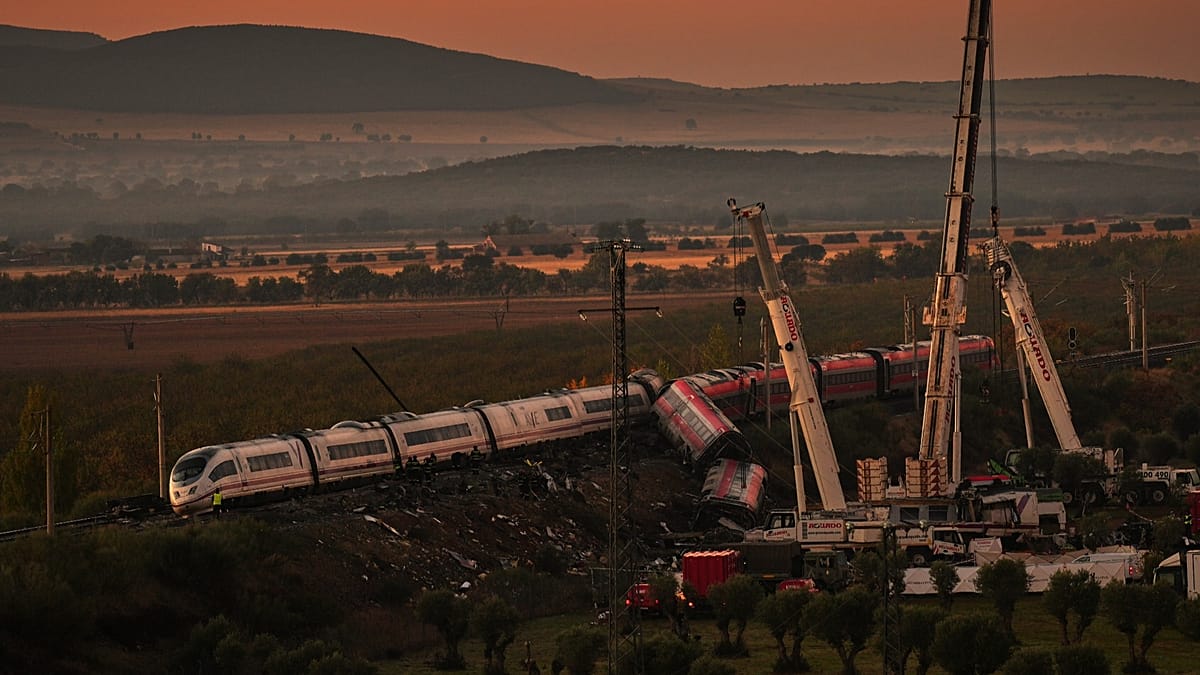
The crash, which occurred on Wednesday, is one of Europe's deadliest rail accidents this century. It happened when a Renfe-operated high-speed train ploughed into the rear of a stationary Iryo service near the village of Urda, about 130 kilometres south of Madrid. The impact left carriages mangled and scattered across the tracks, triggering a massive emergency response.
Forensic teams have been working around the clock to identify the dead, sometimes relying on DNA from individual body parts. A joint police and forensics body set up to handle the identification process said late Sunday that 66 of the 69 victims have now been identified. Three reports for missing people remain active, concerning two Australians and one Japanese citizen, whose families have expressed a wish to travel to Spain for in-person identification.
Rail safety under renewed scrutiny
The disaster has raised fresh questions about Spain's rail safety record, coming just months after a separate high-speed crash in Andalusia in January killed 46 people. That earlier accident had already prompted calls for a thorough review of the country's high-speed network, which is among the most extensive in Europe.
According to preliminary investigations, the latest collision occurred after an automatic safety system failed, halting all trains on a 63-kilometre stretch of track. A control centre then authorised the Renfe service to resume its journey, unaware that the Iryo train was still stationary ahead. Investigators are now examining why the safety system did not prevent the Renfe train from proceeding.
The tragedy has also intensified union demands for a rail safety overhaul, with workers and experts calling for better maintenance of automatic protection systems and stricter protocols for control centres. Spain's rail operator Renfe and infrastructure manager Adif have both pledged full cooperation with the investigation.
For the families of the victims, the wait for confirmation has been agonising. Many have travelled to Toledo, where a religious residence has been set up as a gathering point for relatives seeking information. The identification process has been complicated by the severity of the impact, which left many bodies unrecognisable.
Among those confirmed dead is a Cambridge scientist, whose death has been reported by colleagues and friends. The broader international toll underscores the popularity of Spain's high-speed rail network among tourists and business travellers alike.
Political fallout ahead of elections
The disaster comes at a politically sensitive time for Spain. Prime Minister Pedro Sánchez, leader of the Socialist Party, faces a general election on 29 November, with polls suggesting he may struggle to extend his eight-year tenure. The crash has already become a talking point in the campaign, with opposition parties criticising the government's handling of rail safety.
Analysts say the tragedy could further complicate Sánchez's re-election bid, as voters question whether enough has been done to prevent such accidents. The government has declared three days of national mourning, and King Felipe VI and Queen Letizia visited survivors in hospital over the weekend.
As Spain mourns, the broader European rail community is watching closely. High-speed rail is often touted as a green alternative to short-haul flights, and incidents like this could affect public confidence in the mode of transport. The European Union has already signalled its intention to review safety standards across member states, though any new regulations are unlikely to be in place before the end of the year.
For now, the focus remains on the victims and their families. The identification process is expected to conclude in the coming days, allowing funerals to take place. But the questions raised by this tragedy — about technology, oversight, and accountability — will linger long after the last body is laid to rest.