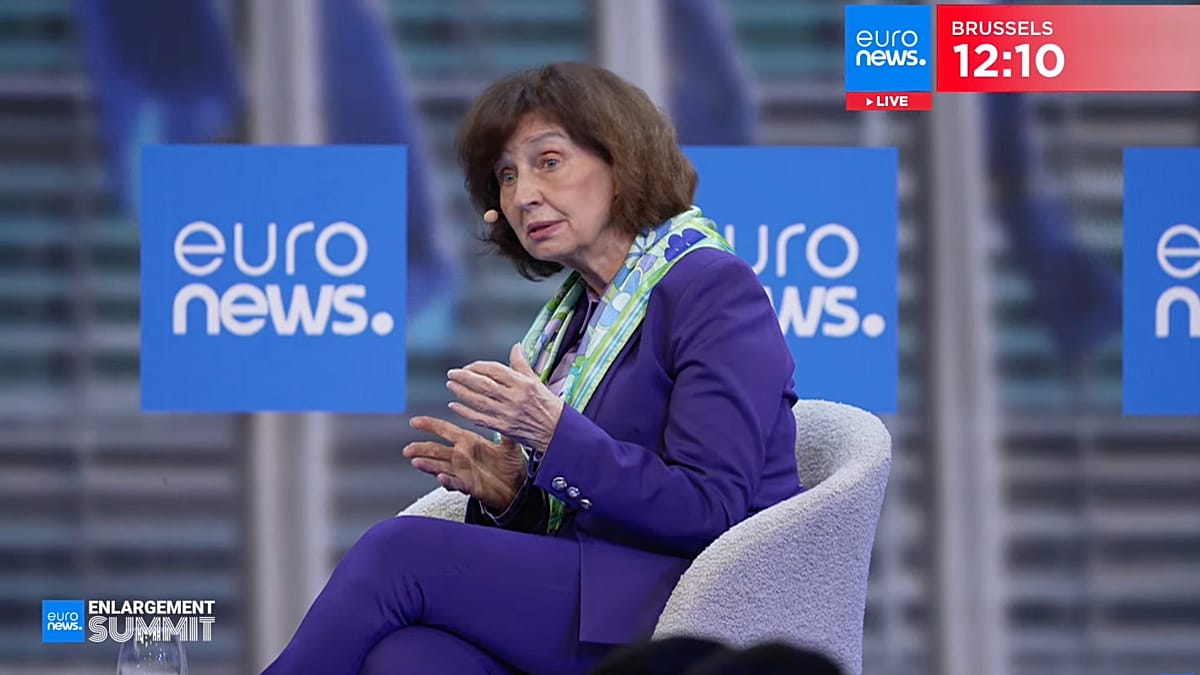
North Macedonia's President Gordana Siljanovska-Davkova has accused Bulgaria of holding her country's EU accession hopes hostage, as Sofia continues to demand constitutional changes that would explicitly recognise a Bulgarian minority in the Balkan state.
Speaking on the sidelines of the Euronews Enlargement Summit on Tuesday, Siljanovska-Davkova said Skopje had already amended its constitution 26 times, often under external pressure. “We are champions at changing the constitution – 26 times – most of the amendments are imposed,” she said.
The president, who took office in 2024, argued that further concessions cannot be made without the backing of the public. “My legitimacy derives from the citizens and belong to them. So how can I promise you that we will change the Constitution?” she asked.
A long-standing bilateral dispute
At the heart of the dispute is a demand from Bulgaria that North Macedonia amend its constitution to list Bulgarians among the country's recognised communities. This was part of a compromise brokered by France in 2022 to unblock the EU accession process, but it has met with strong resistance in Skopje.
Amending the constitution requires a two-thirds majority in the parliament, a threshold the current government has not been able to reach. Siljanovska-Davkova said that 80% of citizens oppose the changes, and that the proposed amendments have not even passed the first stage in the parliamentary constitutional commission.
The president said the main obstacle to European integration is not a lack of reforms or compliance with EU requirements, but what she described as a lack of political will among neighbouring countries.
North Macedonia, a country of about 1.8 million people, has been governed since mid-2024 by a conservative-led coalition with a solid parliamentary majority. Yet its EU path remains blocked by the long-running dispute with Bulgaria, which has been a member of the bloc since 2007.
Skopje first applied for EU membership in 2004 and became an official candidate in 2005, but progress has been repeatedly hampered by political setbacks.
Siljanovska-Davkova framed the current dispute as part of a longer history of concessions made in pursuit of EU membership. She pointed to the 2018 agreement with Greece, under which the country changed its name from Republic of Macedonia to North Macedonia, ending a decades-long dispute that had blocked its NATO and EU ambitions.
The latest constitutional demand raises questions about how far a candidate country should be expected to go to satisfy bilateral disputes before joining the bloc, she said.
Despite the tensions, Siljanovska-Davkova said she intends to keep pursuing a solution through dialogue. “I have met previous presidents and the current prime minister several times [...] I expressed the same feelings and the same tension, and I will continue to do that only through dialogue,” she said.
She stopped short of directly accusing Bulgaria of deliberately obstructing accession, instead calling for “pragmatism” and “greater political willingness” among neighbouring countries.
The standoff is a reminder of how bilateral disputes can stall the EU's enlargement process, a challenge that also affects other Western Balkan candidates. As the bloc seeks to reinvigorate its enlargement policy, the question of how to balance national interests with the collective goal of European integration remains unresolved.