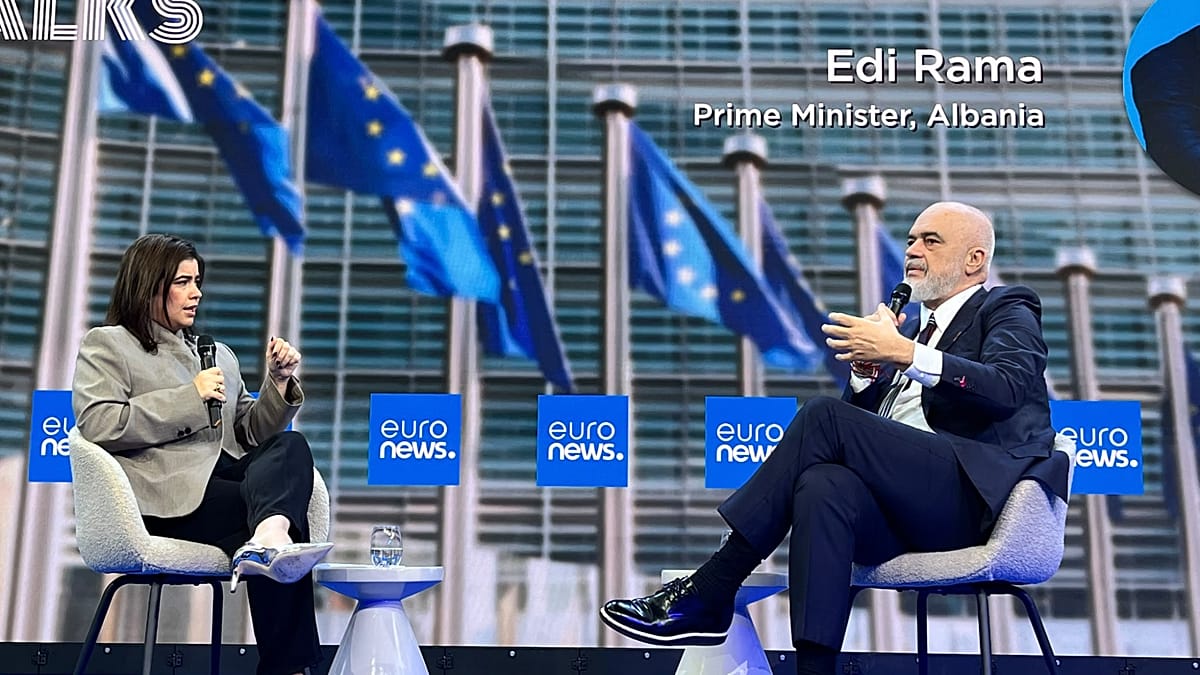
Albanian Prime Minister Edi Rama has cast doubt on any imminent shift in Serbia's position on Kosovo, saying the country's new leadership remains firmly opposed to recognizing the breakaway territory. Speaking at the Euronews Enlargement Summit in Brussels, Rama said the Student List, which won Serbia's recent election, shows no willingness to engage on what he called the "dearest subject" to Albanians.
"They are completely closed towards recognizing Kosovo, so this means that the music in Belgrade will not change," Rama told the gathering of EU officials and regional leaders.
Kosovo declared independence from Serbia in 2008 and applied for EU membership in 2022. But the Serbian student movement, like nearly all political forces in the country, regards Kosovo as an "inalienable part of the Republic of Serbia" and rejects any move toward recognition. The dispute remains a major stumbling block on Serbia's path to EU accession, with Brussels long pressing for a "normalisation of relations" between Belgrade and Pristina as a key step toward easing regional tensions.
Rama also took aim at Serbia's reluctance to align with other EU policies, notably the bloc's sanctions against Russia. "We need Serbia with us, as part of a neighbourhood that should be a whole part of the EU. But Serbia has to deserve that belonging, by delivering in full what is non-negotiable," he said.
Albania's own EU bid
Turning to Albania's accession process, Rama stopped short of setting a firm membership deadline but reaffirmed his commitment to concluding negotiations by the end of 2027. Albania has been a candidate country since 2014 and formally opened talks in 2020. It is considered the second closest to joining the EU after Montenegro, though the process remains far from complete.
"I have seen how the EU is able to not deliver in its promises; I have seen how the EU is able to deliver much more than you expect. So with the EU you never know," Rama said, reflecting the uncertainty that surrounds enlargement.
While defending enlargement as a merit-based process and acknowledging that his country still faces challenges before it is ready, Rama invoked a "Helmut Kohl moment" for expanding the EU, referring to the chancellor who unified Germany. "Europe needs to bring everyone around a table as part of the same family," he said.
Rama, who has previously called for the partial integration of candidate countries into the EU as an intermediate step, compared them to the children of European Commission President Ursula von der Leyen, who need to "stay around the table."
"If you leave the kids in the neighbourhood, then your daughter will not come anymore at home because she falls in love with a Russian gangster and your boy...because he would like to play with Chinese toys," he said, continuing the same metaphor.
Rama also took a swipe at the United Kingdom, which is seeking to reset relations with Brussels a decade after the Brexit referendum. His comments come as the EU grapples with the broader challenge of enlargement, with Montenegro, Albania, and Ukraine pressing for entry at the same summit.
The Albanian leader's remarks underscore the persistent divisions in the Western Balkans, where the Kosovo issue remains a key obstacle to regional stability and EU integration. As Brussels pushes for progress, the question of whether Belgrade can be persuaded to change course remains open, but Rama's assessment suggests little hope for a breakthrough in the near term.