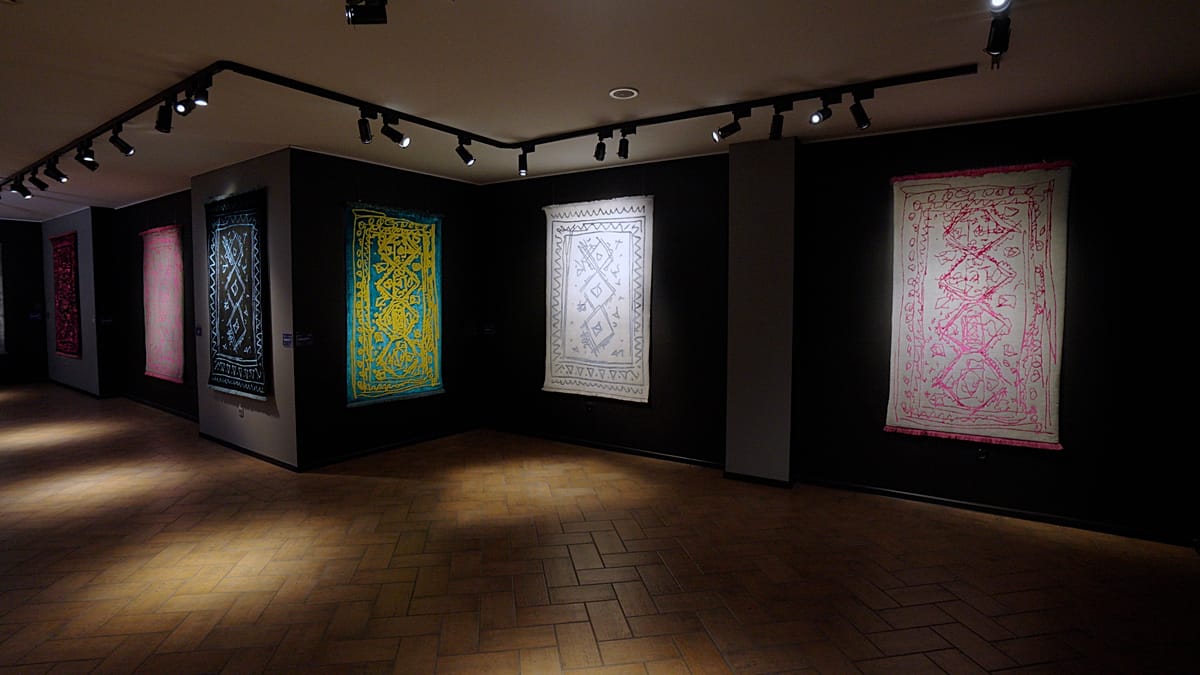
How does a carpet become a canvas for contemporary expression? What happens when a painter trades a brush for a syringe? And can a photograph freeze a moment of beauty and destruction that the human eye would miss? These questions were explored at the "Fly to Baku" art weekend, a gathering that brought together painting, sculpture, photography, digital art, and film in the Azerbaijani capital.
Artists from Azerbaijan and beyond converged in Baku, presenting works that ranged from reimagined Karabakh carpets to experimental canvases. The event, held across venues including the Azerbaijan National Museum of Art and the Museum of Modern Art, offered a platform for creative dialogue between tradition and innovation.
Nature as a Central Theme
Nature emerged as a recurring motif, with a focus on the Caucasus region's biodiversity. The "Wild Five"—the Eastern imperial eagle, Caucasian leopard, grey wolf, goitered gazelle, and brown bear—were featured as a reminder of the area's rich fauna and the urgent need for conservation. The inclusion of these species underscored the event's environmental consciousness, a theme that resonated through several installations.
Dutch-Canadian artist Ryan Koopmans explored the intersection of architecture and nature in his digital images. His photographs depict abandoned buildings gradually overtaken by vegetation, with trees and plants reclaiming spaces once shaped by human hands. "The message I want to portray is the cyclical nature of time," Koopmans explained. "Architecture takes the place of the natural world, and then nature slowly takes over the architecture, and the cycle continues." His work also drew inspiration from Azerbaijan's architectural landscape, where Azerbaijani, Persian, Ottoman, and Soviet-era influences converge.
Tradition Reimagined
Azerbaijani artist Farid Rasulov, born in Shusha, grew up surrounded by Karabakh carpets, particularly those adorned with images of animals and plants. His series Karabakh Carpets 2.0 breathes new life into this traditional craft. "I was born in Karabakh, and from my childhood I was playing on these carpets," Rasulov said. "After so many years, I became an artist and decided to make new types of these carpets." For him, tradition is not static: "Tradition is not something frozen in the past, but something that can evolve and develop."
Sculptor Aydan Salahova, who divides her time between Italy and Azerbaijan, drew on the legend of Baku's Maiden Tower for her installation. Rather than retelling the familiar story, she imagined a woman flying away in search of freedom. "This project is about choice, how to live, how to find freedom," Salahova said. Working with Carrara marble in Italy and local Aglay limestone in Azerbaijan, she noted that "different materials and different textures need different languages."
Unconventional Techniques
Chinese artist Zhang Ji took an unconventional approach, using syringes instead of brushes to apply paint to his canvases. His work also incorporated architectural patterns from religious traditions around the world, without singling out any particular belief. Zhang does not expect viewers to analyze every reference: "I just want you to feel it." He sees art as a form of communication that transcends language: "People from different countries and different cultures can understand art through experience, not through translation."
London-based photographer Ori Gersht used his camera to capture fleeting moments beyond ordinary human perception, exploring the relationship between beauty and destruction. "I find that beauty and destruction are interconnected," he said. "Every moment of destruction is also a potential new creation." His work, such as the striking Pomegranate series, highlights how technology can reveal details invisible to the naked eye.
The weekend also featured film, including a screening of Europe's Last Leopard, a documentary by Harriet Pratten that tells the story of the Caucasian leopard, one of the region's most elusive predators. The film underscored the event's conservation message, linking art to the broader European concern for biodiversity.
Baku Art Weekend demonstrated that artistic licence knows no bounds, whether through reimagined carpets, syringe-painted canvases, or photographs of nature reclaiming human structures. As Europe grapples with cultural preservation and environmental challenges, such events offer a space for reflection and innovation.