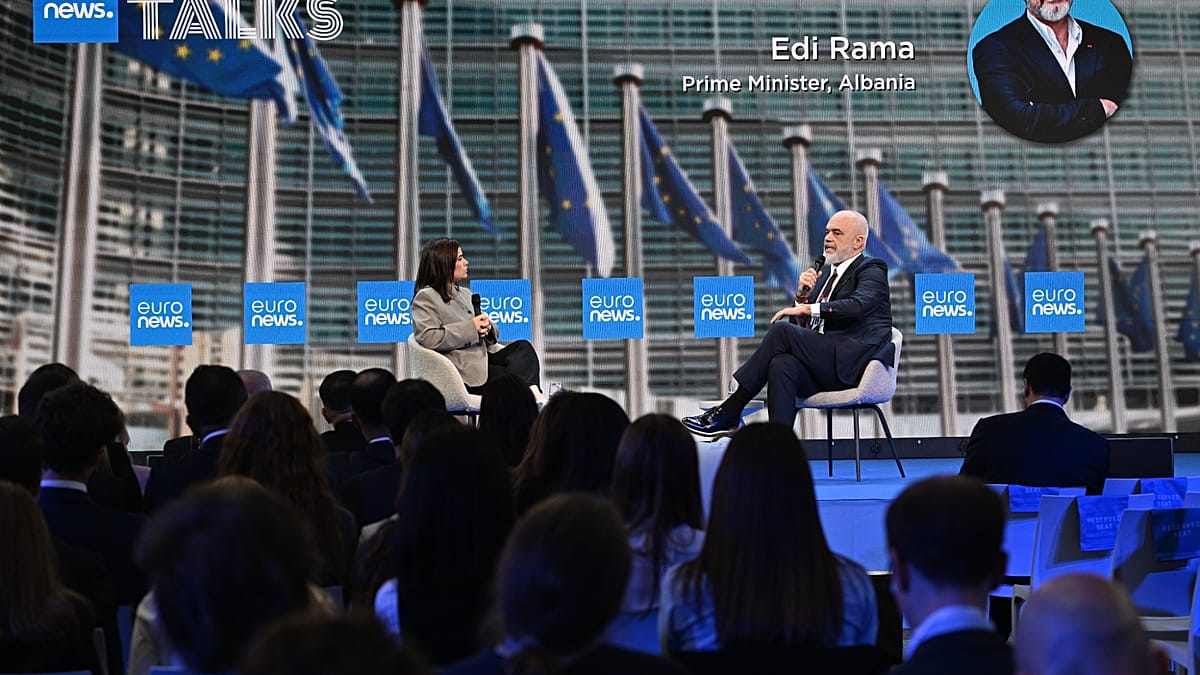
Albanian Prime Minister Edi Rama has indicated that the migration agreement with Italy could remain in force beyond its current term, should Rome ask for an extension. Speaking at the Euronews Enlargement Summit in Brussels, Rama sought to quell speculation that the centres in Albania might close when the partnership expires in 2028.
The deal, signed in 2023, allows Italy to transfer irregular migrants to Albania while their asylum claims are processed or ahead of deportation. It effectively moves part of Italy's migration management outside the European Union's borders, a model that has drawn both criticism and interest from other member states.
Rama ties deal's future to Meloni
Rama was unequivocal about the arrangement's longevity. "The deal will stay for as long as need be," he said, adding that it would remain in force as long as Giorgia Meloni is prime minister. In a light-hearted exchange with moderator Maria Tadeo, he joked: "So [it could be] 2030, 2040, 2050, until she will be prime minister in Italy."
The Albanian leader also brushed aside questions about the deal's significance, saying it was not "such a huge deal to occupy the minds in Europe." His comments come as the European Union recently approved legislation that permits member states to establish return hubs outside the bloc, with at least five countries now exploring similar arrangements with non-EU partners.
However, the future of the Italian-Albanian centres is complicated by Albania's EU accession ambitions. If Albania were to join the bloc, the facilities would no longer be outside EU territory, potentially undermining their purpose. Rama, who has been a vocal advocate for Albania's EU entry, did not directly address this contradiction.
Costs and legal hurdles
The two centres, located in Shëngjin and Gjadër, were initially designed to hold asylum seekers rescued at sea while Italian authorities reviewed their applications. But repeated legal setbacks forced Meloni's government to repurpose them in March 2025, turning them into detention facilities for irregular migrants already in Italy who are awaiting deportation.
Despite the changes, the centres currently hold fewer than one hundred migrants, according to media reports, as the Italian government does not release official figures. An investigation that won the European Parliament's Daphne Caruana Galizia Prize for Journalism found that Italy had spent roughly €1 million per person held during the first two years of operation.
The high costs and alleged human rights violations have sparked controversy in Italy, where the deal has been a flagship policy of Meloni's right-wing government. Critics argue that outsourcing migration management to a non-EU country undermines fundamental rights and sets a dangerous precedent.
Rama, however, downplayed such concerns, framing migration as a broader civilisational challenge for Europe. "Stricter laws will not be enough to manage it," he said, suggesting that the continent needs a more comprehensive approach.
The deal's extension would also have implications for Italy's domestic politics. Meloni's government has faced pressure over its handling of migration, and the agreement with Albania has been a key part of its strategy. With Italy on edge over living costs and other issues, the migration pact remains a politically sensitive topic.
As the 2028 renewal date approaches, the question of whether the centres will remain open is likely to persist. Rama's comments suggest that, at least from Albania's side, there is no intention to terminate the deal. But the ultimate decision, he implied, rests with Rome.