For more than a decade, the Levant has been a theatre of war, displacement, and shattered trust. Now, a group of Syrian intellectuals living in Europe is proposing a different kind of intervention: one that starts not with sanctions or military aid, but with culture and infrastructure. Their argument, put to the European Union, is that rebuilding ancient civilisations could be the foundation for a broader political stabilisation.
Nabil Al Lao, a Syrian linguist and musicologist who founded the Damascus Opera House and now lives in Italy as a refugee, is one of the leading voices behind the proposal. He argues that EU member states—particularly France, Germany, Italy, and Spain—already possess the tools to launch a cultural policy in the Levant with immediate, visible impact. “The EU countries have the tools to launch a cultural policy in the Levant with an initial, visible impact that could evolve into a concrete, broader political process,” Al Lao told Euronews.
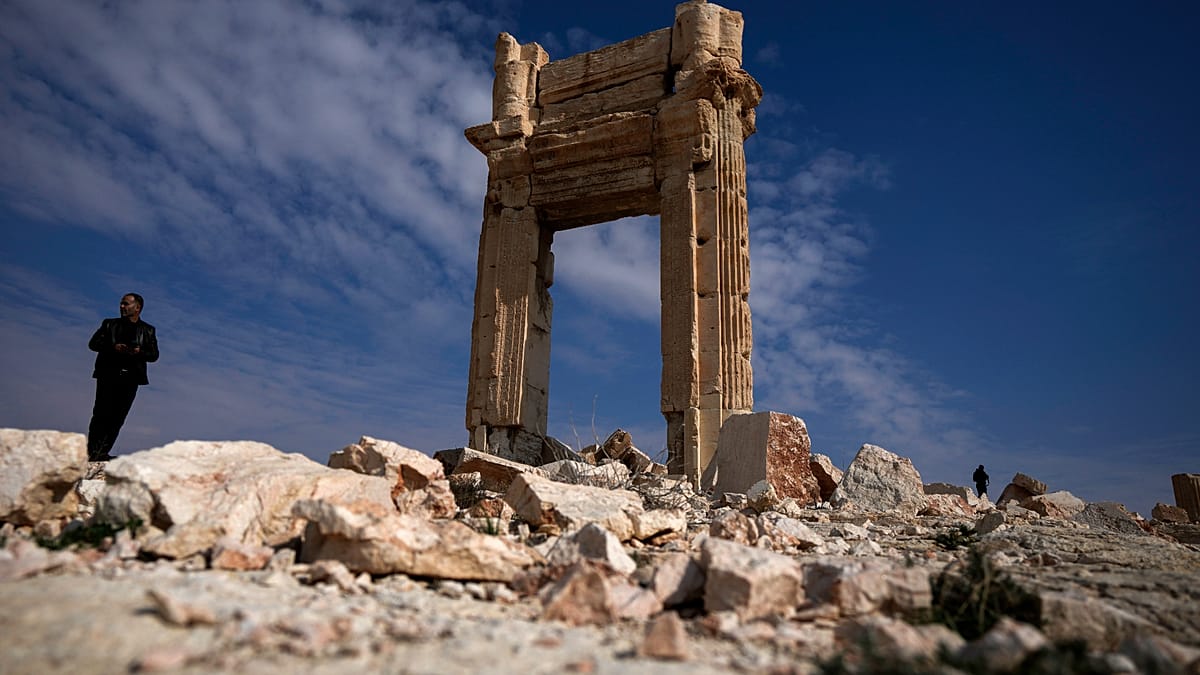
The strategy goes beyond traditional cultural diplomacy. Its aim is to transform the theatre of war into an archaeological landscape, linking the recovery of cultural heritage with civil infrastructure projects. This, Al Lao and his colleagues believe, could engage populations exhausted by years of conflict and help heal the mutual mistrust that remains after the fall of the Assad dynasty regime in late 2025.
A Life Between Cultures
Al Lao’s own biography reflects the complexity of the region. He served as the official French-language interpreter for Hafez al-Assad and later for his son Bashar. He participated in bilateral meetings with French presidents Jacques Chirac and Nicolas Sarkozy. He remembers Chirac as “a man of great culture and profound political refinement.” It was Al Lao who translated into Arabic the live conversation in which Chirac urged Bashar al-Assad not to kill former Lebanese Prime Minister Rafiq Hariri. Despite the warning from the Élysée, Hariri was assassinated in 2004 in Beirut, an attack widely attributed to Syrian intelligence. “The deadly attack on Hariri was the regime’s point of no return,” Al Lao says.
In 2004, as superintendent of the Damascus Opera, Al Lao managed to send a group of young Syrian musicians to Ramallah to perform alongside Israeli and Palestinian musicians. The concert was organised by conductor Daniel Barenboim and intellectual Edward Saïd. Al Lao recalls Saïd’s phone call: “He introduced himself, saying he was at the Syrian-Lebanese border. He wanted to meet me in Damascus and simply needed an invitation.” Al Lao replied: “You are welcome, Professor Saïd.” The escapade cost Al Lao a reprimand from Syrian intelligence, but he was protected by the fact that the idea for the orchestra came from King Juan Carlos of Spain, who at the time maintained cordial relations with Bashar al-Assad.
Years later, Al Lao had to flee Syria after falling out of favour with the regime. He was captured in 2013 by men he later discovered were regime security personnel disguised as Islamic State militiamen. “They were regime security men disguised as Islamic State militiamen,” he reveals. “They too took part, directly and indirectly, in the devastation.”
Rebuilding Through Heritage
The reconstruction of ancient Mesopotamian and Levantine culture—which also underpins European civilisation—could become a unifying force for a country made up of multiple ethnicities and religions. “Such a strategy could even bring Syria and Lebanon into a shared project for the first time in more than half a century,” Al Lao says, referring to recent damage to the Greco-Roman archaeological heritage of Baalbek in Lebanon’s Beqaa Valley. The war between Israeli forces and Hezbollah militias has struck not only civilian infrastructure but also ancient stone remains.
For Al Lao, whose father is Syrian and mother Lebanese, a European project extending from Syria to Lebanon would heal old wounds. He suggests the EU could start by restoring the old Damascus–Baalbek railway line, a project that would combine infrastructure with cultural connectivity. The idea echoes broader European efforts to use heritage as a tool for peace, such as the revival of transhumance in the French Alps, which shows how ancient practices can foster community resilience.
The proposal is not merely idealistic. It is a realistic strategy designed to create new civil and political balances in a country struggling to emerge from a bloody inter-communal war. As Al Lao puts it, “The EU could, for example, start by bringing back into operation the old Damascus–Baalbek railway line.” Such a move would signal a commitment to rebuilding not just roads and bridges, but the cultural fabric that holds societies together.