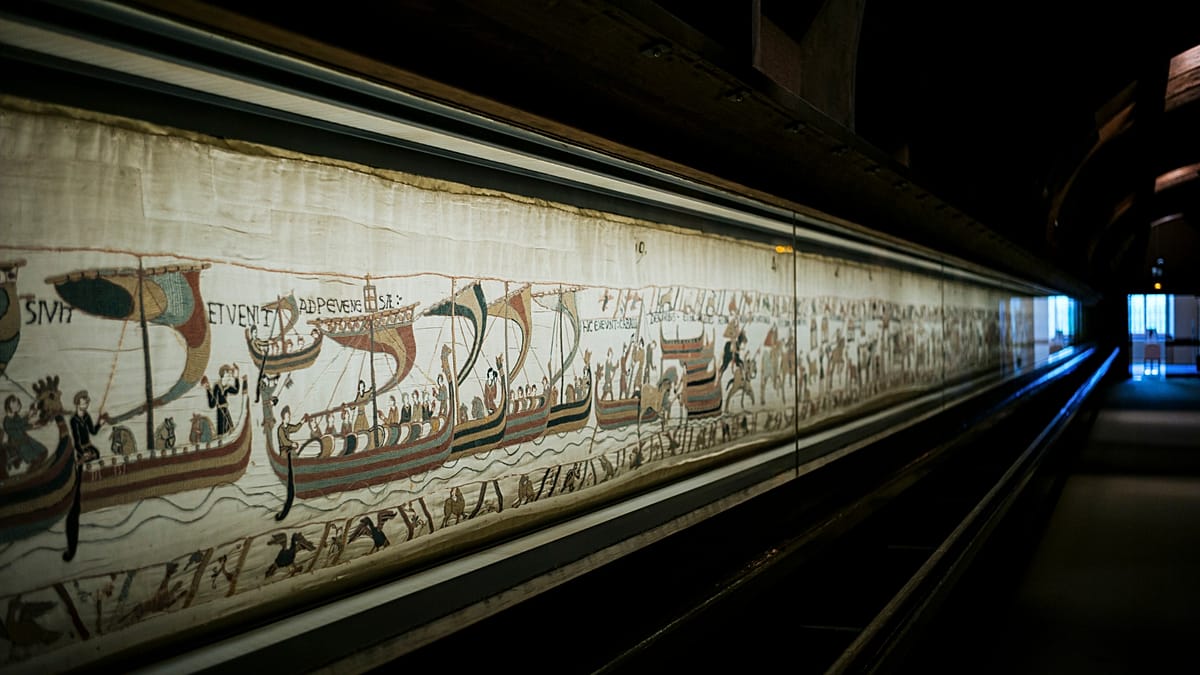
Under cover of darkness and with tight security, the Bayeux Tapestry crossed the English Channel early on Friday morning, arriving at the British Museum in London around 3 a.m. The 11th-century wool embroidery on linen, which chronicles William the Conqueror’s invasion of England in 1066, left its home in Bayeux, Normandy, on Thursday evening after months of careful preparation.
The tapestry had been kept in strict secrecy since September inside the Museum of Art and History, just a short distance from Bayeux Cathedral. Its transfer involved a specially designed double container to minimise vibrations and maintain a constant temperature of 20 °C. Several dozen people oversaw the operation, which took the work from France to the UK in a single night.
A Loan Decades in the Making
This unprecedented loan was first announced by French President Emmanuel Macron in July 2025 as a gesture to revitalise cultural ties with the United Kingdom a decade after Brexit. Writing in The Times, Macron described the tapestry as an unfinished work and said: “It is up to us to write the next chapter, in a spirit of respect, trust and renewed alliance.” He called for the historic Entente cordiale to evolve into an “Entente amicale”.
Previous attempts to bring the tapestry to London — in 1953 for the coronation of Queen Elizabeth II and in 1966 for the 900th anniversary of the Battle of Hastings — both fell through. This time, the UK has pledged £800 million (around €917.9 million) in case of major damage, and will lend France items from the Sutton Hoo treasure — funerary furnishings from a 7th-century Saxon leader — as well as Renaissance drawings. The total cost of transport and exhibition is estimated at €20 million, borne entirely by the British side.
The tapestry will be displayed in the Sainsbury Exhibition Gallery at the British Museum from 10 September 2026 to 11 July 2027. After an acclimatisation period, it will be installed in a controlled environment. Tickets for visits up to January 2027 sold out within a single day, according to the French Ministry of Culture. Standard prices are set at £33. Tickets for the remaining months will go on sale later.
Restoration Plans After Return
When the tapestry returns to France in 2027, it is expected to go back on display at its museum in Bayeux, currently closed for renovations. A long-delayed restoration is planned to begin in 2028, possibly carried out in public view inside the museum to avoid another removal. The tapestry’s journey is a reminder of the deep cultural connections across the Channel, much like the revival of historic venues elsewhere in Europe, such as San Sebastián's historic cinema reborn as a boutique hotel.
The loan also underscores the broader European cultural diplomacy at play. As Macron noted, the tapestry is a shared heritage that bridges France and the UK, a sentiment echoed in other cross-border initiatives, like Von der Leyen's donation of a controversial gift to a Belgian museum. For now, Londoners and visitors alike will have a rare chance to see one of Europe’s most iconic medieval artefacts up close.