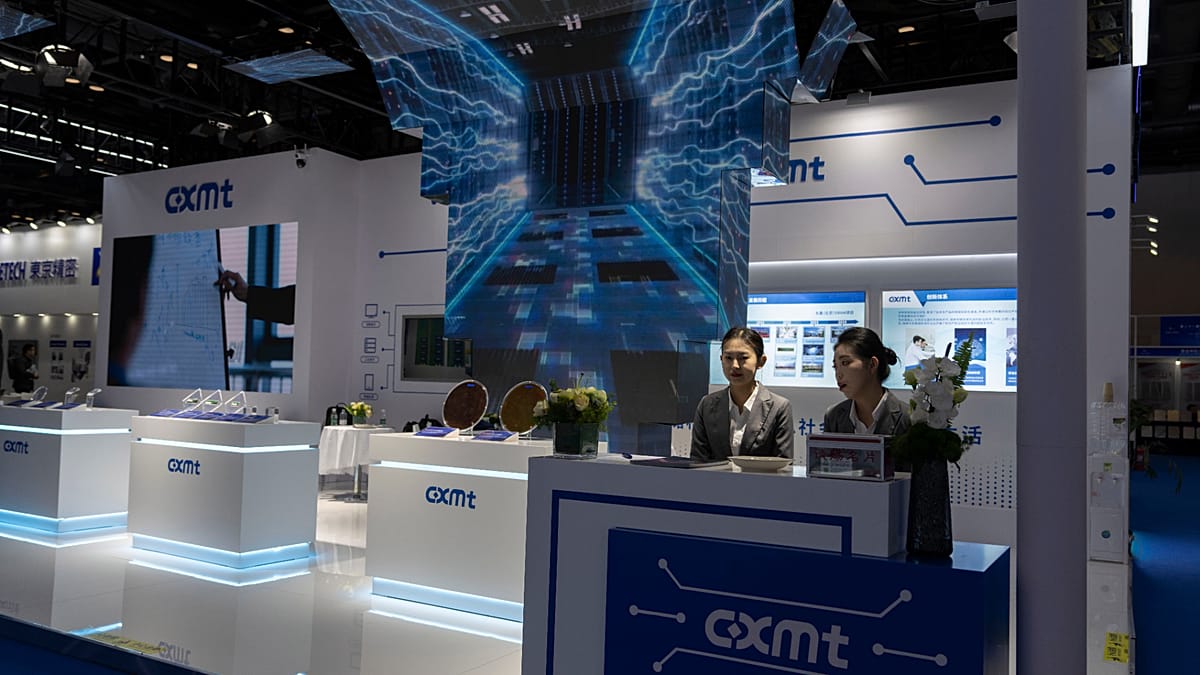
Shares of CXMT, China's leading DRAM memory chipmaker, skyrocketed on Monday after the company began trading on the Shanghai Stock Exchange's STAR Market. The stock surged 472% in its debut, settling at a 462% gain by early afternoon in Asia, giving the Hefei-based firm a market capitalisation of roughly 3.3 trillion yuan (€415 billion). That makes CXMT the most valuable company listed on a mainland Chinese exchange, though it still trails global giants like Samsung Electronics, SK Hynix, and Micron Technology.
The blockbuster listing raised at least $8.6 billion (€7.3 billion), making it mainland China's second-largest initial public offering after Agricultural Bank of China's 2010 dual listing in Shanghai and Hong Kong. CXMT's shares were priced at 8.66 yuan (€1.10) each on the Nasdaq-like STAR Market, which is designed for tech and innovation companies.
AI Boom and Self-Sufficiency Drive
CXMT is one of the world's largest makers of DRAM (dynamic random access memory) chips, used in everything from AI servers to automobiles and consumer electronics. The company has benefited enormously from the artificial intelligence boom, which has driven a global memory chip shortage and pushed up prices for computers and smartphones. Its revenue surged to 50.8 billion yuan (€6.4 billion) in the first three months of 2026, up more than 700% year on year.
China's push for greater self-sufficiency in advanced technologies, combined with restricted access to cutting-edge chipmaking equipment under US-led export controls, has also propelled CXMT's growth. The company is seen as Beijing's best hope for developing its own high-bandwidth memory (HBM) chips, a type of DRAM critical for powering Chinese AI models. US restrictions currently bar China from importing HBM chips.
“CXMT plays a critical role in China’s AI push, particularly in the face of US export controls,” said Kyle Chan, a fellow at the Brookings Institution and an expert in China’s technology policies. He noted that a key question is whether CXMT can help alleviate the broader global memory chip shortage.
Despite its rapid ascent, CXMT faces significant challenges. Its access to the world's most advanced chipmaking tools is highly restricted, forcing it to rely on Chinese equipment makers. This creates supply chain bottlenecks in scaling up manufacturing capacity. Some US lawmakers have also called on the Trump administration to block American companies from buying CXMT's memory chips over national and economic security concerns. The Pentagon has designated CXMT, like many other Chinese firms, as having links to the Chinese military—a label Beijing typically rejects.
According to Counterpoint Research, CXMT was the world's fourth-largest DRAM chipmaker by shipments in 2025, with roughly 8% of the global market. Samsung Electronics held 36%, SK Hynix 29%, and Micron about 24%. In the first three months of this year, CXMT's share rose to about 9%, and Counterpoint forecasts it could reach 11% by 2028. However, the research firm estimates CXMT will likely need at least a 15% global market share to be competitive in the long term.
“Trade restrictions on tools are remaining as the key challenge for CXMT,” said MS Hwang, a research director at Counterpoint specialising in memory semiconductors.
CXMT's public offering followed SK Hynix's $26.5 billion Nasdaq listing earlier this month, underscoring the intense global competition in memory chips. For European readers, the story highlights how US-China tech tensions are reshaping supply chains and creating new market dynamics that affect everything from smartphone prices to the cost of AI infrastructure in Europe.
The broader context includes the EU's ongoing efforts to manage its own trade relationship with China. As the bloc grapples with a €1 billion daily trade deficit and navigates US tariffs, the rise of Chinese chipmakers like CXMT adds another layer of complexity to European industrial policy and technology sovereignty.