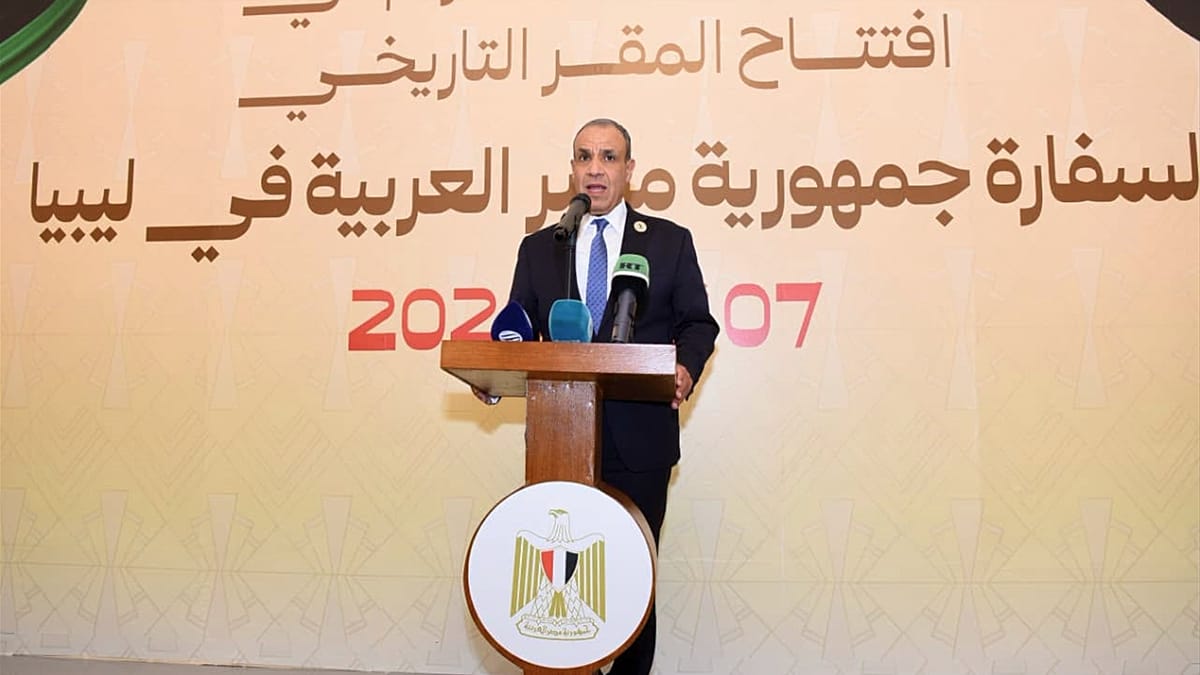
Egypt has formally reopened its embassy in Tripoli, marking a significant step in its efforts to recalibrate relations with Libya's internationally recognised government. Foreign Minister Badr Abdelatty travelled to the Libyan capital on Saturday for the ceremony, which was attended by Libya's acting foreign minister, Taher al-Baour. The building had been closed since January 2014, when gunmen abducted five embassy staff members; Egypt's diplomatic mission resumed operations in May 2021 but the embassy itself had remained shut.
The move signals a shift in Cairo's long-standing approach to Libya. For years, Egypt has been a key backer of Khalifa Haftar, the military commander who controls much of the east, where a rival administration is based. By reopening its embassy in Tripoli, Egypt is seeking to strengthen ties with the Government of National Unity (GNU) led by Prime Minister Abdulhamid Dbeibah, while maintaining its influence in the east.
During his visit, Abdelatty met Dbeibah and discussed ways to ease trade between the two countries. Dbeibah praised the contribution of Egyptian companies and workers to Libya's reconstruction, according to a statement from Egypt's foreign ministry. The two sides also addressed energy cooperation, with Abdelatty calling for faster progress on gas pipelines linking the two countries and on plans to refine Libyan crude in Egypt for export. Libya's acting oil minister said he would travel to Cairo for further talks, Libya's state news agency reported on Sunday.
Maritime dispute with Turkey
A central issue on the agenda was Egypt's opposition to the 2019 maritime agreement between Turkey and Libya's then-government in Tripoli. Abdelatty raised Egypt's objections during his talks with Dbeibah, stressing that Cairo's concerns should be taken into account when maritime boundaries are drawn. Dbeibah told Egyptian broadcaster Al-Qahera News that officials from both countries would discuss the maps and their respective claims at their next meeting.
The 2019 deal delineates maritime zones between Turkey and Libya in the eastern Mediterranean, an area rich in potential oil and gas reserves. Greece has long argued that the agreement ignores the rights of its islands, including Crete, which lies between the Turkish and Libyan coasts. Egypt and Cyprus have also voiced opposition. The EU said the agreement infringes on the rights of other countries and can have no legal effect on them.
Libya's eastern-based parliament ratified the agreement on 20 October, after years of rejecting it. Turkish Foreign Minister Hakan Fidan defended the pact as "an entirely legitimate agreement, both from a legal and a political perspective". The ratification has added urgency to Egypt's diplomatic push, as it seeks to counter Turkish influence in the region.
The reopening of the embassy comes amid broader European interest in Libya's stability and its energy resources. The EU has been wary of external interference in Libya and has supported UN-led efforts to unify the country. Egypt's move could be seen as an attempt to play a more constructive role in Libya's political process, while also safeguarding its own strategic interests.
For European observers, the maritime dispute is a reminder of the fragile geopolitics of the eastern Mediterranean. The region has seen tensions over gas exploration, with Turkey and Greece at odds, and the EU has sought to mediate. Egypt's objections to the Turkey-Libya deal align with those of Greece and Cyprus, potentially creating a common front.
As Egypt deepens its engagement with the GNU, the question remains whether it can balance its ties with Haftar and the east. The reopening of the embassy in Tripoli is a tangible step, but the underlying divisions in Libya persist. The next round of talks between Egyptian and Libyan officials on maritime boundaries will be closely watched, not only in Cairo and Tripoli but also in Athens, Nicosia, and Brussels.