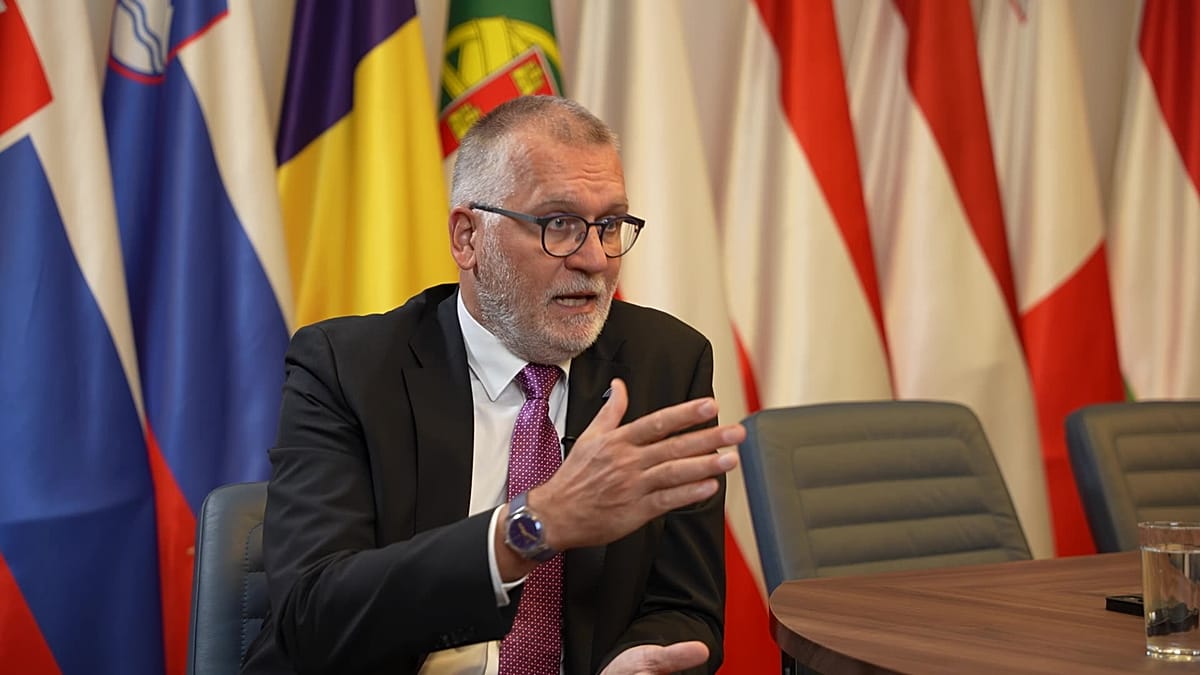
The European Investment Bank (EIB) is broadening its focus in Central Asia, seeking cross-border projects that can lift the entire region while also offering opportunities for European industry. During a visit to Astana, EIB Vice-President Marek Mora told Euronews that the bank is keen to move beyond single-country financing.
“We would be, of course, very much interested not only in financing the individual country projects, but if there was a cross-country project, it would be even more interesting for us because we would also see a potential for development of the whole region,” Mora said.
Interstate hydropower plant
One flagship example is the Kambar-Ata-1 hydropower plant in the Kyrgyz mountains, developed jointly by Kyrgyzstan, Kazakhstan and Uzbekistan. The EIB has allocated €900 million to the three countries for water management and energy grid construction. Expected to be completed around 2035, the plant will generate 5.6 billion kWh of electricity annually, significantly strengthening regional energy security.
Mora also pointed to potential European benefits: “We heard some ideas about energy or electricity interconnector between Kazakhstan under the Caspian Sea to Azerbaijan, which could then further continue to Europe.”
The water management aspect is equally crucial. The plant sits on the Naryn River, Kyrgyzstan’s largest, which merges with the Kara Darya in Uzbekistan to form the Syr Darya. That river flows through Uzbekistan and Kazakhstan into the Aral Sea, supplying water for agriculture and drinking. By regulating seasonal flows, the plant will store water during snowmelt and release it in dry months, providing a more stable supply downstream.
Transport and industry beyond transit
The EIB also sees Central Asia as a vital transport corridor between Asia and Europe. Mora stressed that Kazakhstan’s potential goes beyond being a transit country: “We have a firm conviction that Kazakhstan does not have only potential as a transit country. We think that around this whole transit industry, there could be its own industry built around it, be it logistics, be it services.”
To that end, the EIB has provided a €150 million loan to KazAvtoZhol, Kazakhstan’s national road operator, to upgrade key routes including access roads to border crossings, the Caspian route, corridors to China, and major interregional highways. A further €200 million loan to the Development Bank of Kazakhstan supports transport and energy projects, with a letter of intent to add €120 million.
What projects need to qualify
Financing is not automatic. Projects must meet strict environmental and social standards, which exclude coal and gas technologies. The EIB prefers green innovations, such as a proposed autonomous truck corridor that Mora discussed with Kazakhstan’s transport minister. “These trucks could be even electric and maybe of European origin,” he noted.
Equally important is a “win-win situation” for both the host country and Europe. “A win for Kazakhstan, but also a win for the European economy or the European industry,” Mora explained, adding that European content in projects is highly valued.
Regional development remains a priority. “I think water management is, I would say, a global public good. So, the better we do in Kazakhstan, the better we contribute to the world management of this resource, which will become more scarce in future everywhere,” Mora said.
The EIB’s commitment is underscored by its new representative office in Tashkent, opened in June, and its ongoing engagement with regional partners. As Central Asia’s infrastructure ambitions grow, the bank’s cross-border approach could help knit the region closer together—and to Europe.