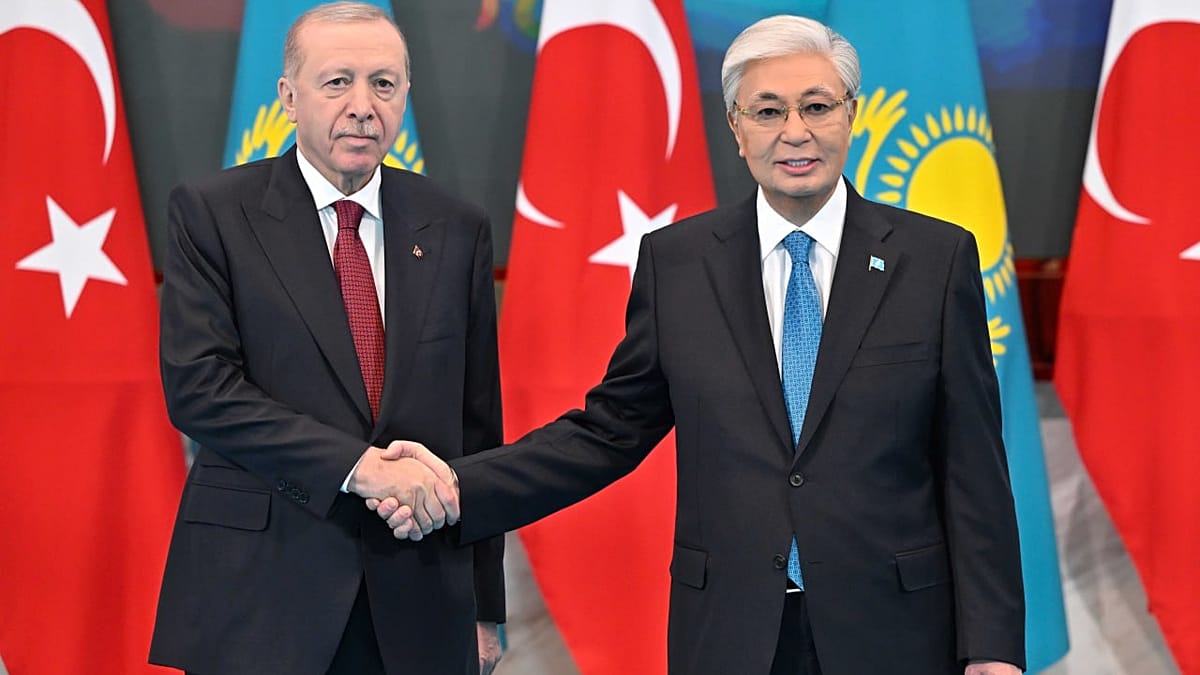
President Recep Tayyip Erdoğan's state visit to Astana on Thursday culminated in the signing of a Declaration on Eternal Friendship and Expanded Strategic Partnership between Turkey and Kazakhstan. The two countries set an ambitious bilateral trade target of €13 billion — nearly three times the current level — and agreed to deepen cooperation in defence, energy, transport, and digital sectors.
Kazakhstan, which has long pursued a multi-vector foreign policy balancing ties with Russia, China, the West, and Turkey, framed the partnership as a strategic pivot. President Kassym-Jomart Tokayev described Turkey as a "golden bridge" connecting Europe and Asia, adding that "Ankara's influence on the global stage continues to grow steadily" thanks to its balanced and far-sighted policy.
Erdoğan was awarded the newly established Order of Qoja Ahmet Yasawi — named after a 12th-century Turkic Sufi mystic and poet — becoming its first recipient. Tokayev called the honour "deep symbolic significance," while Erdoğan accepted it as a gesture of respect toward the Turkish people and a symbol of brotherhood between the two nations.
Trade and Investment on the Rise
Bilateral trade rose nearly 9% to more than €4.5 billion, with around 4,000 Turkish companies operating in Kazakhstan. Ankara is among the country's top five trading partners. Turkish investment in Kazakhstan exceeds €5 billion, while Kazakh investment in Turkey stands at over €2 billion.
Kazakh Deputy Prime Minister Serik Zhumangarin said 100 investment projects worth nearly €3.5 billion had been completed, with another 50 worth a similar sum under way. Kazakhstan aims to increase its exports to Turkey to nearly €573 million. Agricultural trade grew 25% last year to almost €327 million, with Turkish companies investing in wheat processing and greenhouse complexes. A 2026–2028 roadmap for agricultural cooperation has been proposed.
To achieve the €13 billion target, Erdoğan stressed the importance of implementing the 67-point Action Plan adopted during the 14th session of the Intergovernmental Commission on Economic Cooperation in Astana on 15 April.
Transport and Energy Corridors
On transport, Tokayev reaffirmed plans to expand the Trans-Caspian International Transport Route, which connects China to Europe via Kazakhstan, the Caspian Sea, Azerbaijan, Georgia, and Turkey. Rail cargo between the two countries rose 35% this year, and road transport by 5%. Tokayev called on Turkish investors to increase participation via the Aktau and Kuryk ports.
Kazakhstan also expressed support for TAV Airports Holding to build an international airport in Almaty, a proposal Erdoğan welcomed. In the energy sector, Kazakhstan welcomed plans by Turkey Petrolleri Anonim Ortaklığı to enter the Kazakh market. Tokayev invited Turkish companies to participate in mining projects, citing their expertise in metals, processing, and lithium production.
The declaration was accompanied by a series of bilateral agreements covering legal assistance, cultural centres, investment protection, oil and gas cooperation, UAV production, education, broadcasting, and financial centre collaboration.
Digital and Regional Dimensions
On the digital side, Kaspi.kz is expected to support Turkish e-commerce platform Hepsiburada, while Freedom Holding Corp is expanding digital and brokerage services in Turkey. Tokayev expressed confidence that "the partnership between the financial centres and digital trading platforms of both countries will promote deeper trade and economic relations."
The visit comes ahead of an informal summit of leaders of the Organisation of Turkic States (OTS) on 15 May in Turkistan, under the theme "Artificial Intelligence and Digital Development." The OTS, founded in 2009, groups Azerbaijan, Kazakhstan, Kyrgyzstan, Turkey, and Uzbekistan, with Hungary and Turkmenistan as observers. Turkey informally leads the organisation, while Kazakhstan provides the largest economy after Turkey. Russia and China are not members.
This deepening of ties between Ankara and Astana reflects a broader realignment in Central Asia, where countries are increasingly diversifying their partnerships. For European observers, the development underscores Turkey's role as a pivotal actor in the region — a role that has implications for EU connectivity and energy diversification strategies. As the Global Europe: MEPs Debate Whether the EU Can Lead in a Shifting World Order discussion highlights, the shifting regional order demands careful attention from Brussels.