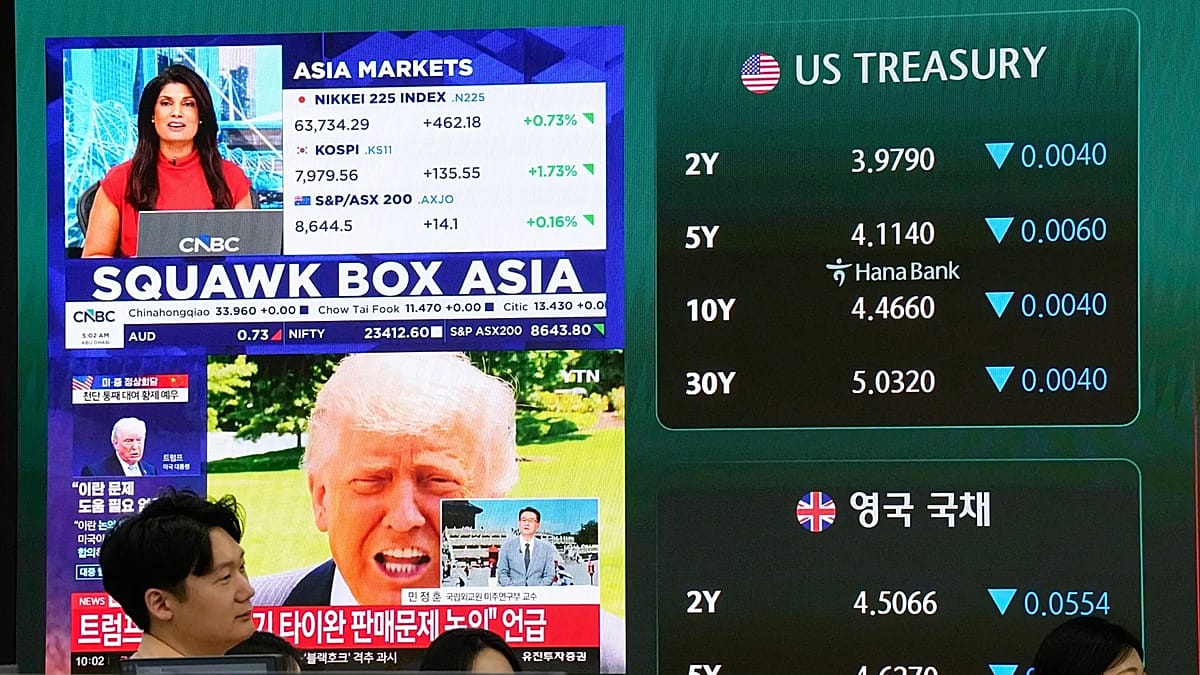
Global equity markets climbed on Thursday, with European indices leading gains, as investors parsed the outcome of the summit between US President Donald Trump and Chinese leader Xi Jinping in Beijing. The meeting, held at the Great Hall of the People, produced a joint commitment to keep the Strait of Hormuz open—a critical demand as the war in Iran drags into its third month.
In early European trading, London's FTSE 100 rose 0.3% to 10,351.36, supported by better-than-expected UK GDP data for March, which showed 0.3% growth despite the ongoing conflict. Paris's CAC 40 gained 0.6% to 8,057.64, while Frankfurt's DAX surged 1.4% to 24,462.22, reflecting broad optimism across the continent.
Asian Markets Mixed Amid Tech Boom
Asian markets delivered a mixed picture. Tokyo's Nikkei 225 fell 1% to 62,654.05, after briefly touching a fresh intraday record above 63,700, buoyed by strong corporate earnings. Seoul's Kospi closed 1.8% higher at 7,981.41, a new all-time high driven by technology stocks riding the artificial intelligence wave. Shanghai's Composite lost 1.5% to 4,177.92, while Hong Kong's Hang Seng was flat at 26,389.04. Australia's S&P/ASX 200 edged up 0.1% to 8,640.70.
Taiwan's Taiex rose 0.9%, and India's Sensex climbed 1.1%, underscoring the regional divergence. The White House confirmed that Trump and Xi discussed enhancing US-China economic cooperation, with both sides agreeing on the necessity of keeping the Strait of Hormuz open—a vital chokepoint for global oil shipments.
Oil Prices and the Iran War
Oil prices were mixed. Brent crude, the international benchmark, edged up 0.2% to $105.87 per barrel, compared with around $70 before the Iran war began in late February. US benchmark crude slipped 0.2% to $100.86. The International Energy Agency warned on Wednesday that supply losses from the strait were depleting global oil inventories at a record pace, a concern that has kept energy markets on edge.
Some investors had hoped the Trump-Xi meeting could yield results, after US officials indicated that Beijing could leverage its close economic ties with Tehran to press Iran to reopen the waterway. The summit also saw a high-profile US business delegation, including Nvidia's Jensen Huang, Tesla's Elon Musk, and Apple's Tim Cook, meet Chinese Premier Li Qiang on Thursday afternoon. The presence of these tech titans has intensified scrutiny on Europe's own AI strategy, as the continent grapples with the implications of US-China tech dominance. For more on this, see US Tech Titans in Beijing: Europe's AI Strategy Under Pressure.
Wall Street Records and Fed Transition
On Wednesday, Wall Street set new records. The S&P 500 climbed 0.6% to 7,444.25, the Nasdaq composite rose 1.2% to 26,402.34, and the Dow Jones Industrial Average edged down 0.1% to 49,693.20. Technology stocks led the gains, reflecting the AI boom that has also lifted Seoul and Taipei.
The yield on the US 10-year Treasury edged down to 4.46% from 4.47%, though it remains well above the roughly 3.97% seen before the Iran war began. A report on Wednesday showed US wholesale prices surged in April, driven by the energy shock from the conflict. Meanwhile, the US Senate confirmed Kevin Warsh, Trump's nominee, to lead the Federal Reserve, replacing Jerome Powell, whom Trump had repeatedly criticised for not cutting interest rates faster or deeper.
The US dollar rose to 157.91 Japanese yen from 157.86, while the euro traded at $1.1709, down marginally from $1.1711. For European policymakers, the summit's outcomes—particularly on trade and technology—underscore the urgency of a unified response. As one Greens MEP recently warned, the EU must unite or face irrelevance after the Trump-Xi talks. Read more in EU Must Unite or Face Irrelevance, Greens MEP Warns After Trump-Xi Talks.
Xi Jinping also pledged deeper market access for US firms during Trump's visit, a move that could reshape global supply chains and put additional pressure on European exporters. For a deeper analysis, see Xi Jinping Pledges Deeper Market Access for US Firms During Trump's Beijing Visit.