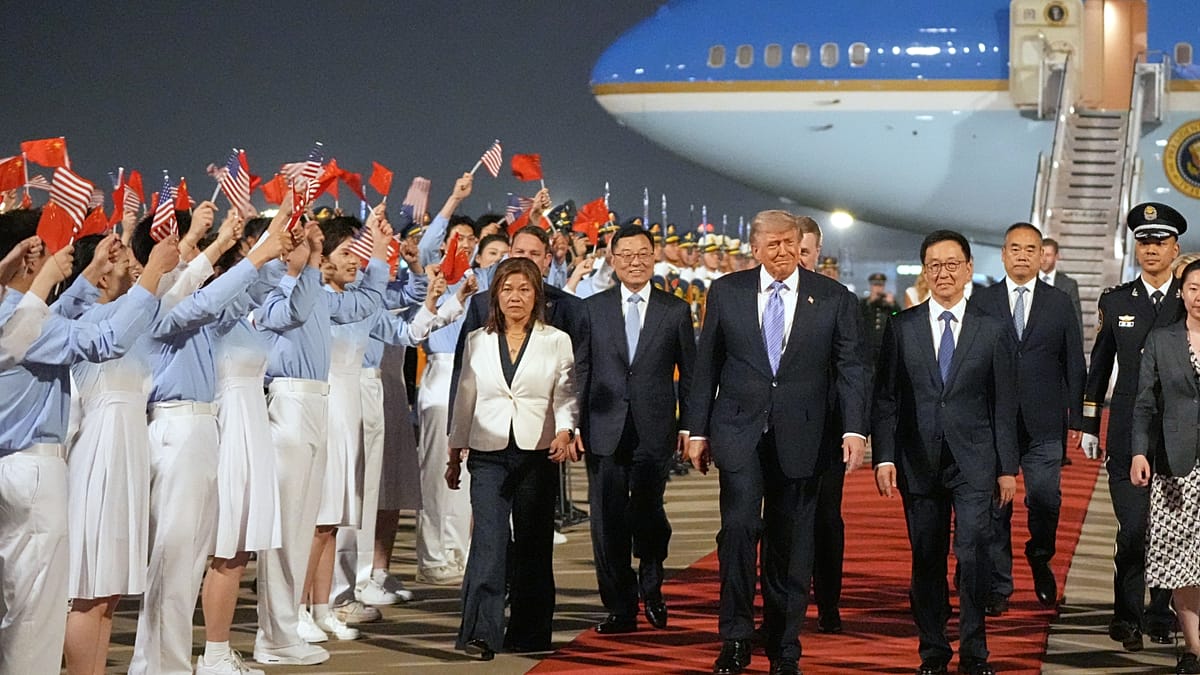
A group of prominent American technology executives has accompanied President Donald Trump to Beijing for a summit with Chinese President Xi Jinping. The delegation includes Nvidia’s Jensen Huang, Apple’s Tim Cook, and Tesla’s Elon Musk, among others. According to a White House official, the talks are intended to press China to “open up” its market to US firms and address critical issues such as trade barriers, artificial intelligence development, and geopolitical stability.
Yet many of these tech leaders are no strangers to China. Their companies have long-standing business relationships with the world’s second-largest economy, and the summit comes at a time when export restrictions and tariffs have reshaped the landscape. The agenda is dominated by AI chip export curbs and the future of semiconductor supply chains.
Nvidia’s Jensen Huang: From Taiwan to the AI Frontline
Jensen Huang, the CEO of Nvidia, was born in Taiwan and moved to the United States at age nine. His company, now valued at over a trillion dollars, has been a key player in China’s AI ecosystem since 2011, when it began training Chinese university students on its CUDA software. By 2017, Nvidia was supplying chips to major Chinese firms such as Baidu, Tencent, and Alibaba’s cloud division.
Nvidia’s manufacturing partner, TSMC, based in Taiwan, has built its chips since 1998. However, in 2022, the Biden administration imposed export restrictions on Nvidia’s most advanced chips—the A100 and H100—citing national security concerns. Nvidia estimated it would lose $400 million in potential sales to China. Beijing responded by calling the restrictions “sci-fi hegemony” aimed at suppressing emerging markets.
To comply, Nvidia developed the H20 chip, a less powerful “AI accelerator” designed for the Chinese market. Orders surged after the launch of DeepSeek, a low-cost Chinese AI model that competes with OpenAI. Yet the H20 faced its own hurdles: Trump initially restricted it in April 2025, then quietly reversed course in July. In September 2025, Beijing launched an investigation into the H20 and eventually imposed an import ban. Huang stated at the end of 2025 that Nvidia’s market share in China had fallen from 95% to zero.
Chinese AI companies, including DeepSeek, are now building models using domestic alternatives like Huawei’s Ascend chip cluster. Alibaba and ByteDance have also started their own chip design efforts.
Apple’s Tim Cook: Navigating Tariffs and Tensions
Apple’s relationship with China dates back to the late 1990s, when the company began sourcing manufacturing in Asia. Tim Cook, then a new hire, approached Foxconn founder Terry Guo to set up production in China. By 2003, Apple had consolidated most of its manufacturing there, benefiting from Chinese policies that enabled rapid scaling.
However, the partnership has not been without controversy. Investigations in the 2010s revealed unpaid wages and excessive working hours at Foxconn factories, which were described as “labour camps” by some Chinese universities. Cook has also played a diplomatic role, warning Trump during the 2018 trade war that a tough stance could threaten Apple’s position. He succeeded in securing tariff exemptions twice: in 2019, 10 of 15 requests were approved, and in 2025, iPhones not made in the US were spared a 25% tariff.
Apple has invested heavily in China, signing a $275 billion deal in 2021 to ease regulatory pressure and launching a $101 million energy fund in 2025. The summit’s outcome could affect Apple’s supply chain and its ability to navigate ongoing trade tensions.
Elon Musk’s Tesla: Betting on China’s EV Market
Elon Musk’s primary business link to China is through Tesla. The company announced plans to sell the Model S in China in 2013, though initial efforts were delayed by copyright disputes. Analysts at the time were skeptical, citing China’s nascent electric vehicle market and lack of charging infrastructure. Despite these challenges, Tesla has since built a Gigafactory in Shanghai and become a major player in China’s EV sector.
The summit comes as Europe braces for the fallout from any US-China deal, particularly in the automotive and technology sectors. Musk’s presence underscores the high stakes for American companies that rely on Chinese manufacturing and sales.
For European observers, the Beijing summit highlights the delicate balance between market access, technological sovereignty, and geopolitical rivalry. As US and Chinese leaders negotiate, European firms and policymakers will be watching closely—aware that any agreement could reshape global supply chains and competitive dynamics.