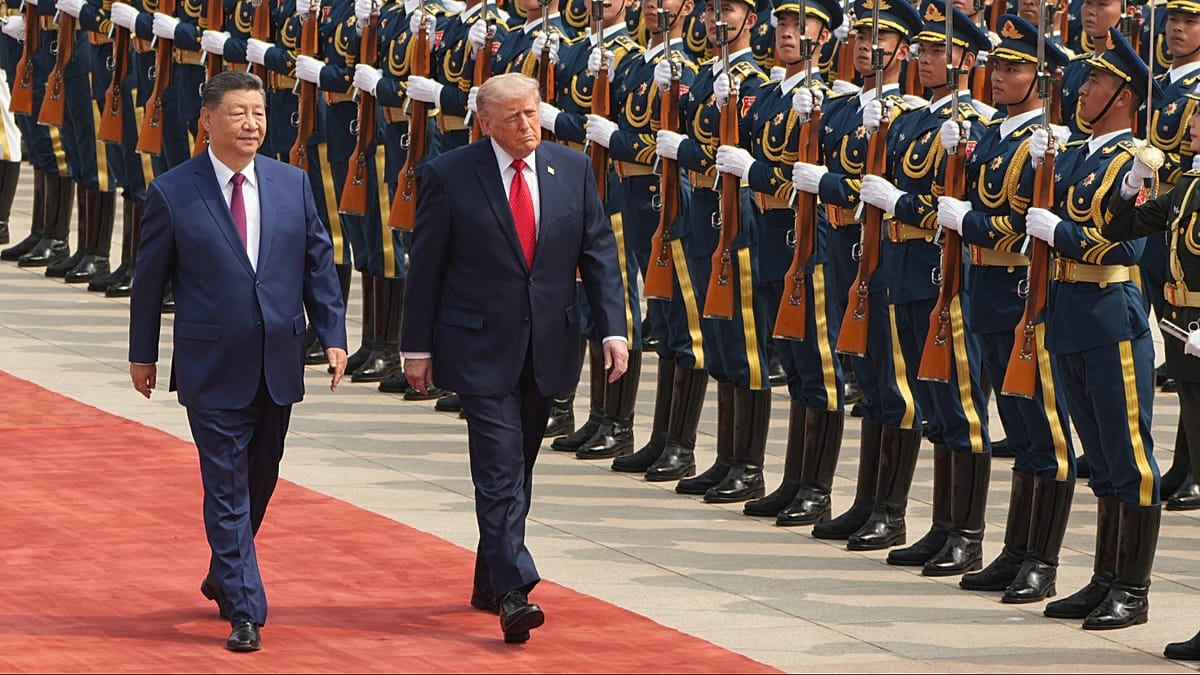
US President Donald Trump and Chinese leader Xi Jinping opened a three-day summit in Beijing on Thursday, with both sides seeking to stabilise a relationship strained by trade wars, geopolitical rivalries, and conflicts in the Middle East. The meeting, which runs from 13 to 15 May, marks the first US presidential visit to China since 2017.
Trump, speaking at the Great Hall of the People, told Xi that the two nations would have a "fantastic future together." He added, "It's an honour to be with you. It's an honour to be your friend, and the relationship between China and the USA is going to be better than ever before." Xi responded by emphasising that the two superpowers should be "partners and not rivals," stating that "a stable China-US relationship is a boon for the world. Cooperation benefits both sides, while confrontation harms both."
Trade, Iran, and Taiwan Top the Agenda
The summit comes as Trump's trade war with Beijing has sent bilateral trade into freefall, forcing companies on both sides of the Pacific to restructure supply chains. The US president is seeking to secure deals for Chinese purchases of American agricultural products and aircraft, saying trade would be the central topic. However, the agenda also includes the ongoing Iran war and the status of Taiwan, issues with direct implications for European security and economic interests.
Europe has been closely watching the talks, as any US-China deal could reshape global trade dynamics and affect European industries. The EU is already grappling with its own budget negotiations, where defence spending is surging while farmers and regions face cuts. A potential US-China agreement on tariffs or technology could either ease or exacerbate pressures on European exporters.
Trump arrived in Beijing accompanied by a high-profile delegation of US tech executives, including Nvidia's Jensen Huang, Tesla's Elon Musk, Apple's Tim Cook, and leaders from Meta, Visa, JPMorgan Chase, Boeing, and Cargill. The presence of these CEOs underscores the importance of technology and semiconductor supply chains in the bilateral talks. Trump added Nvidia's CEO to the delegation at the last minute, highlighting the contentious issue of AI chip export curbs.
Ceremonial Welcome and Strategic Implications
The formal welcome included a red carpet reception at the Great Hall of the People, where a Chinese military band played both national anthems and cannons fired. Trump and Xi walked past rows of honour guards and children waving American and Chinese flags. Xi also shook hands with US officials, including Defence Secretary Pete Hegseth and Secretary of State Marco Rubio, before the two leaders entered for bilateral talks.
For Europe, the outcome of this summit carries significant weight. A rapprochement between Washington and Beijing could reduce the risk of a two-front trade war, but it might also lead to new agreements that sideline European interests. Conversely, a failure to stabilise relations could deepen global economic uncertainty. European capitals are bracing for fallout as they assess the potential impact on their own trade and security policies.
The summit also touches on the Iran war, where China has maintained a neutral stance while the US has escalated military involvement. Any US-China understanding on Iran could affect European efforts to de-escalate the conflict. Similarly, discussions on Taiwan are closely monitored by EU member states, which generally support a status quo that avoids unilateral changes.
As the talks continue, European policymakers will be analysing every statement for signs of a broader strategic realignment. The EU's own €2 trillion budget talks are already under strain, and a US-China deal could either provide a tailwind or create new headwinds for European competitiveness.