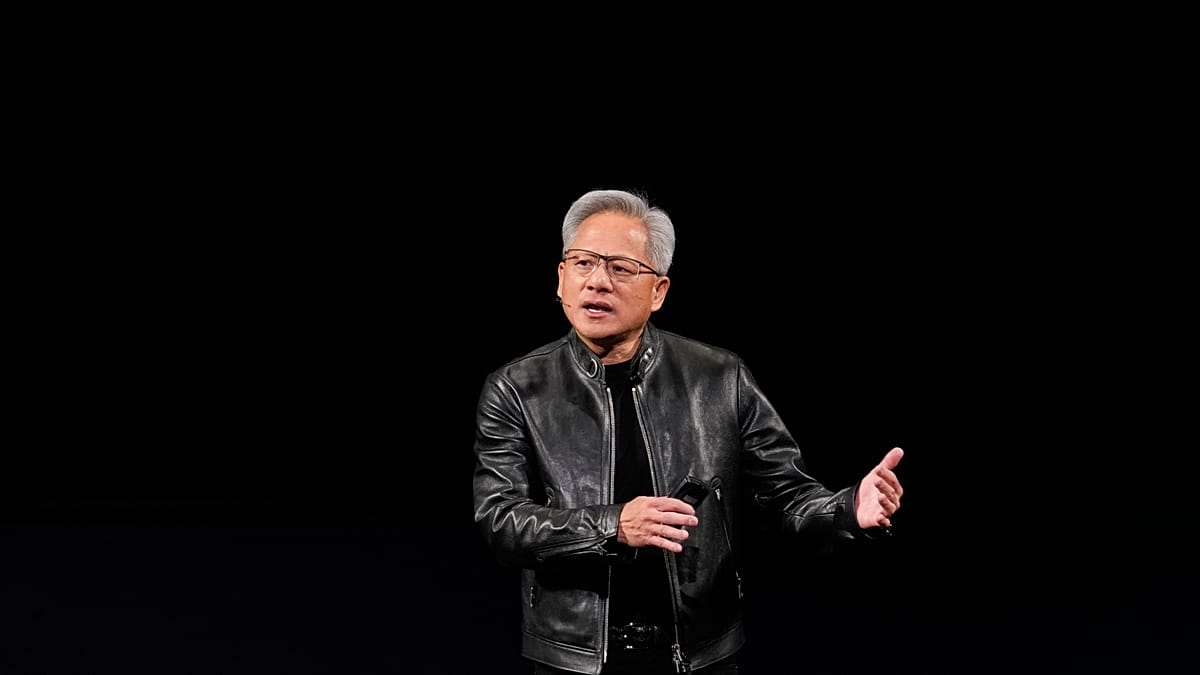
US President Donald Trump has added Nvidia CEO Jensen Huang to the delegation of technology leaders accompanying him to Beijing for a summit with Chinese President Xi Jinping, according to multiple reports. Huang, who was not on the initial list of invitees circulated on Monday, boarded Air Force One after a personal phone call from Trump.
An Nvidia spokesperson confirmed to Euronews Next: “Jensen is attending the summit at the invitation of President Trump to support America and the administration’s goals.” Trump himself posted on Truth Social that Huang was on board, denying earlier reports that the Nvidia boss had been excluded. However, Reuters and CNBC, citing sources familiar with the matter, reported that Trump called Huang after seeing media coverage of his absence from the delegation.
The last-minute invitation highlights the central role of semiconductor export controls in US-China relations. Nvidia has repeatedly lobbied the US administration to relax restrictions on selling its powerful H200 artificial intelligence chips to China. In February, the company stated that US-government-approved versions of these chips had not yet been allowed into the country.
AI Chip Competition Heats Up
China is investing heavily in domestic AI chip development. Companies such as Huawei, Alibaba, and ByteDance have launched their own chip design initiatives, aiming to reduce reliance on US technology. According to the 2025 AI Index Report from the Stanford Institute for Human-Centered Artificial Intelligence, China has narrowed the gap with the United States in overall AI capabilities. The US still leads in capital investment, infrastructure, and advanced AI chips, but China excels in patents, publications, and physical AI—also known as robotics.
Trump’s decision to bring Huang to Beijing comes as he seeks to press Xi on trade imbalances, technology transfer, and security issues. In his Truth Social post, Trump wrote: “I will be asking President Xi, a Leader of extraordinary distinction, to ‘open up’ China so that these brilliant people can work their magic.” The remark underscores the administration’s dual approach of pressuring Beijing while showcasing American tech prowess.
For European observers, the summit carries significant implications. The EU has its own semiconductor ambitions, with the European Chips Act aiming to double the bloc’s global market share to 20% by 2030. Any US-China deal on chip exports could reshape global supply chains and affect European companies like ASML, Infineon, and STMicroelectronics. Trump's Beijing visit: What a US-China deal could mean for Europe's strategic interests explores these potential outcomes in depth.
Experts have told Euronews Next that a breakthrough agreement on semiconductors appears unlikely. The US continues to view advanced chips as a national security concern, while China is determined to achieve self-sufficiency. The summit may instead focus on other topics, such as AI warfare and cybersecurity, as discussed in Trump-Xi Summit: AI Warfare and Cybersecurity to Dominate as Chip Deal Fades.
Huang’s presence on Air Force One signals that Nvidia remains a key player in the US-China technology rivalry. The company’s chips are critical for training large language models and other AI applications, making them a strategic asset. Whether Trump’s personal intervention will lead to policy changes remains uncertain, but the episode underscores the high stakes involved.
As the summit unfolds, European capitals will be watching closely. The outcome could influence everything from trade policy to defense cooperation. Middle Powers Forge New Alliances as Trump Heads to Beijing examines how countries like France, Germany, and the UK are positioning themselves amid the shifting geopolitical landscape.