As US President Donald Trump prepares for his first visit to China in nine years, the world's middle powers are recalibrating their strategies. The summit, hosted by President Xi Jinping in Beijing, is expected to cover the war in Iran, trade tensions, and Taiwan, with promises of ceremonial pomp. Yet for many nations, the real story lies in how they can navigate a landscape increasingly shaped by the rivalry between the world's two largest economies.
The US-China relationship accounted for roughly 44% of global GDP in 2025, but Trump's second term has been marked by trade spats, annexationist rhetoric, and conflict. Analysts note his weakened hand in negotiations, as he angles for a trade deal and a potential climbdown from frozen triple-digit tariffs. This uncertainty has prompted smaller nations to seek alternatives.
Canada and Europe: A Strategic Pivot
Canadian Prime Minister Mark Carney argued at Davos in January that the world should not be run by “hegemons.” Instead, he called for middle powers adhering to a rules-based order to form like-minded coalitions. Canada has since deepened ties with the EU, signing 20 security, defence, and economic agreements in the past year. Foreign Minister Anita Anand told Euronews that this partnership is “not just a policy response” to Trump's tariffs but a long-term strategy. “What I believe we should be looking at is how we can work together pragmatically for our respective countries to deliver economic benefits and defence and security benefits,” she said.
Canada made history last week as the first non-European country to participate in a European Political Community (EPC) summit in Yerevan, Armenia. At the EPC, Carney declared that Europe would not submit to an “insular and brutal world” and could serve as a base for rebuilding a new international order. Anand echoed this enthusiasm for continued cooperation with Europe and like-minded partners.
Australia's Diversification
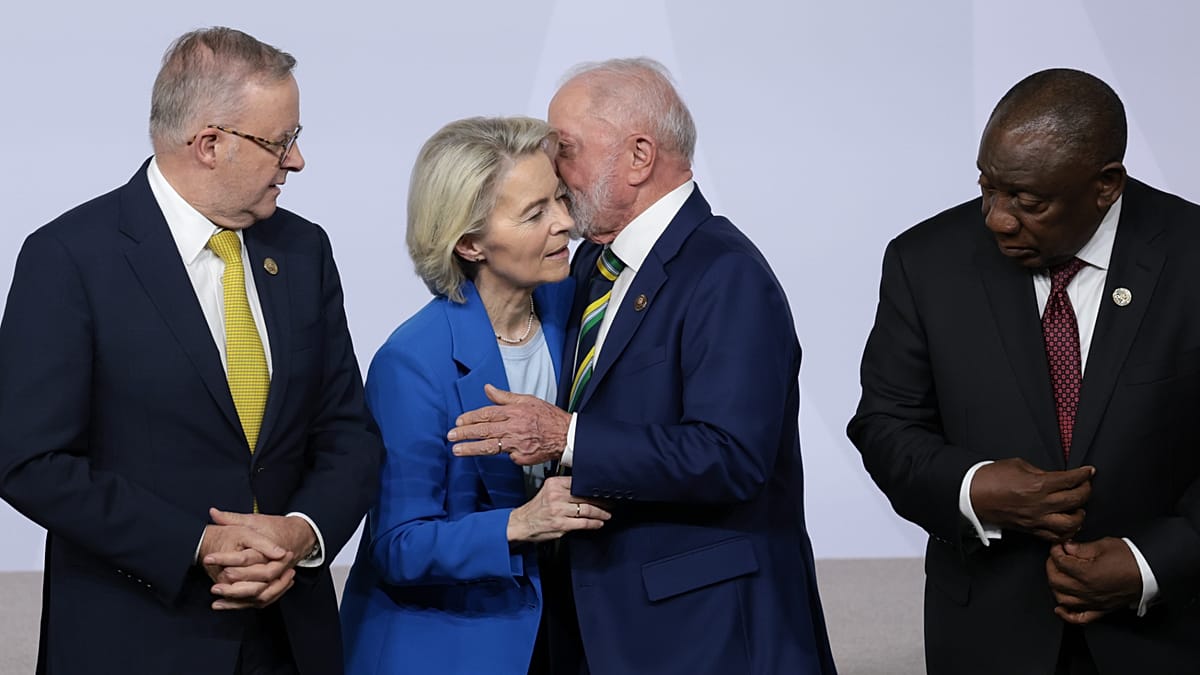
In March 2026, European Commission President Ursula von der Leyen and Australian Prime Minister Anthony Albanese signed a free trade agreement in Canberra. The deal removes over 99% of tariffs on EU goods and boosts cooperation in defence, saving the EU €1 billion annually in duties. Exports are projected to climb 33% over the next decade. Australia's Ambassador to the EU and NATO, Angus Campbell, told Europe Today that while Australia maintains a “constructive” and “very significant trade relationship with China,” its success relies on diverse partnerships. “Australia trades into North America, into ASEAN, to South Asia, to North Asia and into Europe,” he said. “We're an island continent dependent on global trade, on the rules of trade and free trade agreements matter because they enable the prosperity for all.”
This strategic diversification reflects a broader trend among middle powers. As Trump's Beijing visit unfolds—with reports of talks, a banquet, and a visit to a religious site frequented by Ming and Qing dynasty emperors—all eyes are on how these nations can slot themselves into the outcomes.
EU Considers Social Media Ban for Children
Separately, European Commission President Ursula von der Leyen announced on Tuesday that the EU could propose a bloc-wide social media ban for children as early as this summer. Speaking at the European Summit on Artificial Intelligence and Children in Copenhagen, she noted the “lightning speed” at which technology advances and penetrates childhood. Support for stricter controls has grown in France, Spain, Greece, and Denmark, though Brussels faces pressure to maintain a harmonised approach across the single market.
Venice Biennale Funding Suspended
Fourteen EU member states have criticised the reopening of the Russian pavilion at the Venice Biennale, prompting Brussels to call for a suspension of funding. The controversy has sparked fierce debate in Italy, highlighting cultural tensions amid geopolitical shifts.
Belgian General Strike
Between 40,000 and 70,000 people marched through Brussels on Tuesday in a general strike called by the country's three main trade unions. They denounced the federal government's reforms as “anti-social,” with protests drawing tens of thousands to the capital.
For more on how middle powers are navigating superpower dynamics, read our analysis on Trump's Beijing Visit: What a US-China Deal Could Mean for Europe's Strategic Interests and Canada’s Anand: EU Partnership Is a Long-Term Strategy, Not Just a Response to Trump.