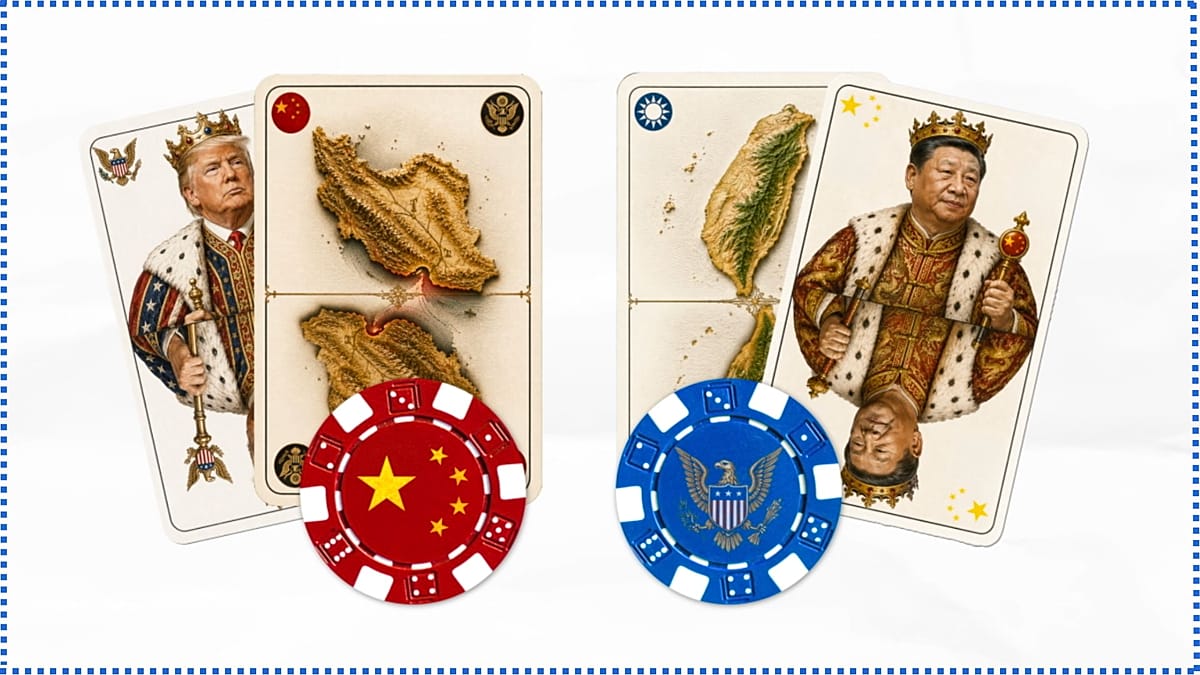
For the first time since 2017, Donald Trump is in Beijing for talks with Xi Jinping. The agenda spans Iran, nuclear non-proliferation, trade, and artificial intelligence. But the US president arrives with a weakened hand: an unpopular military engagement in Iran and domestic court rulings that have blocked his tariff policies. The outcome of this summit could have profound consequences for Europe, potentially leaving the continent on the sidelines of major strategic decisions.
Security Bargains and Taiwan
One of the most sensitive topics is Taiwan. Xi Jinping is seeking a clear signal that Washington will step back from its commitment to the island's defence. If Trump treats Taiwan's security as a bargaining chip to secure Chinese cooperation on ending the Iran conflict, he could hollow out Europe's own strategic posture in the Indo-Pacific. Several EU member states, including France and Germany, have naval assets and diplomatic interests in the region. A US-China deal that sidelines Taipei would undermine the principle of stability that European powers have long supported.
As analysts have noted, Trump's weakened position in Beijing may force him to make concessions that ripple far beyond the bilateral relationship.
AI and Chip Export Controls
Another critical area is technology. Trump is under domestic pressure to relax export controls on advanced semiconductors in exchange for quick business deals. If he trades away this leverage, Washington and Beijing would effectively set global standards for artificial intelligence without European input. The EU would become a rule-taker, not a rule-maker, in one of the most transformative industries of the 21st century. European tech firms, from Munich to Helsinki, would have to adapt to standards decided in the White House and Zhongnanhai.
This scenario is particularly worrying given the growing role of AI in warfare and cybersecurity, areas where Europe has sought to carve out its own regulatory path.
Trade Squeeze on European Industry
On trade, the stakes are equally high. European manufacturers are already struggling to compete with cheap Chinese imports in sectors like steel and electric vehicles. If Trump relaxes tariffs on Chinese goods, the flood of cheaper EVs and steel into the US market could erode the competitive advantage that European exporters currently enjoy there. The same Chinese rivals that are already gaining ground in Europe would then dominate the American market as well.
Meanwhile, Trump has given the EU a deadline: finalise a new US-EU trade deal by July 4, or face 25% tariffs on European cars. In Brussels, the centre-right European People's Party (EPP) is pushing for a swift agreement, fearing that a weakened Trump could turn his attention to Europe next. But the Socialists and Democrats group is holding firm, insisting that European legislation should not be shaped by what they call "threats on social media."
The July 4 ultimatum has already created tension within the EU institutions, with some member states urging a pragmatic response while others demand a principled stance.
What This Means for Europe
The Trump-Xi summit is a reminder that Europe's interests can be collateral damage in great-power competition. Whether on Taiwan, AI governance, or trade, the continent risks being reduced to a passive observer. The EU's ability to act as a sovereign player depends on its willingness to forge its own path—on chip sovereignty, on strategic autonomy in the Indo-Pacific, and on a trade policy that does not bend to every ultimatum from Washington.
As the talks unfold in Beijing, European capitals should be watching closely. The decisions made in the Great Hall of the People could shape the continent's strategic environment for years to come.