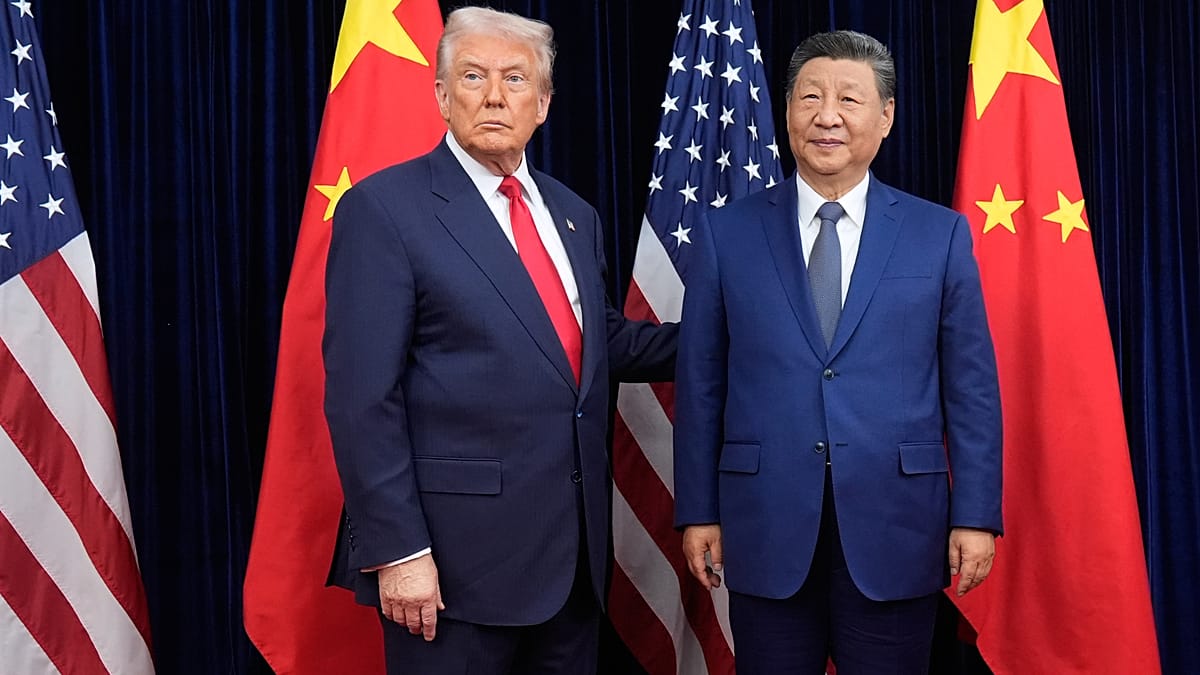
When US President Donald Trump finally lands in Beijing this Thursday for his long-delayed summit with Xi Jinping, the script has flipped. What was once billed as the most consequential foreign visit of his second term now feels more like a plea for assistance from a leader whose domestic and international standing has frayed.
The trip was originally scheduled six weeks ago, but Trump postponed it at the last minute to launch a military campaign against Iran—a conflict that has since become a quagmire. Oil prices have soared, his approval ratings have tanked, and the midterm elections in November loom large. For a president who thrives on projecting strength, the optics are awkward.
“The summit’s diplomacy has only reinforced the deeper drivers diminishing the likelihood of substantive gains,” said Jonathan Czin, a China expert at the Brookings Institution in Washington. “By signalling early and loudly a desire for multiple presidential encounters this year, the Trump administration may have reduced Beijing’s incentive to offer any major concessions.”
China’s Calculated Restraint
Beijing has watched the Iran crisis unfold with a mix of caution and opportunism. While publicly rejecting US hegemony, China has avoided crossing Washington’s red lines—particularly on arms supplies to Tehran. Instead, it has pursued a strategy of “calculated containment,” as Alicia Garcia-Herrero, senior fellow at the Brussels-based think tank Brueghel, describes it.
“China has opted for a calculated containment strategy based on tough rhetoric and public rejection of US hegemony,” Garcia-Herrero said. “However, it has not so far—at least overtly—crossed the red lines Washington has drawn, particularly on arms supplies to Iran.”
Yet behind the scenes, Chinese firms have reportedly sold satellite imagery to Iran used to target US forces in the region, as Michael Froman of the Council on Foreign Relations noted. This dual approach allows Beijing to maintain plausible deniability while benefiting from America’s entanglement.
For European capitals, the stakes are high. The Trump administration’s July 4 ultimatum to the EU on trade has already strained transatlantic relations, and a US-China deal could reshape global trade dynamics. Brussels is particularly concerned that any agreement between Washington and Beijing might sideline European interests, especially in sectors like aviation and semiconductors.
Trump’s delegation includes 16 CEOs, among them Elon Musk of Tesla and SpaceX, Boeing’s chief, and leaders from Apple, Meta, Citi, Goldman Sachs, Cargill, and Qualcomm. The agenda is clear: Boeing aircraft sales, Chinese rare-earth exports, and a fragile trade truce extension. But Beijing is not expecting a grand “reset.” It wants predictability, not promises.
China’s energy security has been vindicated by the crisis. Having built up strategic oil reserves and invested heavily in renewables, it can weather the Strait of Hormuz closure better than most. Yet as an export-oriented economy, it cannot afford a global recession. “The Chinese are affected by the prospect of a global economic slowdown. So, they’ve got interests on both sides,” said Edgar Kagan, a former special assistant to President Joe Biden and senior director for East Asia in the National Security Council. “On one hand, they clearly don’t want the US to be too successful. On the other hand, if the strait remains closed that has very significant implications.”
For now, Xi seems content to let the US bleed in the Middle East while positioning China as a responsible global stakeholder. The question is whether Trump can offer enough to change that calculus. European diplomats, already grappling with Trump’s threats to relocate US troops from Germany to Poland, are watching closely. A weakened Trump may test China’s appetite for deal-making—but the menu may not be to Beijing’s taste.