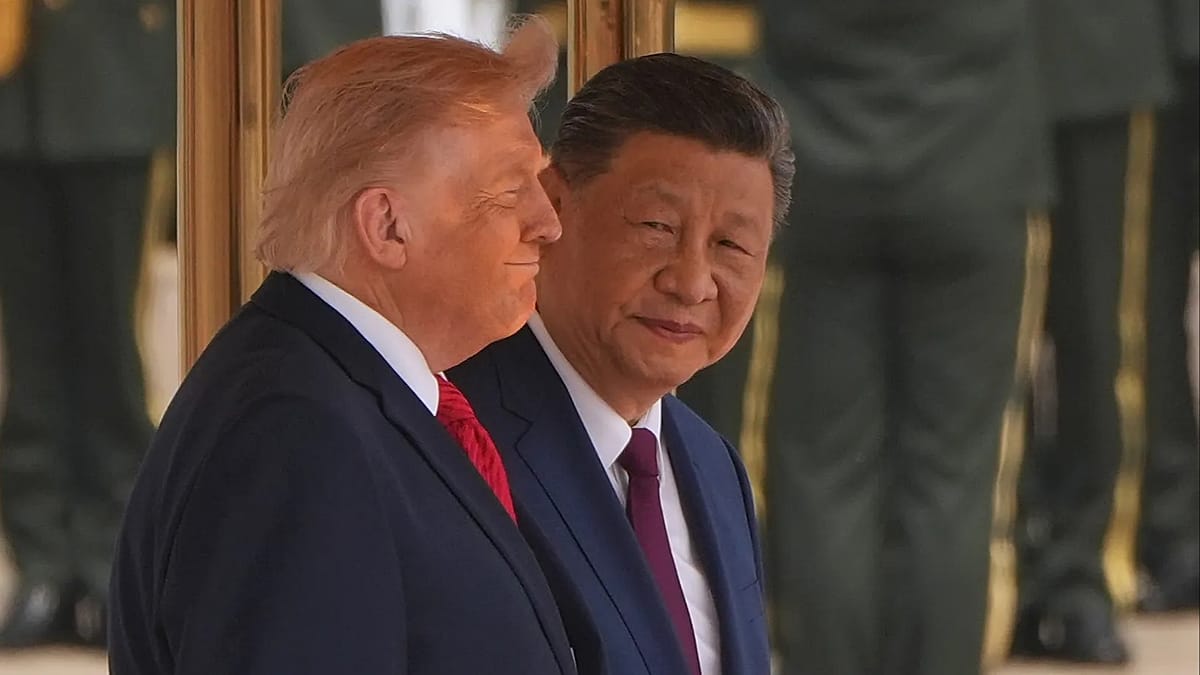
During US President Donald Trump's state visit to Beijing, Chinese President Xi Jinping addressed American business leaders with a message of reassurance, stating that China "will only open its door wider" and that bilateral economic ties remain "mutually beneficial and win-win in nature." The remarks, reported by China's foreign ministry and state-run Xinhua news agency, come as Beijing aims to project economic stability amid slowing growth and heightened geopolitical uncertainty.
Xi emphasised that Beijing would expand market access and improve conditions for foreign companies, noting that "US businesses are deeply involved in China's reform and opening up efforts." He described economic globalisation as an "irreversible historical trend," with Chinese state media coverage of the summit heavily focusing on cooperation and portraying China as a supporter of open global markets and stable supply chains.
Unresolved Tech Disputes Linger
Despite the conciliatory tone, major disagreements between Washington and Beijing remain unresolved, particularly in the technology sector. Both the Biden and Trump administrations imposed restrictions on exports of advanced semiconductor technology to China, citing national security concerns. Beijing has consistently criticised these measures as unfairly hindering its technological development. No concrete progress on easing these restrictions or resolving other sectoral issues has been publicly disclosed.
Nevertheless, both governments appeared keen to frame the visit as constructive. Beijing leveraged the presence of prominent American executives to reinforce its message that China remains open for business, even as tensions with Washington persist. This strategy mirrors broader efforts by European leaders to navigate similar trade and tech challenges, as some MEPs warn the EU must unite or face irrelevance in the wake of such summits.
CEOs Meet with Chinese Premier Li Qiang
Alongside the Xi-Trump meeting, several senior American executives held separate discussions with Chinese Premier Li Qiang and other top economic officials. According to Chinese state media, the talks focused on market access, investment conditions, and cooperation in advanced technology sectors. Executives including Tesla CEO Elon Musk, outgoing Apple CEO Tim Cook, and Nvidia CEO Jensen Huang—whose last-minute addition to the delegation was noted by reports—discussed supply chains, AI, electric vehicles, and semiconductor policy with Chinese counterparts.
While no concrete agreements were announced, Chinese officials emphasised continuity and economic stability. Premier Li reiterated Xi's message that China would continue improving the business environment for foreign companies and expand opening-up policies. The meetings reflect Beijing's strategy of separating commercial engagement from wider political disputes, highlighting the increasingly central role multinational companies play in US-China diplomacy.
For Beijing, hosting these executives alongside Trump's visit allows Chinese leaders to project confidence at a time of economic pressure and rising scrutiny from Western governments. For the companies involved, the trip offers a rare opportunity for direct engagement with China's senior leadership amid ongoing uncertainty over tariffs, export controls, and regulatory barriers. As Europe watches these developments closely, the fallout for trade and tech remains a key concern for Brussels.