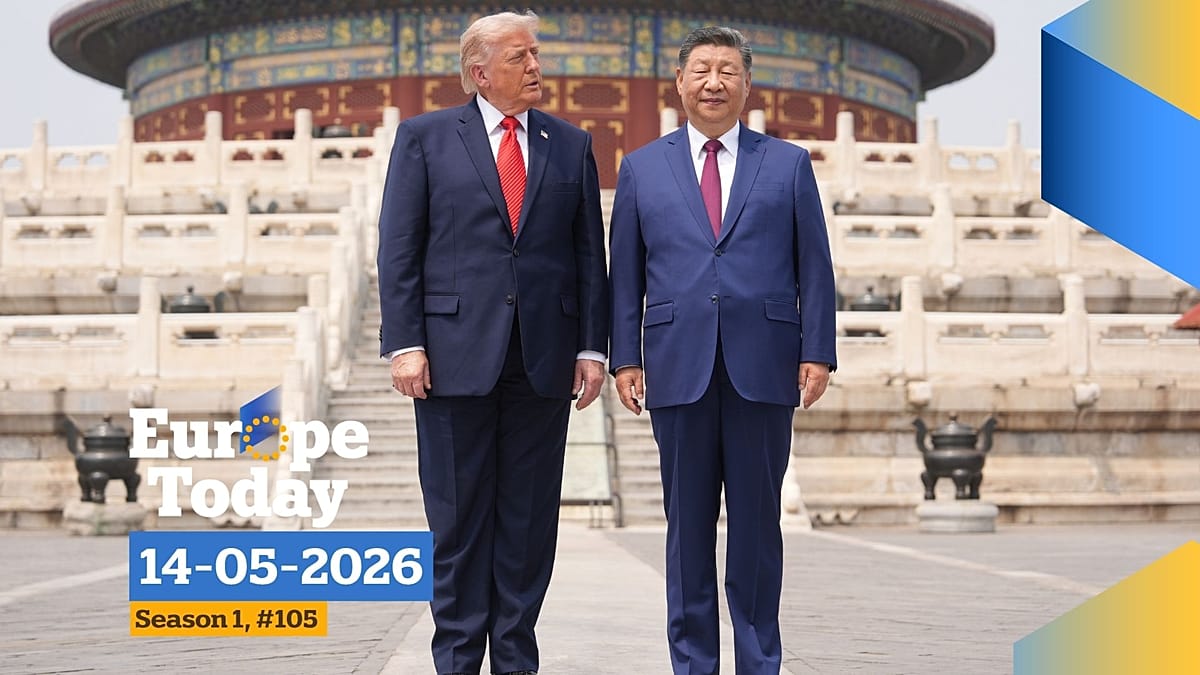
All eyes are on Beijing this week as US President Donald Trump meets Chinese President Xi Jinping for the first time since 2017. Accompanied by a delegation of top US tech executives—including the CEO of Nvidia, added at the last minute—Trump is expected to press Xi on trade imbalances, Iran, and Taiwan. But for European capitals, the real anxiety lies in what a potential US-China deal might mean for the continent's own economic and technological interests.
Brussels has been following the summit closely, with EU officials privately expressing concern that Washington and Beijing could strike a bilateral agreement that sidelines European companies and undermines the bloc's push for strategic autonomy. The stakes are particularly high in the semiconductor sector, where US export controls on advanced AI chips to China have already reshaped global supply chains. As US tech titans in Beijing seek to protect their market access, European chipmakers and equipment suppliers worry they could be caught in the crossfire.
Europe's Tech Sovereignty at Risk
The US-China AI race has become a central theme of the summit. Jakub Janas, a policy analyst, notes that Europe's dependence on both American and Chinese technology leaves it vulnerable. "If the US and China agree on a framework that excludes European players, the EU could find itself locked out of key markets and technologies," he warns. The European Commission has been pushing for greater investment in domestic chip production and AI research, but progress has been slow. Meanwhile, the last-minute addition of Nvidia's CEO to the US delegation underscores how central AI chips are to the negotiations.
Michael Bloss, a member of the European Parliament from the Greens/EFA group, argues that Europe must use this moment to accelerate its own tech agenda. "We cannot afford to be spectators in the US-China rivalry. The EU needs to invest heavily in homegrown AI and semiconductor capabilities, and ensure that our data and digital infrastructure remain under European control," he said in an interview. Bloss also called for stronger antitrust enforcement to prevent US and Chinese tech giants from dominating European markets.
Security and Energy Concerns Loom
The summit is not just about trade and technology. Security issues are also on the agenda, with Trump expected to raise Iran's nuclear program and Taiwan's status. European diplomats are particularly worried that any US-China understanding on Iran could undermine the EU's diplomatic efforts to revive the nuclear deal. Separately, the ongoing conflict in Iran has already driven up European household gas prices by 6.8%, hitting Brussels and Berlin the hardest, as reported by European Pulse.
In Bucharest, the B9 summit of NATO's eastern flank countries is also taking place this week. Euronews' Shona Murray reports that discussions there are focusing on European security in light of the US-China dynamic. "The B9 countries are keen to ensure that any US-China deal does not come at the expense of European defense commitments," she notes. The war in Ukraine remains a backdrop, with European leaders wary that Washington might shift its strategic focus toward the Indo-Pacific.
Domestic EU Agenda Continues
Amid the international drama, the EU is also pushing forward with its internal agenda. Hadja Lahbib, the EU Commissioner for Equality, has been reflecting on efforts to tackle conversion therapies across the Union. In a recent statement, she called the practices "barbaric" and urged member states to outlaw them. The Commission has proposed a directive that would criminalize conversion therapies for LGBTIQ+ individuals, but implementation varies widely among the 27 member states. Lahbib's comments come as Brussels urges EU states to outlaw these practices, highlighting the bloc's commitment to human rights even as geopolitical tensions dominate headlines.
As the Trump-Xi summit unfolds, European policymakers are left to navigate a complex landscape. The outcome could reshape global trade, technology, and security architectures for years to come. For now, Brussels watches nervously, hoping that Europe's voice will not be drowned out by the superpowers' duet.