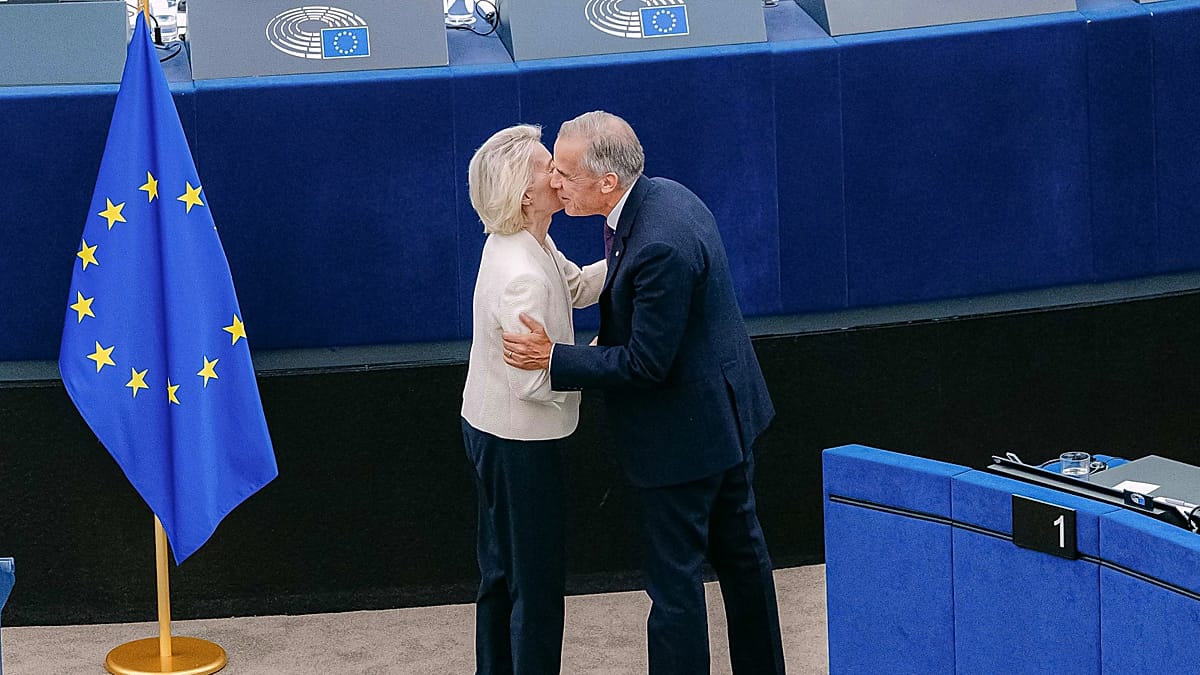
For nearly two years, the European Union and Canada have shared a similar ordeal: tariffs, threats, and public scorn from Washington. Now, they are turning to each other. This week, in Strasbourg, the two sides unveiled an ambitious plan to deepen their partnership, a move that would have been unthinkable just a few years ago.
The catalyst is unmistakable. Donald Trump's return to the White House has upended long-held assumptions in Brussels and Ottawa. Both had relied on the United States as their primary security guarantor and top trading partner. That trust has been shattered by a barrage of punitive tariffs and annexationist rhetoric, forcing a strategic reassessment.
A new status for Canada
European Commission President Ursula von der Leyen used her State of the Union address to propose that Canada become the EU's first-ever 'associate member' – a novel legal category designed to accommodate Ottawa. 'We believe that power does not belong to the strongest, the richest or the loudest, but to all of us,' she said, in a thinly veiled jab at Trump. The announcement, which was not in the pre-released speech, drew thunderous applause in the European Parliament. Canadian Prime Minister Mark Carney, seated in the audience, rose to kiss von der Leyen on the cheek.
The following day, Carney addressed the same chamber. 'Europe and Canada are stronger together,' he declared. 'Let us now deepen these roots, widen this canopy and grow a transatlantic forest under which our citizens can flourish as free people on free ground.' His speech was met with more applause, and lawmakers lined up for selfies with the Canadian leader.
The enthusiasm was not confined to Strasbourg. Spanish Prime Minister Pedro Sánchez tweeted a European flag with a maple leaf beside the stars; French Foreign Minister Jean-Noël Barrot said the EU and Canada were 'destined' for closer bonds. European Parliament President Roberta Metsola even suggested that Australia and New Zealand could follow as associate members. 'In such times of uncertainty, having friends matters,' she told Euronews.
Public opinion in Canada appears to back the pivot. A poll taken before Carney's trip found that 56% of Canadians feel they have more in common with the EU than with the US, despite sharing an 8,891-kilometre land border with their southern neighbour.
Beyond the rhetoric
The two sides are eager to highlight concrete areas of cooperation: trade, energy, critical raw materials, batteries, AI, quantum computing, finance, defence, space, and the Arctic. Carney proposed a youth mobility scheme to allow young people to live, work, and study on either side of the Atlantic. Von der Leyen spoke of creating a 'common prosperity and economic security space'.
These are precisely the domains where cooperation with Washington has become fraught. Trump has launched a trade war with Canada that threatens key sectors of its economy, and his administration has shown little interest in multilateral rules. The EU and Canada, by contrast, share a commitment to liberal democracy, the rule of law, and open markets – values that now seem more aligned with each other than with the US.
Yet there are nuances. Von der Leyen's 'associate member' label caught many by surprise, and it remains unclear how it would work in practice. Carney, for his part, preferred the term 'alliance for the future', wary of any suggestion that Canada might cede sovereignty to Brussels. 'The precise nomenclature is a question for Europe,' he said.
Despite the warm words, anxiety lingers. Both the EU and Canada are squeezed between Trump's 'America first' agenda, China's assertive competition, and Russia's aggression. The global order they once helped build is fraying. Their friendship is as much about survival as it is about prosperity.
Trump has already reacted with threats of new tariffs on European goods, but Brussels has insisted that the partnership with Canada is not a hostile act. As the relationship deepens, the transatlantic landscape is being redrawn – with Europe and Canada finding in each other a more reliable partner than the one they once counted on.