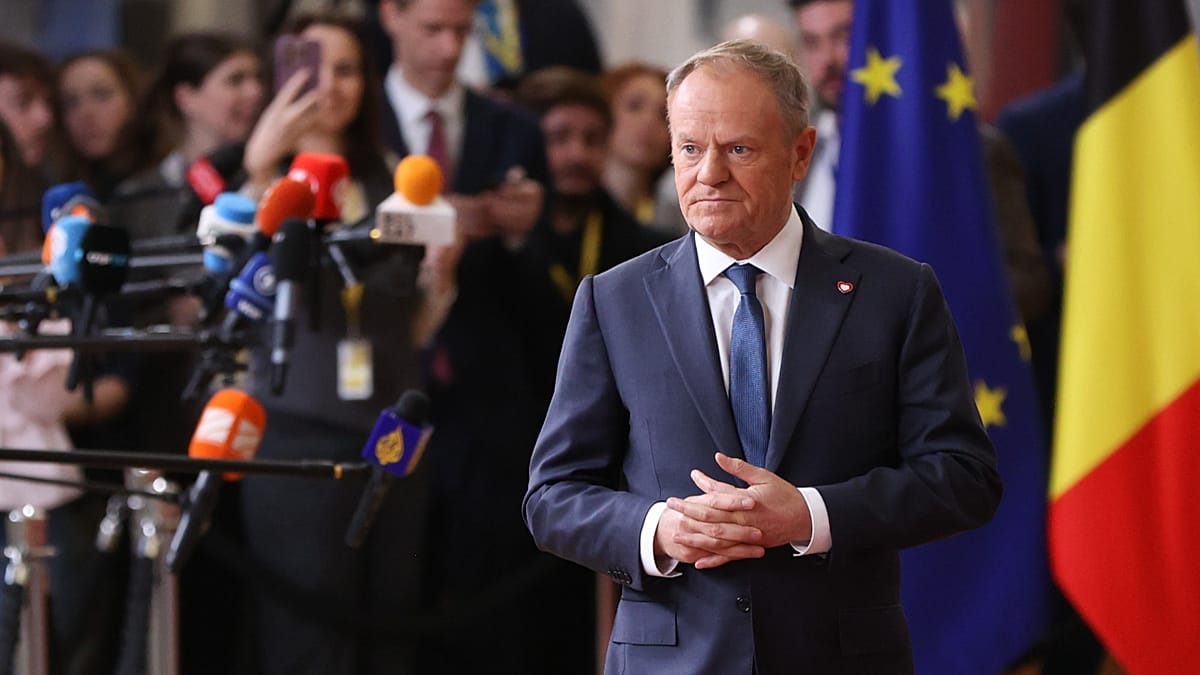
WARSAW — Poland is in the grip of a constitutional crisis that has pitted Prime Minister Donald Tusk's government against President Karol Nawrocki, with the country's top court at the centre of a bitter political battle. In a televised address on Saturday evening, Tusk vowed that the rule of law would prevail over violence, as tensions over the judiciary reached boiling point.
“Restoring the rule of law is our duty,” Tusk said. “After years of PiS-led lawlessness, this is a difficult process, sometimes painful, and it requires decisive action. There is no other way.”
The dispute centres on the composition of the Constitutional Tribunal, Poland's highest court. On Friday night, President Nawrocki attempted to enter the tribunal building amid a deadlock over the appointment of new judges. Police surrounded the building as the explosive scenes unfolded live on television, drawing attention to the crisis beyond Poland and into the wider European political debate.
Law and Justice (PiS), the conservative party that controlled the government until 2023, has accused Tusk's administration of attempting a coup. The government, meanwhile, says it is pushing ahead with long-needed reforms to restore the rule of law after years of PiS interference in the judiciary.
A standoff with no easy exit
Marcin Przydacz, a secretary of state and adviser to President Nawrocki, told Europe Today that there is no “legal basis” for the government's behaviour. “The two most important judges in Poland also said publicly that there is absolutely no legitimate basis,” he added. “There is a constitutional crisis, definitely, and the people of Poland gathered in front of the tribunal protesting against this kind of situation.”
Brussels is watching closely. European Commissioner for Justice Michael McGrath told Euronews in a statement that the Berlaymont is following developments. The Venice Commission, the Council of Europe's top advisory body on constitutional law, has been clear that appointing the new judges lies within the power of the Sejm, the lower house of parliament, and that “full respect for the rule of law is what Polish citizens expect and deserve.”
Michał Wawrykiewicz, a Polish MEP from Tusk's Civic Coalition, argues that the crisis began in 2015 when PiS rose to power. “The government, the majority in the parliament, and the judges elected by the parliament are all acting according to the rulings of the European courts, of the Court of Justice and the European Court of Human Rights, according to what the Venice Commission confirmed two weeks ago,” he said. “This is an unprecedented situation, not only in Poland but in the whole of Europe.”
The standoff has also drawn international attention, with French far-right leader Marine Le Pen wading into the fray, drawing a sharp rebuke from Warsaw. The crisis has become a test of whether Poland can restore judicial independence after years of PiS reforms that Brussels said undermined the rule of law.
As the confrontation continues, the Polish people are watching closely. The government insists it is acting within the law, while the president's camp says the opposite. The Venice Commission's opinion may carry weight, but the political reality on the ground remains deeply polarised.
The crisis is not just a Polish affair. It resonates across Europe, where the balance between executive power and judicial independence is a delicate one. The European Union has made clear that respect for the rule of law is a fundamental condition of membership, and Poland's struggle is being watched from Brussels to Berlin.
For now, the streets around the Constitutional Tribunal in Warsaw remain tense, and the political future of the country hangs in the balance. Tusk has promised decisive action, but the path forward is far from clear.