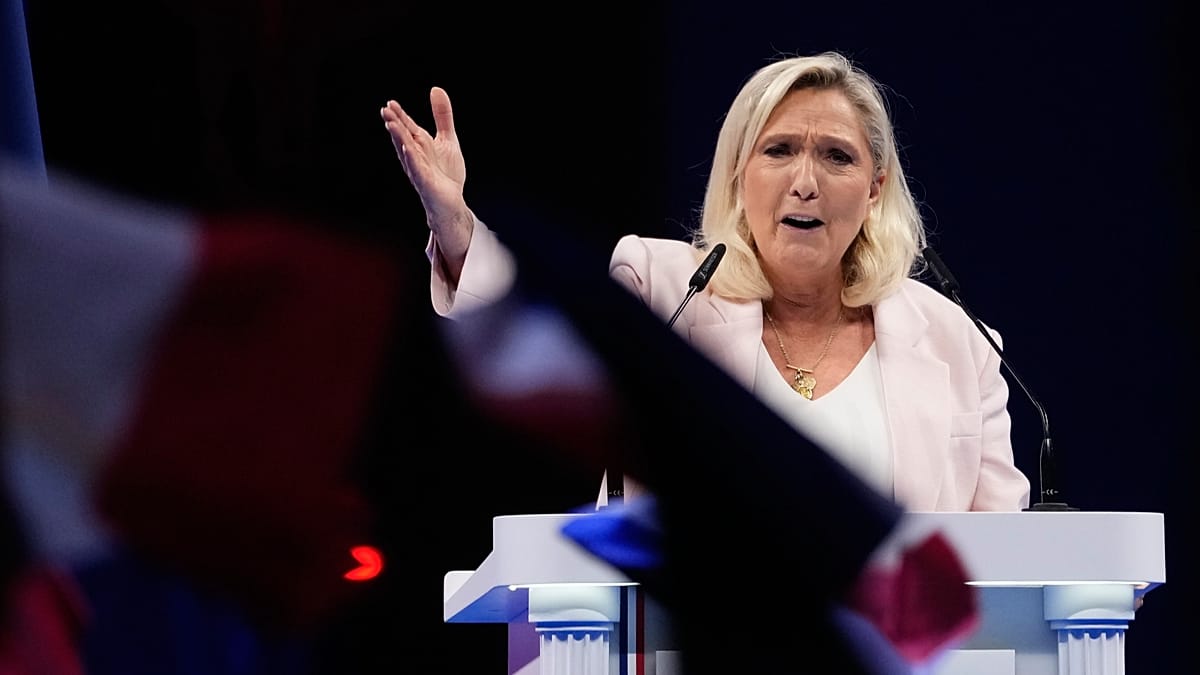
The deepening standoff over Poland's Constitutional Tribunal has drawn an unusual intervention from France's far-right leader, Marine Le Pen, who accused Warsaw of undermining the country's constitutional order. Her remarks were swiftly rebuffed by Poland's foreign minister, Radosław Sikorski, who told her to mind her own business.
In a post on X, Le Pen, who leads the National Rally (RN), expressed "profound concern" over the crisis, pointing to the contested suspension of the Tribunal's president and the deployment of security forces around the court building. "The indifference of the European Union and the silence of the media in the face of the Polish crisis are raising legitimate questions," she wrote. "One cannot claim to defend democracy and the rule of law while remaining silent when the constitutional balance of a member state is gravely threatened."
The confrontation escalated on Friday night when President Karol Nawrocki attempted to enter the Tribunal building in Warsaw, only to be met by a police cordon. The scene, broadcast live on television, underscored the intensity of a dispute that has been simmering for months over the appointment of new judges.
Sikorski, who serves as Poland's top diplomat, did not mince words in his response to Le Pen. "Ms Le Pen, as a friend and ally of France, Poland does not interfere in your politics. We ask you to respect us by not interfering in ours," he wrote on X. The exchange highlights the delicate balance between European solidarity and national sovereignty, a theme that resonates across the continent.
A clash over judicial independence
At the heart of the crisis is a battle over the composition of the Constitutional Tribunal, Poland's highest court for constitutional review. The opposition, led by the Law and Justice (PiS) party, accuses Prime Minister Donald Tusk's government of attempting a coup. The government, for its part, insists it is restoring the rule of law after years of PiS-era interference in the judiciary.
Tusk has defended his government's actions, saying it had tried to resolve the crisis through dialogue but was blocked by PiS and the president. He noted that the parliamentary majority had waited patiently for the terms of judges appointed under the previous PiS government to expire, hoping to avoid a confrontation. "The Sejm made its choice, the judges took the oath, but the president did not deign to receive that oath," Tusk said.
The Sejm, Poland's lower house, elected the new judges, who then took their oaths. However, President Nawrocki refused to formally accept them, and Tribunal President Bogdan Święczkowski barred the new judges from taking up their duties. Tusk described the newly elected judges as legally appointed and said they had been attacked, criticising PiS-linked politicians and activists for their conduct during the standoff.
In a colourful analogy, Tusk compared the dispute to a thief stealing an elderly woman's handbag and then accusing others of violence when they try to recover it. "In certain matters there can be no compromise," he said, adding that lawlessness could not be negotiated away. He stressed that physical force, aggression and party interests must not determine who is right in a state governed by the rule of law.
Tusk also made clear that no politician, including the president, had the right to enter a court or tribunal, issue instructions to judges or intimidate them. His comments came after Nawrocki aborted a trip to Senegal, turning his plane around to return to Warsaw and make his way to the Tribunal building.
The European Commission has been monitoring the situation closely. A spokesperson said on Saturday that it was for the Polish authorities to ensure the Constitutional Tribunal operates in accordance with the Polish constitution and with respect for the relevant case law of the Court of Justice of the European Union. The spokesperson added that the appointment of eight new members of the Tribunal falls within the constitutional powers of the Sejm.
Tusk also warned that pro-Russian groups could exploit the political conflict, pointing to Russian bots operating online that, in his assessment, were supporting opponents of Poland's current constitutional order. He pledged to provide the Tribunal with the security and conditions needed to carry out its duties. "And I intend to fulfil this task," he said.
The crisis has drawn attention beyond Poland, with commentators across Europe watching closely. The dispute is not just about judicial appointments; it is a test of whether the rule of law can be upheld in a member state without triggering a broader institutional breakdown. As the standoff continues, the stakes for Poland and for the European Union's commitment to democratic principles have rarely been higher.