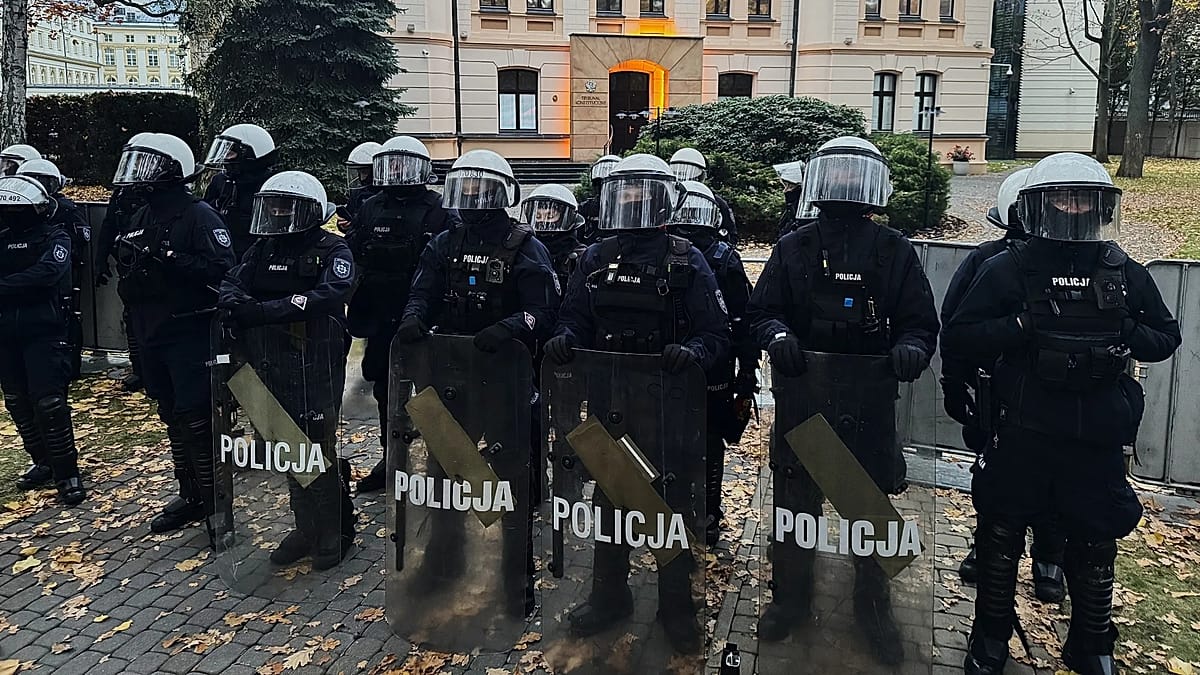
Warsaw was plunged into a fresh constitutional crisis on Friday night when seven judges appointed by the Sejm entered the Constitutional Tribunal under the protection of the State Protection Service, leading to the suspension of the court's top judge. The dramatic events have transformed a long-running legal dispute into a direct confrontation at the heart of Poland's judicial system.
President Karol Nawrocki, who had been on a visit to Senegal, flew back to Warsaw and headed straight to the Tribunal's headquarters, where he was filmed pushing past a group of judges as he attempted to enter the building. He later accused the government of orchestrating a forcible takeover of one of the country's key constitutional institutions.
Overnight standoff at the Tribunal
The crisis began when the seven judges, chosen by the Sejm to serve on the Tribunal, entered the building. According to Tribunal spokesperson Weronika Ścibor, security guards were ordered to pack up and leave, while the incumbent president, Bogdan Święczkowski, and his deputy, Bartłomiej Sochański, were denied entry. Ścibor suggested the operation was timed to exploit the absence of some staff members.
Judge Anna Korwin-Piotrowska then announced she was assuming leadership of the Tribunal and suspending Święczkowski from his duties. The current leadership has challenged the legality of these moves, setting the stage for a legal and political battle over who legitimately controls the court.
President Nawrocki, accompanied by the First President of the Supreme Court, Zbigniew Kapiński, arrived at the Tribunal early Saturday morning. Footage posted on social media showed scuffles breaking out as he tried to enter, with Korwin-Piotrowska among those blocking his path.
President accuses government of power grab
In a statement read out by his chief of staff, Paweł Szefernaker, Nawrocki described the night's events as a breach of Poland's constitutional order and a forcible takeover of a state institution. He called for the restoration of legal order and demanded that government forces leave the Tribunal's grounds.
Nawrocki said he had consulted with Kapiński and that neither recognised the authority of those claiming to lead the Tribunal. He announced plans for emergency talks with parliamentary political groups on Saturday, citing a threat to internal security and the need to stabilise the political situation.
Justice Minister Waldemar Żurek, however, expressed alarm at the president's behaviour. "The president's behaviour alarmed me enormously," he said, adding that he hoped prosecutors would investigate. He argued that footage showed the president "forcing his way in and attacking the judges," and stressed that it was unacceptable for someone protected by presidential immunity to act in such a manner.
Żurek acknowledged that talks had been held with Sochański but that no compromise had been reached. He insisted the Tribunal should resume normal work and address the cases of citizens awaiting rulings.
Protests and political fallout
Outside the Tribunal, protests drew politicians from the PiS and Confederation parties, along with right-wing supporters. Among those present were party leader Jarosław Kaczyński, former prime minister Mateusz Morawiecki, and former Tribunal president Julia Przyłębska. Kaczyński called the events an assault on the Constitutional Tribunal and urged continued protests, warning that Poland risked becoming a police state.
The crisis is the latest chapter in a bitter struggle over judicial appointments that has pitted the government against the Tribunal's leadership, with echoes of earlier disputes that have strained Poland's relations with the European Union. The standoff has raised concerns about the rule of law in the EU's largest eastern member state, and the coming days will test whether a political solution can be found.
As Warsaw braces for further developments, the international community will be watching closely. The crisis comes at a time when Poland is playing an increasingly prominent role in European security, including hosting NATO assets and signing defence pacts with the UK. The stability of its constitutional order is now under scrutiny as never before.